
An image search on Adobe Stock is shown flooded with AI-generated photos
Photo courtesy of Lauren Gaubert
By Jasmin Parrado
The University of South Florida’s graphic arts program is an example of the city’s penchant for creativity.
Students with a graphic design concentration put it to the test through marketing and communication, embedding their work in products ranging from abstract fonts and website visuals to shoe boxes and restaurant menus.
While they brainstorm and create each piece, digital tools refine it.
Then there’s the concept of it being reversed. Artificial intelligence (AI) has knocked on the program’s door, loaded with the ability to generate and streamline images in a matter of seconds. Graphic design students and professors are trying to navigate where AI belongs in the digital landscape they now share with it.
David Watts, professor of graphic design at USF St. Petersburg, believes that AI has no significant place in art – at least, not at the moment.
“I think it’s a tool, like anything else is a tool,” Watts said. “I don’t see it being really that different from Google. If you’re looking for information, it can summarize things. If you’re looking for it to do the work for you, then that’s not going to happen.”
Watts sees that students in the graphic design program are most likely to use AI as a means of reference for their work. Whenever there isn’t a readily available photo or subject for illustrators to observe, AI programs can generate images as prompted.
Companies like Adobe label those programs under the category of “generative art” and explain that a creative convergence does still exist between the human mind and the network delivering the product.
Watts believes AI’s involvement and special ability to generate based on coding soaks up too much attention as a medium.
“Let’s say that I want to make a painting, but instead of just using brushes, I’m going to dip a car tire in paint and use that on the canvas,” Watts said. “Now it’s more about the car tire than it is about the actual form on the canvas.”
Additionally, Watts does not accept how the internet has approached AI, specifically how users proclaiming themselves as “AI artists” have flooded the online art and design community.
“I think saying anything like, ‘I’m an AI artist, I’m an AI writer, I’m an AI prompter, I’m an AI marketer,’ just means that you’re not doing the work,” Watts said.
Lauren Gaubert, a graphic design major, agrees with Watts, especially because of where AI image generators source their results from.
“I am not a fan because they are repurposing other people’s work,” Gaubert said. “It’s also a reason that AI art cannot be copyrighted, because it’s not yours. I don’t think it’s comparable.”
Gaubert noted how AI imagery has bled into the social media and editing environments she frequents. For example, photo-sharing apps like Pinterest have changed their terms of service so that they can train AI models, a concept which veers into the ethical territory of pulling original work from creators’ accounts.
Engines like Adobe Stock are now littered with poor-quality, AI-generated images. Artists have to pay minimum prices of $30 for a broader array of stock photos they can refer to. Otherwise, the tradeoff for free browsing now necessitates sorting through the broader array of AI imagery to find workable outliers or actual photography.
Though Gaubert has largely denounced AI in those areas where it can be problematic as an art form, she’s not entirely closed off to it.
“I have seen it go so wrong in so many different ways, but I feel like I’m beginning to be more empathetic towards it,” Gaubert said. “I have seen a lot of people who do illustrations use it as a tool, and I understand how it makes their process so much more efficient.”
Gaubert has seen how AI-processing can manage an efficient editing process for illustrators and photographers, though those functions are still in a beta phase due to faulty results.
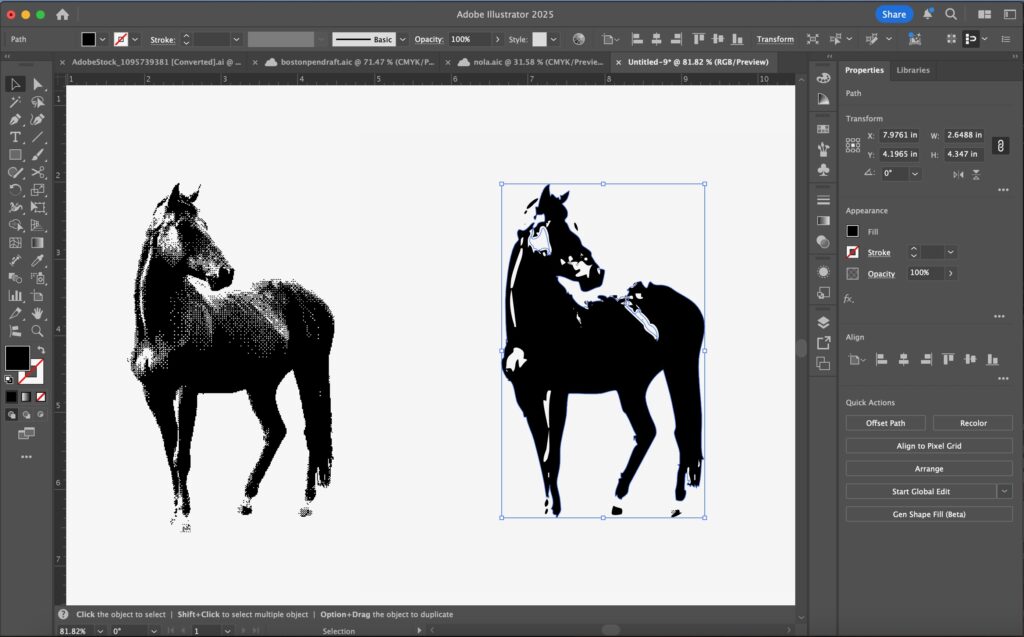
Photo courtesy of Lauren Gaubert
As for USF’s approach to the use of AI in student work, Gaubert finds the topic unprecedented. Professors that once treated AI with skepticism now encourage its use in the creative field.
“I think it’s so hard to make sweeping rules at this point that just blanket-apply to everyone,” Gaubert said. “I really think we’re in wild west territory for AI right now.”
Alexis Okla, a graphic design junior and marketing coordinator for Chick-fil-A, also sees where any policy-wide restriction on AI could get complicated if it were implemented.
“I can’t see how they would put limitations on it, because AI is so complicated,” Okla said. “There would be so many loopholes, almost to a point where the rules would get redundant. So, it’s definitely to each their own.”
As for Okla’s own perspective, she feels there is an extent to which one can work with AI and still maintain conceptual ownership of their work.
“When it comes to design, of course you could plug in information, and it might slap out a finished poster for you,” Okla said. “However, for myself and just the integrity I have in my work, I use it merely as concept.”
Okla observed the process of generating design ideas using AI when she watched one of her professors help students conceptualize a wedding invitation in different colors and layouts through continuous prompting.
Okla appreciated a special detail of the task: they were sourcing from their own images.
The idea lent itself to the balance of taking back creative agency while expediting tasks that would otherwise have taken much longer, she said.
The narrative around how to maintain the balance Okla believes in is largely thought to still be in the works. Especially observant of its gray area are professors like Watts who observe where it may have potential.