Photo by Lilly Kennedy
By Lilly Kennedy
A misconception about political activism is that it’s exclusive to the spoken word, such as protests and speeches. But, the vigor of political activism is not only heard in the chants of protestors or felt in the stampede of marches, but in the deafening clack of typewriter keys and the starkness of black printed letters against a blank slate of paper.
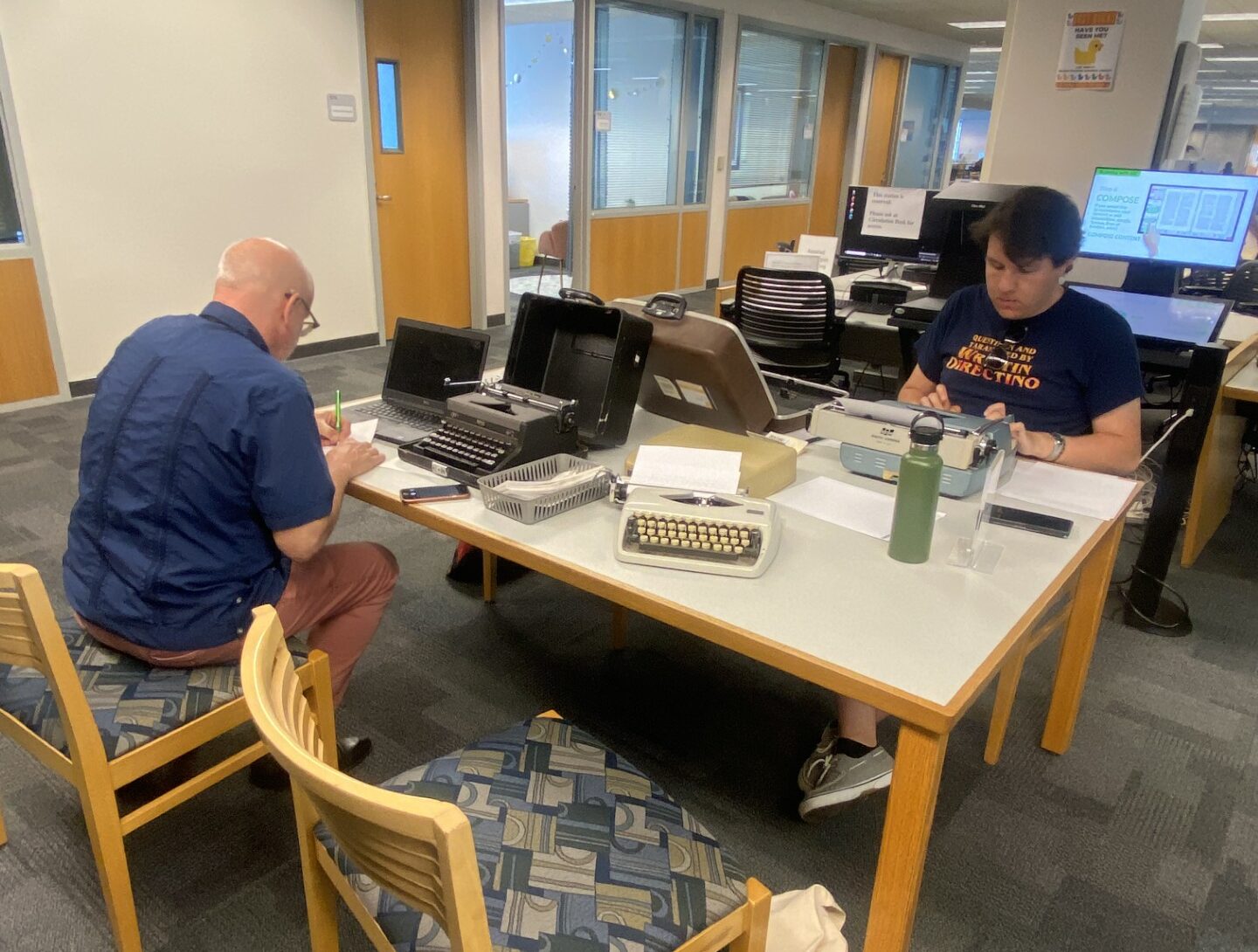
Typewriter Tuesday, an event held in the Nelson Poynter Memorial Library every Tuesday from 12:30 to 1 p.m., allows students the opportunity to mail a typewritten letter to an elected official.
Hosted by Thomas Hallock, an English professor at the University of South Florida St. Petersburg, the event aims to alleviate potential stress caused by a divisive political climate by providing an outlet for students to voice concerns to politicians and policymakers.
“I think a typewritten letter is going to get immediate attention, as opposed to a call or an email, because for every hundred emails they receive, how many typewritten letters do they receive?” said Hallock. “In general, if you want your voice to be heard, the first thing you want to do is make sure your message stands out.”
With prewritten email and phone call script templates becoming a standard way of contacting elected officials, physical letters as a form of political correspondence could prove to be on the decline. However, the merits of traditional physical letters remain. To make one’s voice heard is to be distinct, and in the digital age, a typewritten letter can accomplish just that.
According to the University of Kentucky Center for Community Health and Development, a well-written letter may be more effective because it generally takes more time and thought to compose than an email, for example, and it personalizes communication with an elected official.
Every meeting, Hallock brings his mother’s 1950s Royal Deluxe Typewriter and joins students in the library as they draft their letters. Hallock uses this half hour to vent and cope with his political and social concerns. With each clatter of the key and ding prompting the next entry line, he feels the catharsis of projecting his worries from thought to paper. By the time he seals the envelope, he can breathe a bit easier.
“I feel as if a weight has been [lifted],” he said. “You know how when you’re angry at someone whom you love and you need to have a conversation, and after you have that conversation, you feel better? [It feels] like that.”
Judithanne Scourfield McLauchlan, a USF St.Pete associate political science professor and the director of the USF St. Petersburg Center for Civic Engagement, agreed that frustration and subsequent catharsis are valid and important aspects of political activism. However, she hoped that students would also become aware of how and where to effectively direct that frustration to enact change.
“Typewriter Tuesday is a great first step to raise awareness for all students that they have a voice, that their voice should be heard and they should communicate their concerns to their elected officials,” said McLauchlan. “My concern is that they express those concerns to an elected official who is in a position of power in that particular area.”
McLauchlan, who previously worked in political correspondence, stressed the importance of citizens knowing who to contact for certain issues. For example, while writing to the White House may be appropriate for a federal concern, it is not a catchall. It is important to be educated on local representatives and policymakers who are more apt to listen and respond.
“[Your elected officials] absolutely will listen to you. You need to be writing to your member of Congress, your state legislator, someone who is responsible to you. It’s really important for these elected officials to hear from their constituents,” she said. “When there’s an overwhelming response to a certain policy, they will note that. These folks want to be reelected, and if there’s a massive outcry, they will be responsive. But they can only know that if you write to them.”
Knowing how to format a letter to an elected official is imperative. Supporting one’s worries and frustration with research and a practical solution, such as suggesting a policy amendment, will increase the chance of a response and meaningful change. As well as that, McLauchlan claimed that respect, understanding and patience are paramount to constructive political correspondence.
“You’re not trying to point fingers and be angry. You’re trying to see things from the other person’s point of view and trying to understand the perspective they have,” she said. “It’s also important to take the long view on some of these things. You have to keep fighting and keep forging ahead. The most important changes we’ve had over the course of our American history have not been overnight.”
Political activism, whatever the cause or reason, is a significant component of a functioning and healthy society. Marches, protests and speeches have unquestionable merit in effective political activism. However, as events like Typewriter Tuesday attempt to remind, citizens must never forget or ignore the privilege of free access to their representatives and the unfaltering power of the typewritten word.