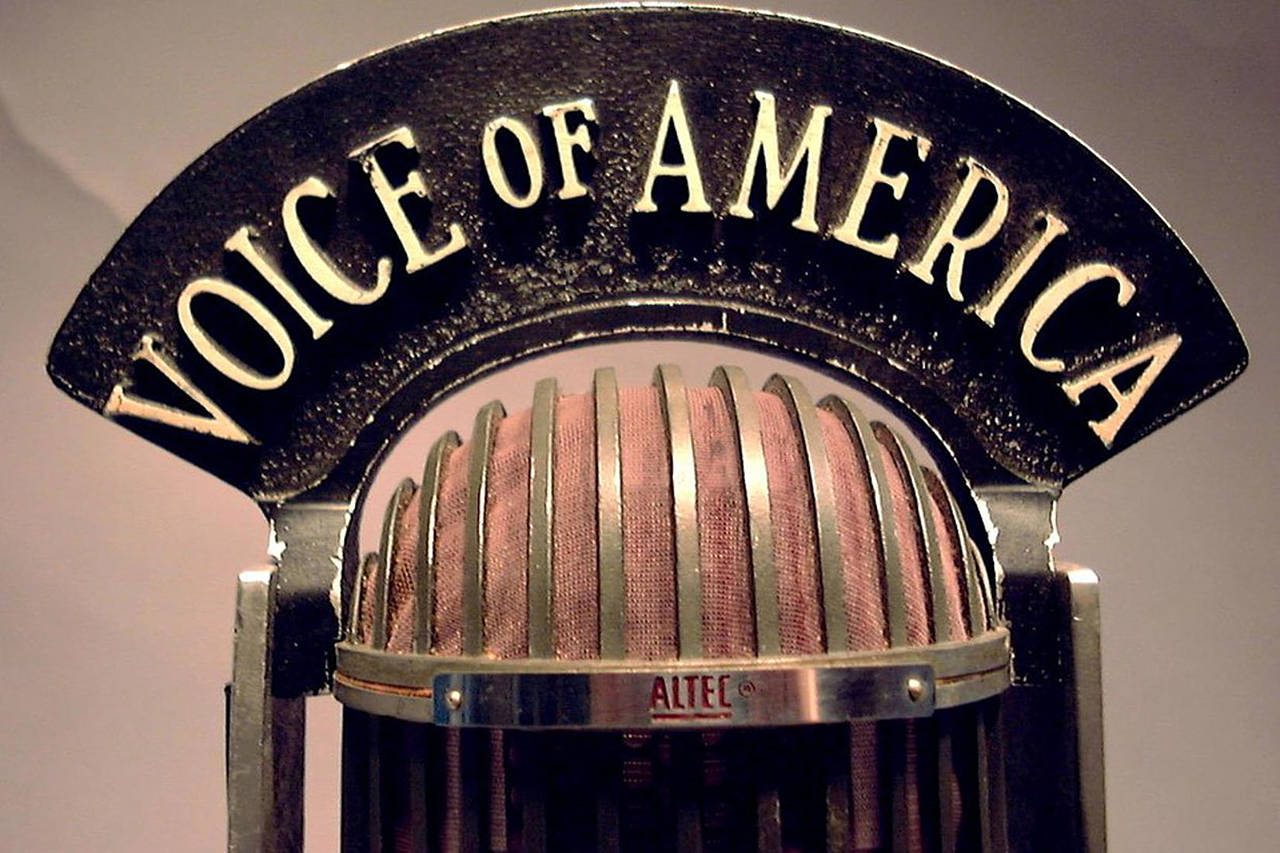
International news network Voice of America was also a target of the Trump Administration. It was dismantled in March before being reinstated in April.
Photo by Audio Engineering Society
By Alisha Durosier
Over 100 executive orders, investigations, the firing and rehiring of thousands of federal workers, lawsuits, a new federal agency, and a bid to rename the Gulf of Mexico to the Gulf of America — the three months since President Donald Trump’s return to the White House have featured a flurry of changes.
The second installment of the Trump administration is moving at a distinctly faster pace. And with such rapid changes, journalists have to face what NPR TV critic Eric Deggans dubs as the “firehose of information” coming out of the White House.
“They’ve been trying to do a lot very quickly,” Deggans said. “And part of that strategy, I think, is to overwhelm the media and make it harder for journalists to figure out what to report on and to create a situation where there’s so many stories about so many different things.”
According to Deggans, Trump’s first administration presented journalists with similar challenges because of the president’s tendency to make announcements unconventionally, such as via social media.
Journalists were used to a more “disciplined” approach in previous administrations.
“The press secretary might come out on Friday at five and say, okay, ‘there’s a full lid on,’ meaning we’re not expecting to make any news for the whole weekend until everybody comes back on Monday… So journalists could plan,” Deggans said.
Various departments under the Trump administration are moving quickly but seemingly operating independently and without coordination.
The U.S. Department of Education has launched numerous investigations against schools and higher education institutions, even with Trump’s intentions of eliminating the department and while enduring massive lay offs.
The Department of Government Efficiency has not yet been declared a government department by Congress. Even so, it’s enacted funding cuts, mass lay-offs and attempts to monitor government employees.
“I think that’s also what’s tricky about what’s happening with the Trump administration right now is things are happening so quickly,” WUSF reporter Gabriella Paul said. “A lot of the people who we focus our reporting on might not know that it may or will affect them,”
Paul covers “Paycheck-to-Paycheck”, WUSF’s news beat that focuses on the stories of Tampa Bay residents who she said are “one emergency away from poverty.”
As the current U.S. legislature fast tracks its budget plans in a process called budget reconciliation, Paul is focusing on about 12 federally funded social programs that will be impacted. She will eventually report on the trickle-down effects of the legislature’s decisions.
“The uncertainty that’s been created is something that I’m seeing right away on the ground… and the other side of things, all of the federal programs are more of a case where I’m watching that slow moving train,” Paul said. “In general, I think fast moving headlines, but slow-moving impacts are very much familiar to this work.”
Josh Robin, Spectrum News anchor and chief national political reporter, acknowledges that the current news cycle is fast paced but also notes that this isn’t unprecedented.
“News is always busy, especially during an administration’s early days,” Robin said. “I think that there are times in the news cycle when it’s very busy. This is one of them, but this is not unprecedented as far as busyness is concerned.”
Both Deggans and Paul noted that what sets this news cycle apart is that the pace appears to be deliberate.
It aligns with the administration’s efforts to discredit the media and hold “fake news accountable,” according to Rapid Response 47, the White House’s account on X dedicated to calling attention to news stories the administration deems inaccurate or biased.
In early February, the U.S. Department of Defense dismissed reporters from various news publications — including NPR, Washington Post and The New York Times — from their workspaces in the Pentagon.
Shortly after, White House officials barred AP reporters and photographers from White House press pools after the publication said they would not refer to the Gulf of Mexico as the Gulf of America at the president’s behest. On April 8, AP regained full access to White House press pools after the publication filed a lawsuit against the Trump administration
The Federal Communications Commission has launched several investigations into broadcast news networks, which are ongoing alongside Trump’s $20 billion lawsuit against CBS for alleged election interference arising from a “60 minutes” interview with Kamala Harris last year.
Deggans emphasizes that journalists must be cautious while navigating the current administration’s intolerance for critique or disagreement and ensure accuracy and fairness in their reporting.
“But you also have to be bold in your coverage, and make sure that those attacks don’t cow you or suppress you or lead you to second guess yourself in ways that would make your coverage less incisive,” Deggans said. “And so that’s two things that are hard to do at the same time.”
Especially during an accelerated news-cycle, journalists must balance the act of reporting quickly, accurately, boldly and objectively, while also maintaining their humanity.
“I think if it’s about reporting the news and not being consumed by it… the world is big, issues are complicated, and adulthood and good journalism involves holding different pieces of information and different views in your head at the same time,” Robin said.
For Paul, the ability to compartmentalize comes naturally to her alongside her ability to “turn off” at the end of a workday.
And much like Robin, she leans on her colleagues for support.
“Also just having faith in other journalists across the country — locally and nationally — that if I’m not able to pick something up, it’s not my sole responsibility,” Paul said.
From publishing guidelines on how to navigate the second Trump term, to being vocal about first amendment right violations and creating data trackers, journalists are showing up for each other.
“You know, this is a burden that’s held by the free press nationally,” Paul said. “To make sure that nothing slips through the cracks.”