
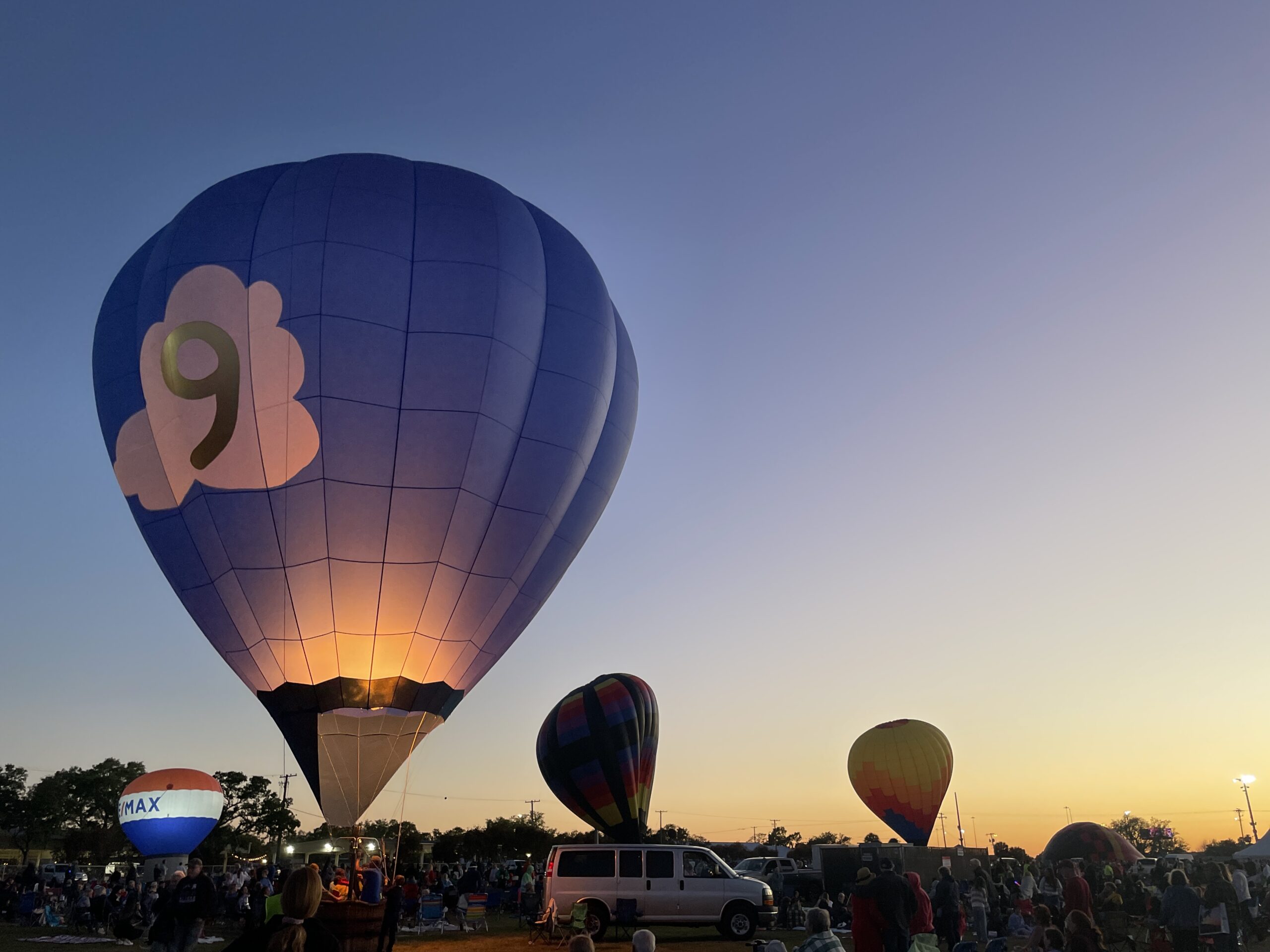
A balloon glows at the Tampa Hot Air Balloon Festival 2025, in which hot air balloons are tethered to the ground once the sun sets and inflated with burners to look similar to lanterns.
Photo by Skyla Rogers.
By Skyla Rogers
Every morning before work, Dave Gardner sets an alarm for 3:30 a.m..
If the weather allows, he heads out to the fields. He meets his guests as early as 6:30 a.m. and brings them to a clearing where they inflate a balloon that reaches up to six stories tall in just 15-20 minutes.
Gardner is a hot air balloon pilot and flies most mornings around sunrise, giving people an experience that lasts around four hours. After the balloon is inflated and ready, the flight itself lasts for an hour. After landing, Gardner treats his guests to the 200-year-old French tradition of a champagne toast.
After breakfast with his guests, Gardner heads out to look for propane gas to refuel the balloon. In the city of Tampa, the sea breeze and afternoon storms make it so he can only fly in the mornings.
“I always wanted to fly something,” he said. “Ever since I was a little kid, I’ve always been enamored with anything that flies; helicopters, airplanes, whatever. It didn’t matter.”
Gardner began his journey flying in Tulsa, Okla., where he attended flight school to become a commercial airline pilot. His passion, however, began years prior.
Gardner’s dreams were cut short when he discovered that his color blindness had progress past the acceptable limit form for pilots. He would have to receive restrictions on his license that others would not. Years later, after studying business at Florida State University and moving to Tampa, he was given another chance to fly.
Big Red Balloon has been operating hot air balloon flights since 1992. Today, Gardner has over 3,000 hours of flight experience and is the company’s sole pilot.
It was just 25 years ago that he made the decision to purchase the business after coming to know its original owners, Phil and Melanie Sekora.
“Phil taught me to fly, and Melanie taught me the business,” Gardner said. “And I bought the company from them about two years later.”
The journey to become a balloon pilot is very similar to getting licensed to fly airplanes or other aircraft, he explained.
“You have to go through ground school and pass the ground school exam with a certain level of proficiency,” he said. “Then you go from there to practical flying. You need to have at least 10 hours in balloons, at least five in instruction and then you can take the exam and then you’ve got your private license, which means you can fly for fun or with friends, but you can’t sell rides or take money for fare.”
Aspiring pilots must undergo more training so they can receive a commercial license. This includes getting another 15 hours under their belt and passing another ground school exam.,
However, then the task becomes getting insured. A pilot must have 100 hours in a balloon to get insured to fly passengers for fare.
“Basically, any time I flew, I had to have another pilot with me, so I had to pay him,” he said. “It was a difficult schlog the first couple of years before I got enough hours to be able to do it, just me.”
Gardner explained that those who do not have a way to begin flying can buy a used system for around $5,000 compared to a new balloon, which costs upwards of $20,000.
These types of balloons don’t last as long but will allow newer pilots to build their hours to get that commercial license. The idea behind this, he said, was for passengers to begin paying for that flight time.
The ballooning industry differs from others.. More passengers on one trip can often be much more expensive for a company like Gardner’s because it requires hiring more pilots. The average basket can fit around four people, and larger groups must be split.
“Almost all balloon companies are very small operations,” he said. “The economies of scale that you find in a lot of other industries don’t work with ballooning.”
Ballooning is entirely reliant on weather. Winds must be below five miles per hour at takeoff to keep the balloon under control, and when landing they must be just as gentle. This makes the colder months the hardest times to fly.
“We are completely at the mercy of the wind,” he said. “…So, you have to be willing to go where the winds will take you.”
Gardner said his favorite part of the job was interacting with his passengers. He has witnessed countless people overcome fears of height and grow to love and understand in the span of one hour what he has known for years. Gardner has watched adults go from peeking out the foot holes at the bottom of the basket to hanging off the edge screaming with joy at those down below.
“Every single time we get someone who says they’re afraid of heights and they’re nervous but it’s not the high adrenaline kind of white-knuckle ride like most people are expecting,” Gardner said. “It’s very peaceful and serene and calm and people get up there and they realize, ‘Wow, there really isn’t anything to be afraid of after all.’”