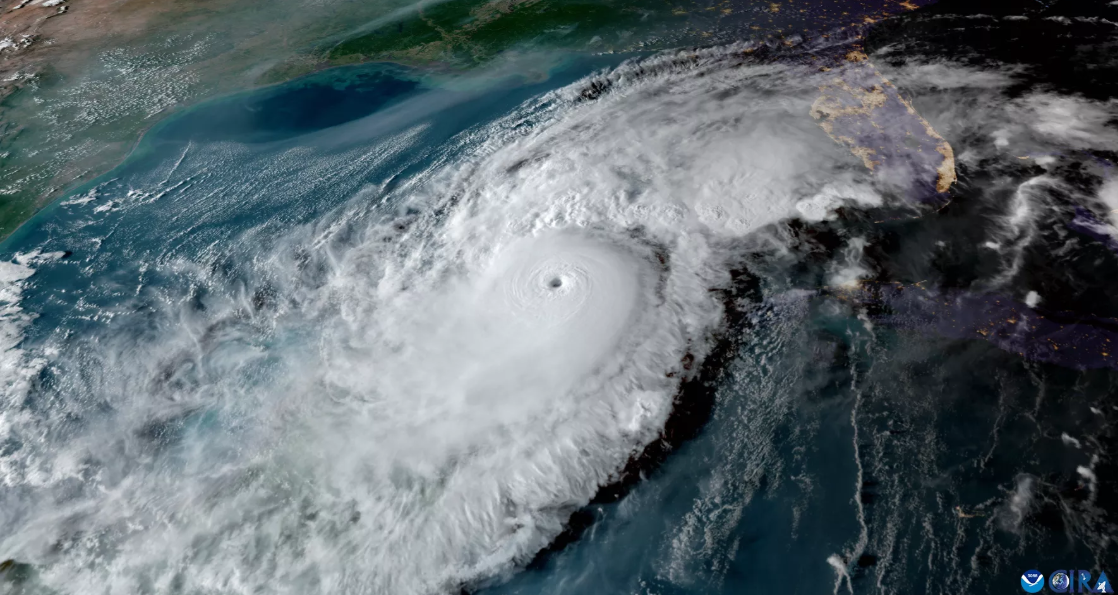
Hurricane Milton made landfall on Florida’s west coast less than two weeks after Hurricane Helene.
Photo by the National Oceanic and Atmospheric Administration
By Alisha Durosier
Lindsay Bixler does not envision her future children settling in Florida when they reach her age; she’s unsure if the state will even be an option for them to call home.
Bixler and her sister own The Campus Grind, a local coffee shop on the edge of the University of South Florida St. Petersburg, which is connected to a local restaurant owned by their parents, The Tavern.
Last year, when Florida’s west coast was hit with back-to-back hurricanes, Helene and Milton, the campus landmarks endured the worst damage they’ve ever seen from a hurricane since the Bixlers took over the businesses in 2019 and 2020. Most of the damage was caused by Hurricane Helene.
“There was three to four feet of water in there and it just pushed and moved things around to the point where we lost a wall,” Bixler told The Crow’s Nest in 2024. “I definitely was not expecting the amount of destruction that we sustained … everything was gone.”
Bixler loved coming of age in Tampa Bay, so it’s not that she simply doesn’t want her children to live here.
“But hurricane season and having that anxiety every single year definitely takes a toll on you,” she said in a recent interview with The Crow’s Nest.
Extreme weather events in the U.S. are becoming more intense as the Earth’s temperatures gradually increase.
In its forecast for the 2025 Atlantic hurricane season, the National Oceanic and Atmospheric Administration (NOAA) predicts a 60% chance of an “above-normal season,” a 30% chance of a “near-normal season” and a 10% chance of a “below-normal season.”
NOAA forecasts between 13 and 19 named storms for the 2025 season. The average Atlantic hurricane season has 14 named storms.
“Of those, 6-10 are forecast to become hurricanes (winds of 74 mph or higher), including 3-5 major hurricanes (category 3, 4 or 5; with winds of 111 mph or higher),” the May 22 report reads.
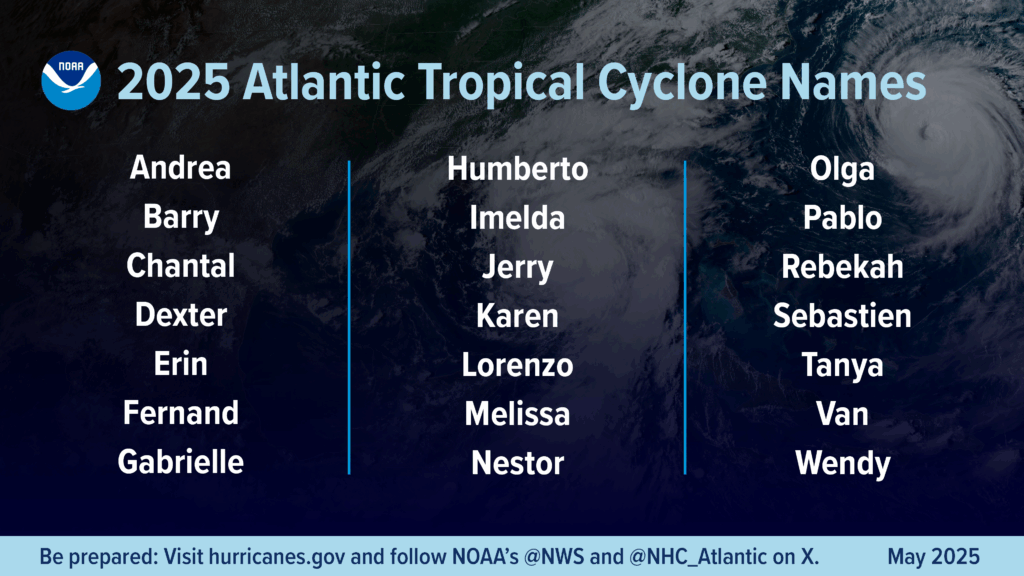
The agency cites “warmer than average ocean temperatures” as one of the major factors influencing its forecasts — conditions that result in bigger, slower-moving and faster-developing hurricanes that coastal states, like Florida, continuously face every year.
The anxiety Bixler describes can be defined as climate anxiety — emotional distress surrounding the impacts of weather-related phenomena and climate change.
“That anxiety can increase when the climate change event is not only a concept, but something that the person experiences themselves,” said USF environmental sociology professor Feng Hao.
According to Hao, people begin to make the connection when their personal priorities are affected. Particularly, when their sense of safety is at risk.
“We see the pictures, the videos after the hurricanes in Florida, [of] the entire community just being damaged and no one knows how long it will take to recover and that is… [a] strong feeling of fear, strong feeling of worry and strong feeling of uncertainty,” Hao said.
For WUSF climate reporter Jessica Meszaros, the recent hurricane season was the first time she’d ever covered back-to-back hurricanes. Now, every time it rains, she thinks about her house, which suffered substantial water damage from Hurricane Milton.
“The back of my mind is like, ‘What’s going to happen to my house?’” Meszaros said. “I’ve lived there for four or five years and I haven’t experienced anything like this.”
She and her fiancé have done everything they could to protect their home from the next storm, but even the thought of another hurricane season is draining.
“I’m… really hoping for an inactive season, at least in Florida or everywhere,” she said. “Obviously I don’t want any of the hurricanes to hit anywhere, but please don’t come to Florida right now.”
USF St. Petersburg political science sophomore Brianna Gutierrez said she experiences quite a bit of climate anxiety, especially as she observes a decline in widespread sustainable initiatives. Growing up in Florida, she was always concerned about rising temperatures and increasingly intense hurricanes, but the 2024 hurricane season left her “shaken up.”
Last season’s hurricanes left a significant mark on USF St. Petersburg’s campus.
“I was one of the RHO residents who was not allowed to come back for weeks. I worry about my academics being interrupted again,” she said.
Both Hurricane Helene and Milton resulted in university-wide evacuations and left lingering debris. Most notably, Hurricane Milton closed the on-campus residence hall, Pelican Apartments (RHO) for nearly a month due to water intrusion, displacing all 352 residents.
For Tampa Bay environmental journalist and author Craig Pittman, his anxieties lie in how local, state and federal governments are handling — or not handling — the impacts of climate change.
“We have managed to repeatedly elect governors and legislators who don’t believe in climate change or say they don’t… and yet at the same time, things just keep getting worse for people who live here,” Pittman said. “We’re getting deeper and deeper in trouble, and the people in charge don’t want to hear about it. They don’t want us talking about it. And that drives me nuts.”
Among the steadfast skeptics of climate change and its impacts is Florida Gov. Ron DeSantis.
While his administration acknowledges Florida’s vulnerabilities through the Resilient Florida Grant Program (SB 1954) — which was established and signed into law in 2021 to help communities prepare for “impacts of sea level rise, intensified storms and flooding,” according to the Florida Department of Environmental Protection — DeSantis has simultaneously taken steps to roll back climate-focused policy.
In 2024, he signed HB 1645, a bill that removed many references to climate change from state law, deprioritized regulation of emissions contributing to global warming and reversed Florida’s 2022 goal of using 100% renewable energy by 2050. On X, DeSantis called the bill a stand against what he described as a “radical climate agenda.”
The state’s political response to climate-related issues reflects a broader sentiment. Many don’t recognize the link between climate change and the increasing intensity of natural disasters.
“I think it shocked a lot of people,” Pittman said of Hurricane Helene. “There were houses in my neighborhood that flooded that had never flooded before and that’s a direct result of rising sea levels. But I also think there’s still a disconnect in people’s thinking about this stuff. They will say, ‘oh, we’ve always had hurricanes,’ and they won’t necessarily connect climate change to that.”
Reporting on a largely Hispanic community in Ruskin in the aftermath of Hurricane Helene, Meszaros also observed the disconnect.
“What I found is that people who are most impacted, people who don’t have the means to recover… in their mind, it’s not ‘Oh, this is climate change,’ it’s more like, ‘Oh wow, this happened to me,” Meszaros said.
This common notion is leading scientists and advocates to change the way they communicate about the risks of climate change.
As Meszaros notes, meteorologists are adjusting their language. Rather than pinpointing possible locations for a storm’s landfall, they utilize phrases like the “cone of uncertainty,” in an attempt to prevent complacency and encourage residents to also prepare for any outcome.
Guitierrez works with USF St. Petersburg’s chapter of genCLEO, a youth-led environmental advocacy group, to host conversations around what sustainability would look like and do for the campus’s surrounding city.
“My advocacy work with genCLEO came from this need to make sure I can do my part to ensure my campus is aware of the effects we see from climate change and what we can do as a city to practice sustainability,” Guitierrez said.
For Bixler, because she has experienced firsthand how destructive a hurricane can be, she is “strangely feeling a little better” about this year’s hurricane season than previous years.
“It sucked. But I was able to rebuild in a way that makes us more sustainable for future events if they were to happen,” Bixler said.
The Grind reopened a couple of months after Helene and Milton. It has since been refurnished with appliances that have their mechanics at the top instead of the bottom, and all wooden cabinets have been replaced with wire racks.
“I don’t want it to happen. I hate thinking about having to close. I hate thinking about all of those things,” Bixler said. “But I feel like I know what to do now, as much as I can.”