Photo by Alisha Durosier | The Crow’s Nest
By Alisha Durosier
WTF really means “Welcome to Florida,” according to journalist and author Craig Pittman.
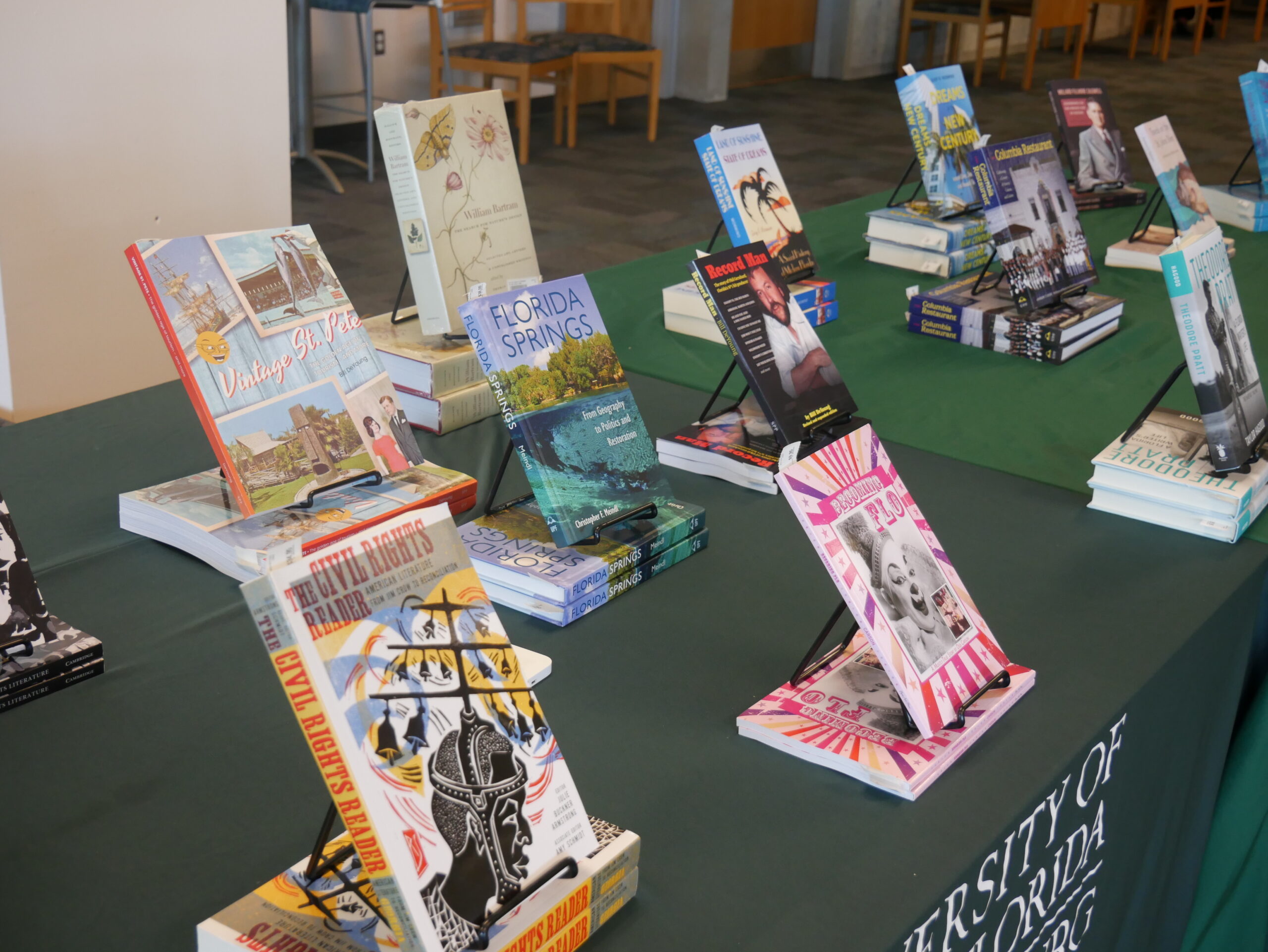
The bestselling Tampa Bay author kicked off the inaugural Florida Studies Book Festival on April 5, with a crowd of Florida literature enthusiasts, local authors and University of South Florida faculty and students at the St. Petersburg campus’s Nelson Poynter Memorial Library.
The all-day festival was hosted by USF’s interdisciplinary Florida Studies Program. Featuring 11 speakers, all of whom were authors ranging from geographers to policy experts, the festival was a celebration of the humanities and the human experience in the multifaceted state of Florida.
The idea for a Florida Studies Book Festival arose a couple of years ago, when former graduate student and festival speaker Debbie Carson suggested the program host a book fair.
“I’m thrilled that we were able to pull this thing off and make it happen, partly because I want to draw attention to the Florida Studies program,” said Florida Studies Program director and USF St. Petersburg geography professor Chris Meindl.
The Florida Studies Program was founded by USF St. Petersburg southern history professor Ray Arsenault and emeritus professor Gary Mormino in 2002. The program officially began in the fall of 2003.
Mormino said in a 2003 university press release that the proximity of USF St. Petersburg and its faculty to local cultural and academic institutions creates a “synergy.”
“There is recognition of a crying need for a place to cultivate the study of Florida,” he said in the press release. “All these things had to come together. If any one of these was missing, the Florida Studies program would not have been possible.”
According to Meindl, the concept of Florida as a living laboratory is what defines the Florida Studies Program. It’s a theme that was emphasized by each festival speaker and is reflected in the program’s diverse course offerings, many of which do not solely center on the state of Florida.
“We’re weird,” Pittman said of Florida. “We produce a lot of weird news. But if that’s all you notice, you’re missing out on a lot of stuff that actually influences the way we live now all over the United States.”
With books on orchid smuggling, saving the Florida Panther and collections of his various essays, stories and columns about the state of Florida, everything about the state is worth exploring for Pittman.
USF St. Petersburg English professor and Duckwall professor of Florida Studies Julie Armstrong sees the state as a literary mecca — a title some won’t necessarily assign to Florida.
“Florida is one of those. And, you know, as a literary scholar, I find that really fascinating. What is it about this state that really has an outsized body of literature prominent about it?” Armstrong said.
She, alongside her husband, USF St. Petersburg English professor Thomas Hallock spoke at the festival about their two-volume anthology on the 500-year history of Florida literature, which they are co-editing with USF St. Petersburg graduate student Benjamin Brothers.
Hallock is primarily working on the first volume, which encompasses literature from the 16th century — where the state of Florida is first mentioned in a poem — to the mid-19th century. Picking up where he leaves off, Armstrong is working on the second volume, a collection of literature from Florida’s declaration of statehood to the present.
Hallock said a major theme in the first volume of the anthology is translation in both a literal and figurative sense.
“The idea of Florida is constantly being translated and retranslated,” he said. “It’s always shifting. And I think in this time of tremendous cultural and social instability, Florida really helps provide insight into that.”
Armstrong also sees the constant shift as a theme in the second volume as well.
“Fluidity and mobility,” Armstrong said. “Moving into and out of and across and through the state, mobility is a huge one.
Armstrong affirms that fluidity as a theme is not just a reference to the fact that Florida is a peninsula.
“Now people try to build homes for lasting value, but prior to the 20, 21st century, we just didn’t have that. It was a much more transient way of living. It’s a much more fluid way of living,” she said.
Through the festival, the program also celebrates the humanities at a time where the discipline is under threat.
The National Endowment for the Humanities, which funds the Florida Humanities Council that funded the festival along with Armstrong and Hallock’s anthology, and helped establish the Florida Studies program, is facing budget and staff cuts at the hands of the federal government.
During this time when support for the humanities is dwindling, the field is often seen as inefficient.
“You can’t build bridges. You can’t do brain surgery. You can’t train dolphins. I get it… But at the end of the day, so many jobs are run or performed by people who do not need technical skills, but they need to be broad thinkers. They need to understand a wide range of things,” Meindl said.
Armstrong said that the humanities is all about “complicating” and criticizing, which she emphasizes isn’t definitively negative.
“We’re not going to give you the happy, pretty, tidy picture of American history. We’re going to tell you it’s messy, it’s difficult,” she said. “It means thinking critically and breaking apart and showing how something works, analyzing it. And, you know, people don’t want that.”
Meindl is hoping to make the book festival an annual event but may need to find additional grant funding. It is uncertain whether the Florida Humanities Council will be able to provide the financial support necessary for the program to run the festival.
“I’m honored to be participating,” Hallock said. “Though I hope diversity is a priority in future book fairs.”