
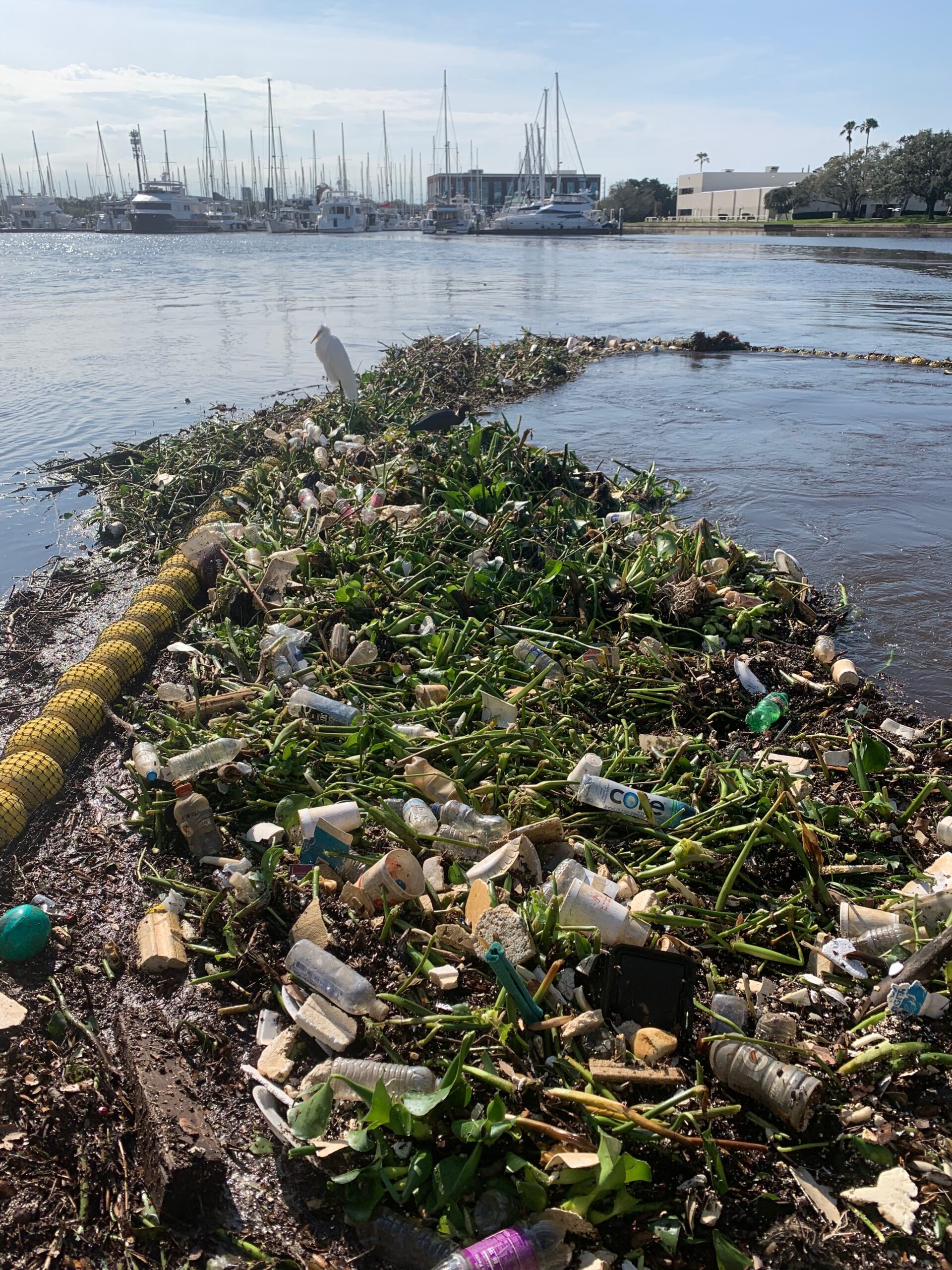
USFSP’s Watergoat is often overflowing with garbage and decaying plants that shoot out of the stormwater drain in Bayboro Harbor.
Photo courtesy of Oliver Laczko
By Julia Birdsall
On a mild January day in 2024, I got to explore the University of South Florida’s St. Petersburg campus for the first time.
The pictures almost did the campus justice, but they didn’t prepare me for the sight of Bayboro Harbor.
Where I expected to find beautiful glimmering water, I saw garbage.
Plastic bottles and aluminum cans, among other things, marred the water’s surface. The current sent a particularly large collection of the trash to the USF St. Petersburg Sailing Center’s docks.
I watched the trash drift in the waves and thought, “This is disgusting. The university should be doing something about this.”
Later, I came to learn that a lack of action is only part of the problem, and Bayboro Harbor’s history of pollution began long before I arrived at its shores.
A timeline compiled by USF St. Petersburg’s students details how over a century of development transformed the harbor, along with Salt Creek and Booker Creek — both of which flow into Bayboro Harbor — into what it is today.
Senior environmental science and policy major, and Vice Chair of the Student Green Energy Fund (SGEF) Oliver Laczko, who wrote his honors thesis about the harbor, explained that today’s campus waterfront was once mud flats and salt marshes, but in 1907 the Bayboro Investment Company began dredging the land to create what is now the Bayboro basin, or Bayboro Harbor. The project was completed in 1909.
“The pollution issues [in Bayboro Harbor] started almost immediately,” Laczko said. “The water quality that plagues Bayboro Harbor is largely because of pollution from runoff from Salt Creek and Booker Creek and pollution due to inadequate infrastructure.”
On top of that, Bayboro Harbor was being filled with raw sewage, petroleum, heavy metals and nutrient pollution.
As the harbor continued to expand, the severity of the pollution came to light.
One project in 1945 caused outrage and confusion after one of the dredges hit a pocket of decaying raw sewage, and sulfide gas was unleashed upon the area surrounding Bayboro Harbor.
An awful smell permeated the air, nearby houses were stained black when chemicals in the gas met their lead paint and residents fell ill from breathing in the contaminated air.
A local family, the Meares, described what it was like to awake one morning and find their previously white house stained black in a St. Petersburg Times (now Tampa Bay Times) story published shortly after the incident took place.
Another local woman, Mrs. Gehrman, stated that she became sick because of the fumes and many of her neighbors told her that they were nauseated.
It was officials from the neighboring county, rather than residents, that became outraged in 1978, when plans were made by the City of St. Petersburg and the U.S. Army Corps of Engineers to further dredge the harbor.
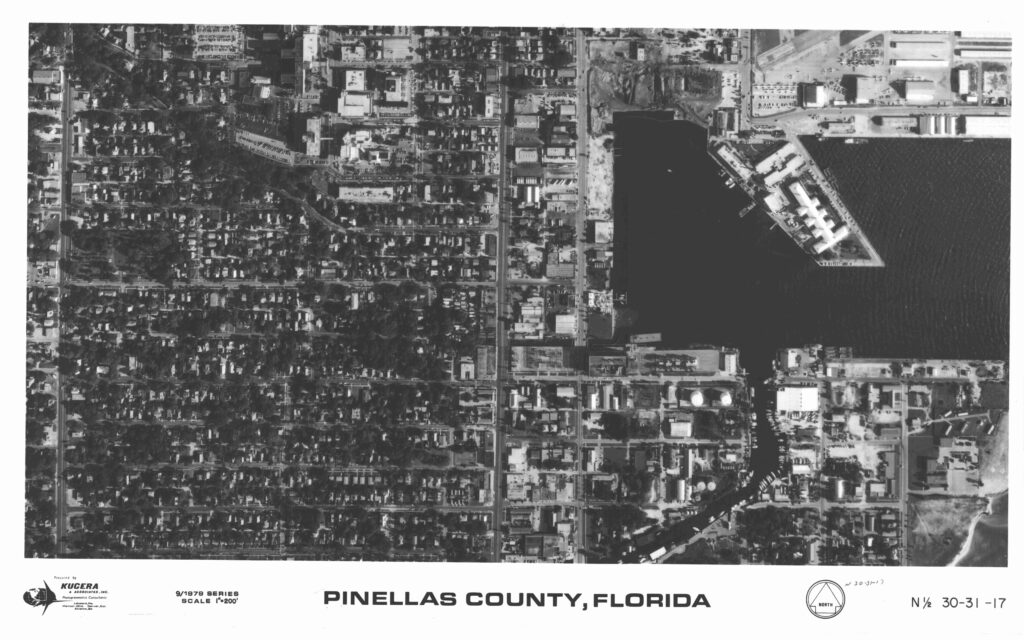
Photo courtesy of Pinellas County Enterprise GIS
The dredged material was supposed to be taken from Bayboro Harbor and dumped into the Gulf of Mexico, near Egmont Key.
Manatee County officials caught word of this, and they pushed back. A Sarasota Herald-Tribune story from 1980 highlighted the officials’ concerns that the polluted material would harm marine life and their fishing industry, as well as pollute their beaches.
The issue was elevated to President Jimmy Carter, as described in another Sarasota Herald-Tribune story, when Chairwoman of the Manatee County Commission, Patricia Glass, sent a telegram pleading for government involvement to stop the dredging and dumping.
“Please issue stop order on dredging of Bayboro Harbor. St. Petersburg, Fla. and resultant dumping of toxic contaminants in continental waters off Egmont Key. Full investigation imperative,” Glass wrote.
While the dredging was allowed to continue, the dump site was moved to deeper waters in the Gulf of Mexico.
As the dredging occurred, USF St. Petersburg scientists took samples from Bayboro Harbor’s water and discovered heavy metals that were far outside the range of what would be considered safe.
Similarly, scientists from Mote Marine Laboratory who observed the area where the dredge material was dumped found that corals and other marine life were impacted by the dumped materials.
“As an official overseeing the project proclaimed that no wildlife was being harmed by the dumping because nothing lived in the area, a loggerhead sea turtle coated in dredged muck swam to the surface,” noted the St. Petersburg Times (now Tampa Bay Times) in an article published in 1990.
Since the 90s, Bayboro Harbor’s water quality hasn’t improved.
Bayboro Harbor’s small stretch of beach located on the USF St. Petersburg’s campus “met water quality standards less than 60% of the time,” according to Tampa Bay Waterkeeper sample data posted to Swim Guide.
Laczko told The Crow’s Nest that current infrastructure has a large part to play in the continual pollution of Bayboro Harbor. One culprit that he identified is the large stormwater drain located near the campus beach.
The drain is part of a culvert that runs below the campus, through downtown St. Petersburg and sections of Interstate 275 around Tropicana Field.
Pollutants from the interstate and the bustling downtown streets are frequently washed into the storm culvert when it rains, Laczko said, along with decaying, nutrient rich water hyacinths from Booker Creek. All of which eventually end up in Bayboro Harbor via the storm drain.
A Watergoat was placed in front of the drain in an attempt to catch the trash coming out of it, but as Laczko explained, trash often seeps under it, especially when excessive storms overwhelm the storm drains and shoot trash past the Watergoat and into the harbor.
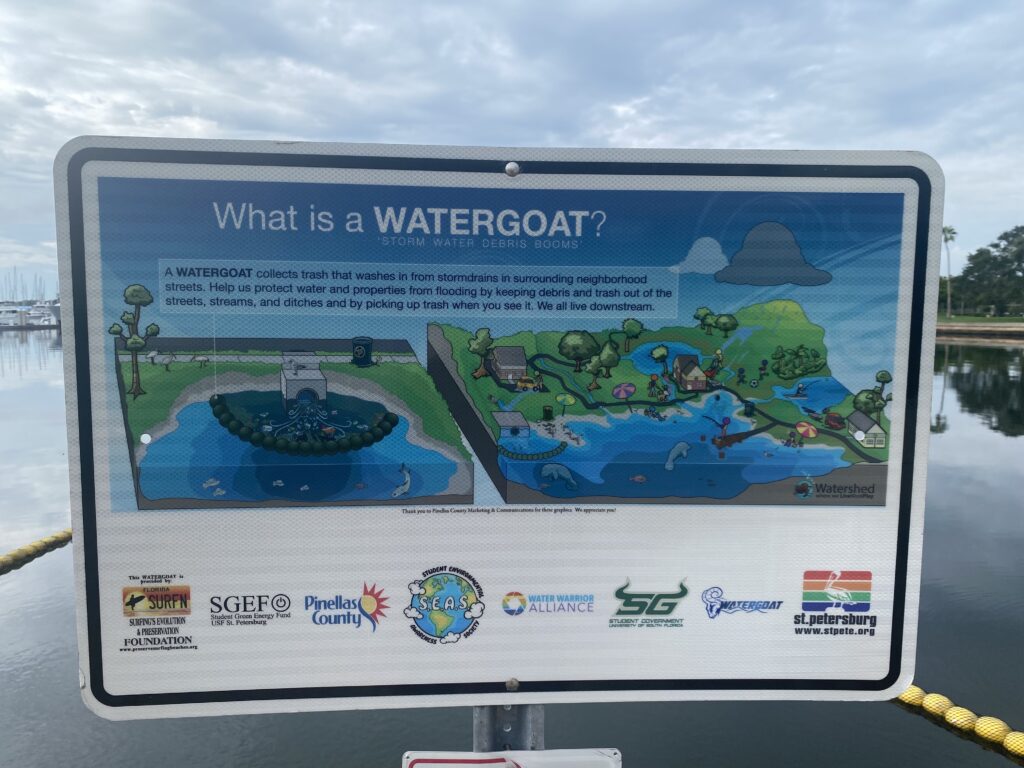
Photo by Julia Birdsall
There is not a lot that has been done to restore Bayboro Harbor, but Laczko hopes to see that change.
In his honors thesis, Laczko explained the benefits of replacing seawalls with living shorelines, which he also told The Crow’s Nest in 2024.
“We should restore the salt marshes that once existed here and the oyster populations that once existed here because they will actually clean and improve the water quality in Bayboro Harbor,” Laczko said.
With SGEF, he is trying to ensure that a living shoreline is installed along the campus beach. They hope to see the project approved within the next couple of months.