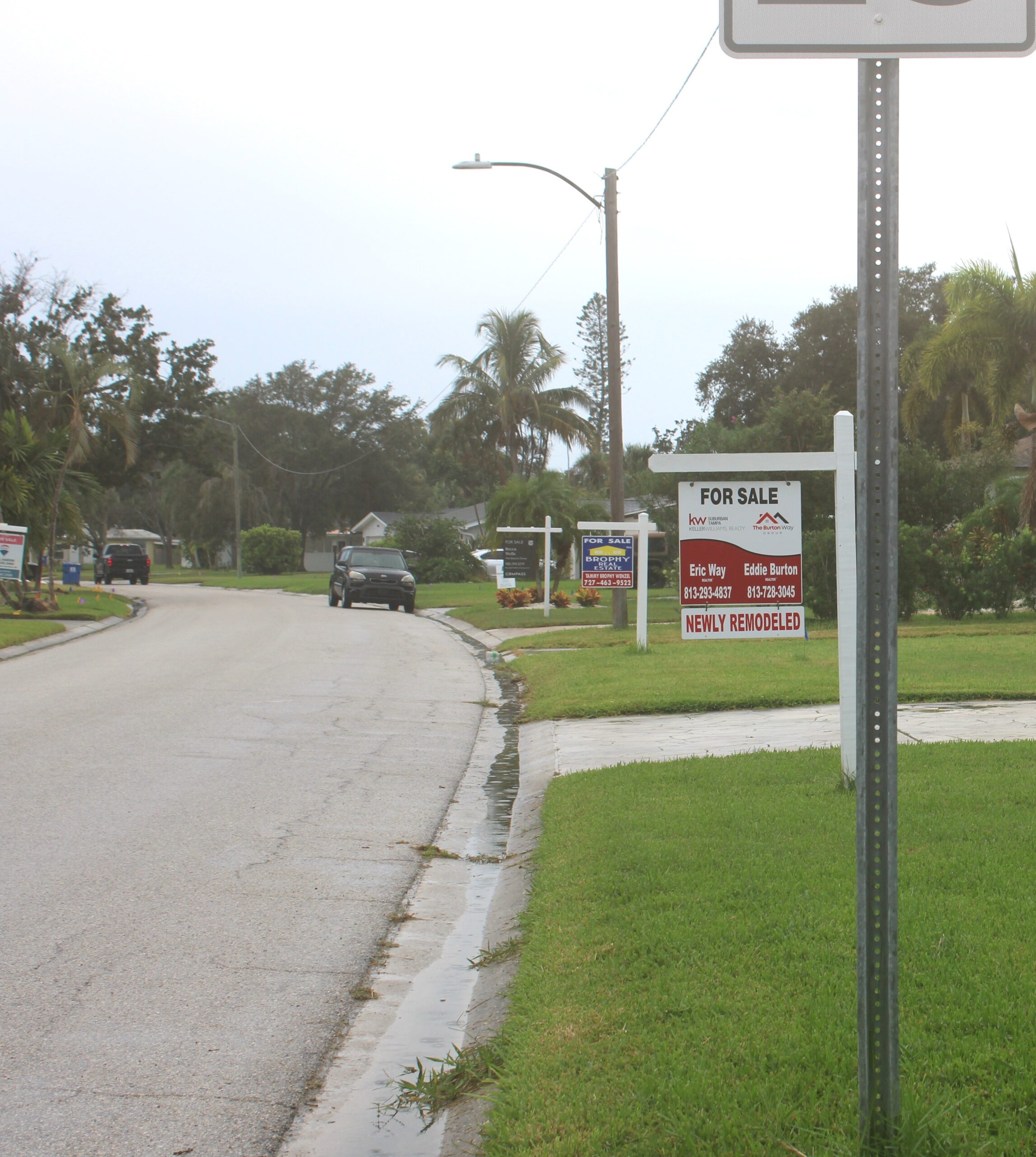
A line of “For Sale” signs decorates the lawns of homes in Shore Acres.
By Jasmine Parrado
When Hurricanes Helene and Milton were projected to strike near Tampa Bay last fall, St. Petersburg homeowner Arturo Finegold and his wife jumped straight to making preparations.
In the waterside neighborhood of Shore Acres, flood vulnerability is high. So, the two quickly removed as many objects as they could from the floor, entrusting them to high ground and dark drawers before swiftly evacuating.
“We knew [Helene] was coming,” Finegold said. “We were hoping it wasn’t going to have as much tidal surge as it did.”
But in the aftermath of the impact, Finegold’s hopes were dulled by his return. Countless items and furniture were swept away and tainted by a murky three-foot flood. The house has been uninhabitable ever since.
Eleven months after the disasters, Finegold is among more than 400 Shore Acres residents who will not receive aid from Elevate Florida, the Florida Division of Emergency Management’s residential mitigation program.
The denial was fairly surprising, Finegold said. When considering the program’s priority factors, which include a history of repetitive flooding, substantial damage and impacts from previous hurricanes, he thought his home would be a reasonable candidate.
Other Shore Acres residents thought so, too. But with around 20% of Florida’s 12,000 applicants projected to receive aid, there are mixed responses within the community.
“I would describe [Elevate Florida’s] decision process as something that was fairly opaque,” Finegold said. “I don’t think they really want us to know why others were approved and we were denied.”
Finegold recalled his wife applying for Elevate Florida after conversations about the program circulated in Shore Acres community chats on social media.
Prior to applying, Finegold did a retro appraisal of the property and was approved to submit plans for basic repairs. The approval was per a Florida rule that sets parameters on “substantial damage,” based on whether or not the cost of repairs is 49% or more of the structure value.
Any property with an estimated damage cost at or over 49% cannot go through repairs without being lifted or replaced. This clashes with the criteria for substantial damage that actually qualifies homeowners for home elevation aid from Elevate Florida.
Kevin Batdorf, president of the Shore Acres Civic Association, described it as a “glitch in the system.”
“For some people that I’ve talked to, that was the reason, most likely, that they were denied now,” Batdorf said.
The initial program application window, which sought to provide $400 million from FEMA grants toward recovery efforts for 2,000 homeowners, was overwhelmed with 10,000 more people than it could accommodate.
Following the hurricanes, applicants searched and applied for various programs. But discrepancies between them were not exactly clarified by any particular department during that time, Finegold believes.
“The city, the state, FEMA, they’re all trying to help us, but there are dependencies that could affect how the other entity could help you,” Finegold said. “So, it’s pretty complicated. If we knew then what we know now, maybe we would have done things differently.”
Finegold had to wait six months to receive a decision. He feels that, in that amount of time, he could have done more to restore the property.
In the midst of the devastation that Helene and Milton brought with them, residents sought financial aid from many programs, without exact guidance as to what they would be eligible for, Batdorf recalled.
“The city was not as helpful as we would have expected,” Batdorf said. “They caused more issues, I think, than they solved.”
Batdorf cited flaws in the city’s restoration efforts, from inefficient debris removal to delayed repairs and lengthy permitting processes.
While the situation has been difficult for the rejected majority of homeowners, Batdorf is looking forward to the aid that did come through for Shore Acres residents in light of the program’s applicant overload.
Out of 555 homeowners that applied from the 33703 ZIP code, 415 were from Shore Acres. Between 100 and 150 are projected to receive funds.
Batdorf estimates that Shore Acres properties are likely to account for that number, as they would qualify given the criteria of continuous reflooding.
He knows it’s not enough, though. Over 800 homes in Shore Acres have flooded three or more times, presenting a greater need.
“Every single one of those homes needs to be lifted at some point soon,” Batdorf said. “It just makes more sense to elevate the house than to pay multiple claims over time.”
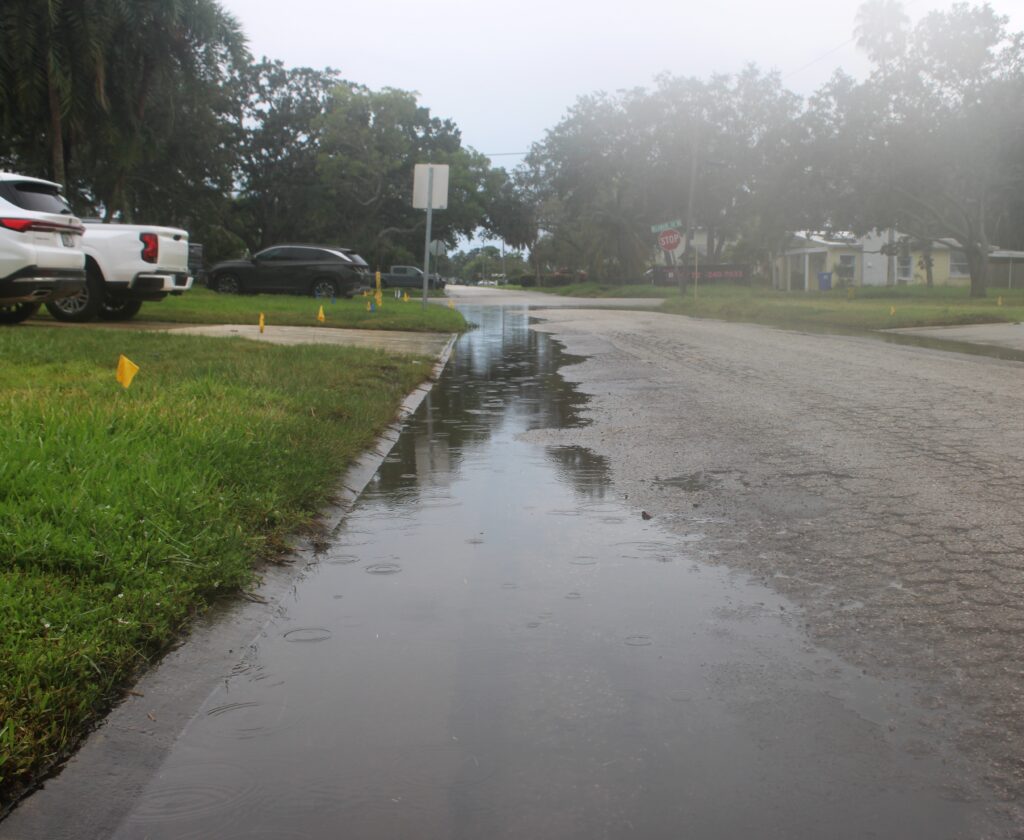
For Batdorf, a major difficulty with the instatement of state and federal programs is that municipalities don’t often favor the idea of larger oversight – and St. Petersburg is not exempt from that problem.
“I think the city of St. Petersburg is resisting the program, and I think it’s an ego thing,” Batdorf said. “They think they’re their own entity. We don’t have the same issues that, say, Childs Park has, or Azalea, or another neighborhood. They’re not lifting their homes.”
As for the state’s response to last season, its problem was mainly being unequipped for the degree of damage it needed to respond to, said Rep. Lindsey Cross, member of the Florida House of Representatives.
“We don’t have all the people and resources to help each and every person become made whole from this disaster,” Cross said. “That’s what people are really looking for and hoping they’re going to get from their government.”
Though hurricanes Helene and Milton did not directly strike Tampa Bay, the storm surge and flash flooding in its wake was enough to stir urgency and concern in residents. Programs like Elevate Florida had to close their application windows after receiving an immense number of applicants.
While the issue of communication might have been a big factor, Cross thinks the disaster also emphasized areas for improvement from the state.
“As we’re seeing attempts to dismantle or reduce funding from FEMA, the state of Florida needs to step up and have more dedicated staff and financial resources dedicated to disaster recovery,” Cross told The Crow’s Nest.
Going forward, Cross emphasized that regardless of residents’ zones, it is essential to be cautious and secure flood coverage. Otherwise, if their homes flood, their insurance company won’t provide a payout.
“People who were not anticipating that level of impact don’t really have any recourse if they didn’t have flood insurance,” Cross said. “So, that’s really challenging.”
Like other residents in Shore Acres, Finegold and his wife are still not able to reside in their home. They’re staying at a friend’s studio apartment in the meantime, contending with their rejection and coordinating efforts to restore a home they love, in a community they enjoy.
Finegold and his wife appreciated the waterside access in the neighborhood. Prior to the storms, they often went kayaking and paddleboarding across the street toward Weeden Island.
“That’s why we chose that house, that location,” Finegold said. “We really love the bay – except when it comes into our house.”