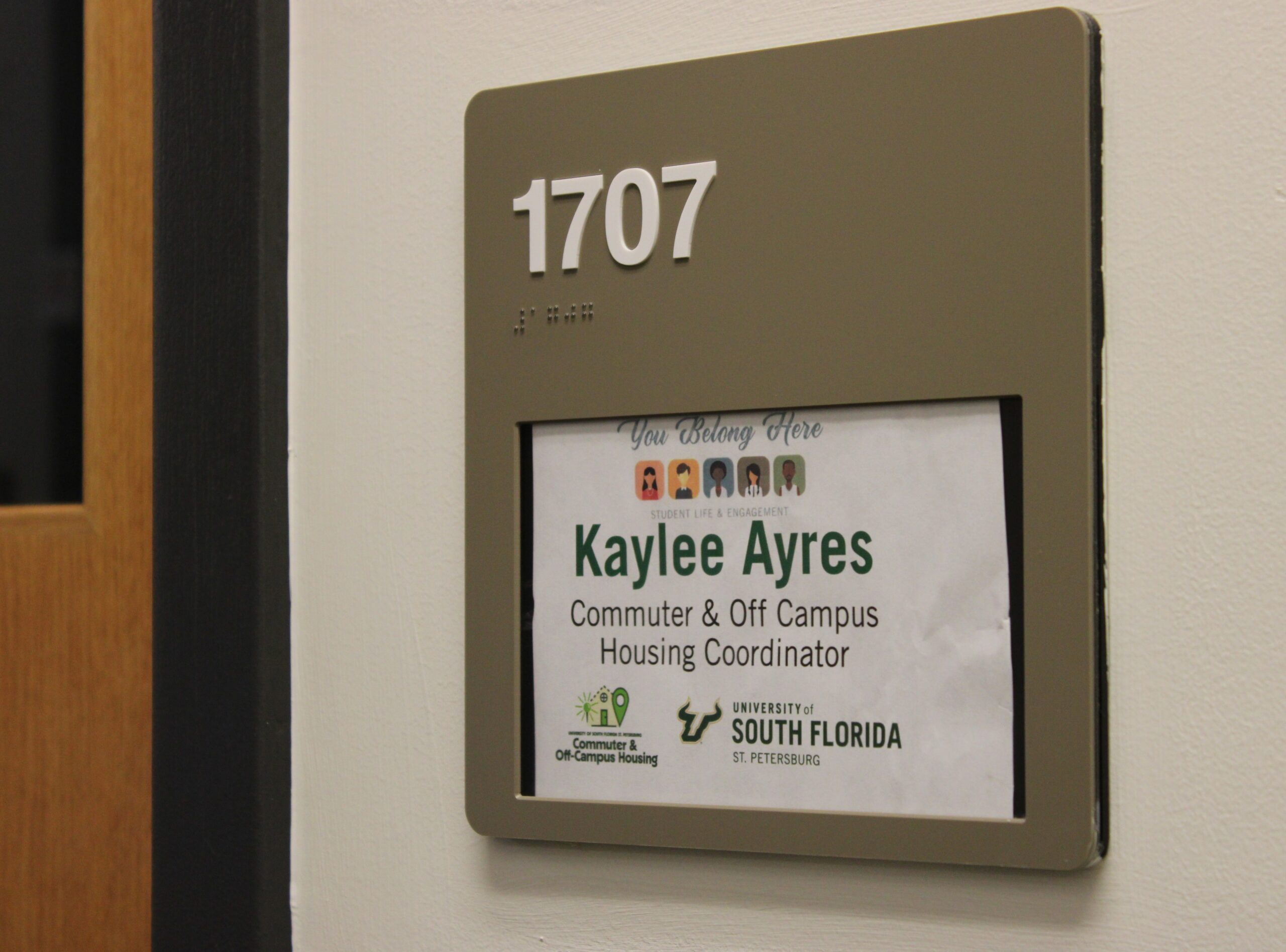
Coordinator Kaylee Ayres’ office is in Suite 1700 of the Judy Genshaft Student Life Center. Students can set up appointments with her to discuss concerns and general inquiries throughout the semester.
Photo by Jasmin Parrado
By Jasmin Parrado
After the University of South Florida St. Petersburg announced its initiative to expand resources for commuters last spring, the campus introduced its first coordinator role for commuting and off-campus housing and a proposal for a commuter lounge by the end of this year.
Coordinator Kaylee Ayres was hired for the position this summer as a new addition to USF St. Petersburg’s Student Life and Engagement (SLE), which houses Harborside Activities Board, Multicultural Programming Board, Leadership and Student Organizations and The Crow’s Nest.
Having previously worked at the Center for Student Involvement at USF Tampa for almost three years, Ayres brings experience in overseeing campus activities and resources to the role.
“[Commuter students] are facing a lot of unique challenges, from navigating transportation and parking to balancing academics, jobs, family responsibilities,” Ayres told The Crow’s Nest. “So, we wanted this area to be a resource for them and to let them feel seen and valued and included on campus.”
Ayres’ position entails developing resources and opportunities specifically for students seeking off-campus housing or commuting to USF St. Petersburg.
In addition to planning activities curated for interests such as housing and student connections, Ayres has facilitated arrangements for more commuter meal plan promotions and monthly “pit stop” provisions by the parking garage on campus.
Resources like these are essential to helping students feel like they can still engage with campus life, despite living away from it, she explained.
“The biggest thing I’ve been hearing from the commuter students that I’ve been talking to is just that desire to feel that connection, both to campus and then to other students,” Ayres said.
Some students, as a result of not having the “traditional college experience,” can tend to feel excluded, Ayres told The Crow’s Nest.
Michaela Courtney, senior nursing student at USF St. Petersburg, feels that if she didn’t have to commute, she’d engage in more activities on campus.
“I’ve always seen USF proms and activities for making a charcuterie board or potting plants,” Courtney told The Crow’s Nest. “I’ve just never been able to do that because I live so far away, and I just don’t want to drive an hour to do an activity that I’ll have to go back home from.”
While on-campus students may be able to attend events on a regular basis, commuters often have to weigh their time and financial expenditures, Courtney explained.
“You’re spending a lot of gas, or you’re spending a lot of money on food because sometimes you don’t get to pack a lunch, or you have to beat rush hour or be there at a certain time,” Courtney said.
Hristiana Ivanova, a senior in anthropology at USF, also explained she feels a noticeable separation from campus life. She has to constantly focus on one factor in her daily routine: transportation.
“As much as I love the St. Pete campus, it’s still like school in my brain,” Ivanova said. “Living on campus, you can just kind of stumble into things, and you can find friends. When you’re a commuter, a lot of people are just in and out of class – in and out of campus.”
Ivanova looks forward to the assistance that commuters can now receive with Ayres’ role. Students may be able to “get their foot in the door” and connect with campus culture with a better understanding of what they have available, she explained.
Among other initiatives, Ivanova hopes to see a higher commuter marketing outreach and a transportation system established between campuses for commuters in the future.
USF psychology senior Isabelle Vatelia feels that, with the social disconnect that arises, loneliness is the biggest struggle commuters can face – but it’s not always a direct result of commuting.
Factors like limited course options also often bleed into commuters’ schedules and necessitate extensive hours on campus between classes, which can be inconvenient, Vatelia explained.
“I’d just like to knock [my classes] out and then maybe be more productive with the rest of my day, instead of just sitting in limbo,” Vatelia said.
Those long hours on campus have incentivized Ayres and the SLE team to propose a lounge space on campus, where commuters can unwind and leave miscellaneous belongings throughout the day.
“Once we do have space for that, the hope is to equip it with lockers, potentially fridges, microwaves, charging ports, all that fun stuff,” Ayres told The Crow’s Nest. “That way, there is a physical space for commuter students to go to rest in between classes and call their own.”
For the meantime, Ayres is promoting two bi-annual commuter events: the fall housing fair on Nov. 3 from 10 a.m. to 1 p.m. and the “Fall Roomie Mixer” on Oct. 21 from 12:30 p.m. to 2:30 p.m.
While the mixer allows students to converse and connect with potential off-campus roommates, the housing fair hosts local housing complexes in an opportunity for students to tackle conversations on prospective housing options in the St. Petersburg area, Ayres explained.
With the gears set for the long-awaited resource area, Ayres said she looks forward to what she can do for commuters.
“We’re definitely building this from the ground up; it’s a totally new area, totally new initiative,” Ayres said. “And I think it’s really exciting to be able to lay the foundation for this program that is going to have a lot of direct impact on students’ engagement and sense of wellbeing.”