Photo courtesy of USF
By Julia Ferrara
Artificial Intelligence, especially within the academic setting, has no plans to slow down.
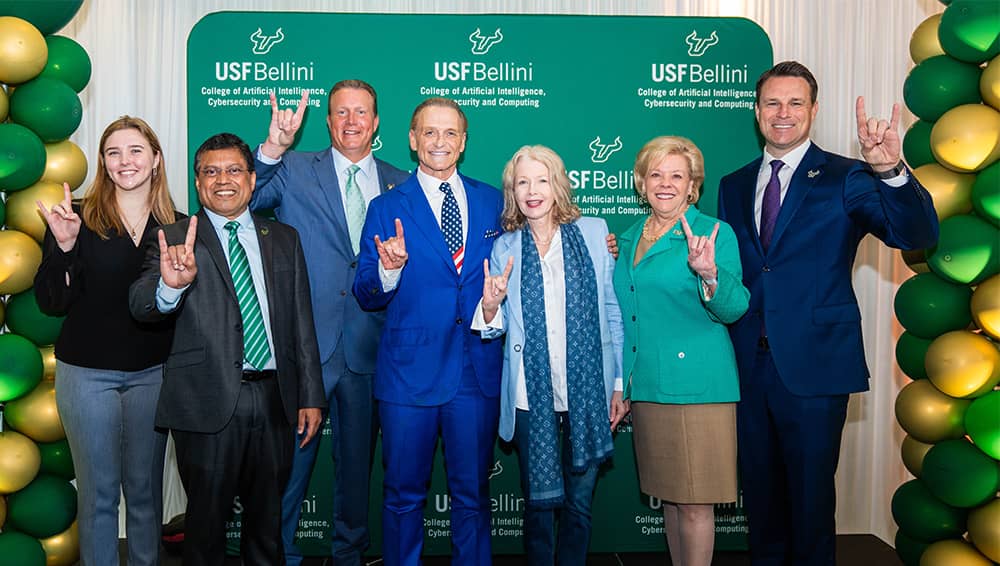
On Oct. 14, at the CyberBay conference, the University of South Florida announced a collection of private philanthropic gifts totaling $2.3 million, all to the Bellini College of Artificial Intelligence, Cybersecurity and Computing.
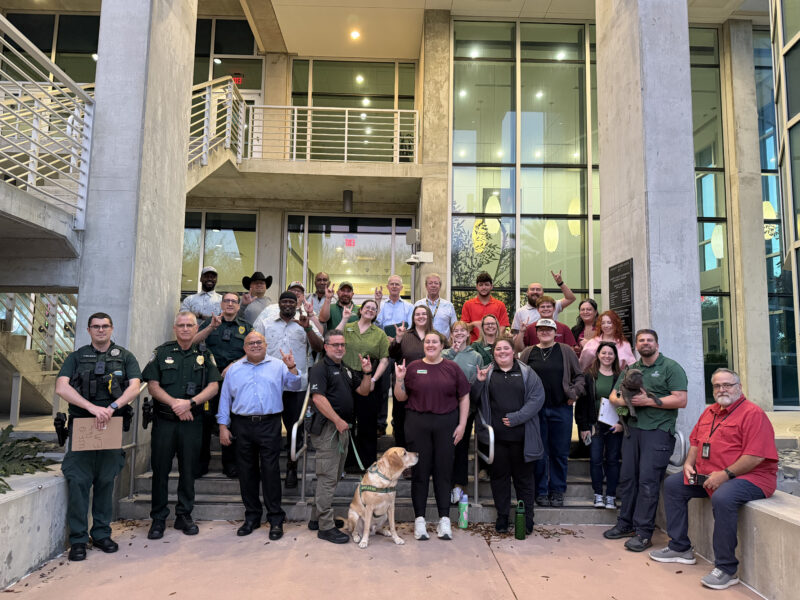
The CyberBay conference was created to combine technology, academic, government, and military sectors in the Tampa Bay area toward a common goal of making the area a national leader in cybersecurity and AI.
The donors included USF President Rhea Law, who contributed $1 million, and philanthropists Kate Tiedemann and Ellen Cotton, who gifted the same amount.
Earlier this year, Arnie and Lauren Bellini donated $40 million to establish the Bellini College, making it the largest single gift in USF history.
The Bellinis, at that time, also agreed to match donations up to $5 million to the college, which also includes the gifts donated by Law, Tiedemann, and Cotton in October.
At the Oct. 14 conference, Law shared that AI and cybersecurity will help to protect data and infrastructure, as well as encourage innovation.
“We are at a pivotal moment in history and thanks to partners and friends like the Bellinis, we are investing in the next generation of leaders – those who will shape the future of cybersecurity, technology and our global community,” Law said.
Some students echo this sentiment. Avery Herman, a freshman Marine Biology major, shares that investing in artificial intelligence, while it’s still a growing field, is a good idea.
“Although it is new and scary, barring AI from classrooms is not the correct way to approach the issue, [rather], schools should focus on educating on how and when AI should be used,” said Herman.
“I hope that the university prioritizes finding ways to make AI better for the environment, as I worry about the long-term consequences it will have.”
While many within university leadership see this as a favorable development, some USF St. Petersburg students disagree.
A junior English major who chose to remain anonymous believes that AI isn’t the future and will only bring about negative consequences.
“AI has never made anyone smarter; it makes humanity worse. If we can’t use our brains, what does that even make us?” he said. “If this was just cybersecurity, I’d have no problem, but anything involving generative AI is an insult to learning and creativity.”
He believes that monetary donations should be used for student-focused efforts.
“I’d prefer for it to go to studies that will enrich the students. Re-expand the programs USF St. Petersburg gutted this semester, like English. Build new science facilities. Invest in the students, not AI.”
Arthur Bellini also shared at the Oct. 14 conference that he and his wife would be contributing another $300,000 to the college.
He noted that the funds would be used specifically for the college’s faculty, staff, and students to conduct cybersecurity research. It would also be used for suggestions to enhance the protection of computer systems within the Tampa, St. Petersburg, and Clearwater governments.
Taylor McLeod, a sophomore Marine Biology major, believes that the Bellini College is more focused on capitalizing on what’s happening in the world of AI than on genuine educational advancements.
As the Student Activities and Services (A&S) budget, which allocates funds to student organizations, faced cuts this past year, students can’t help but wonder where their money is going.
“AI is a hot topic right now, but how do you even get a degree in something already covered in computer science? It feels like a cash grab, a way for the university to attract attention under the trendy label of AI,” McLeod said.
McLeod continues by adding that the $2.3 million gift was disappointing to see and could have been used on improvements for current computer science students.
“Scholarships, updated lab equipment, research opportunities and funding for student projects would have an immediate, lasting impact on those already pursuing the field,” said McLeod.
McLeod believes there were better uses for this money that could have made a difference.
“Investing in the people and programs that exist now would do far more for USF’s future than constructing another building with a trendy name.”