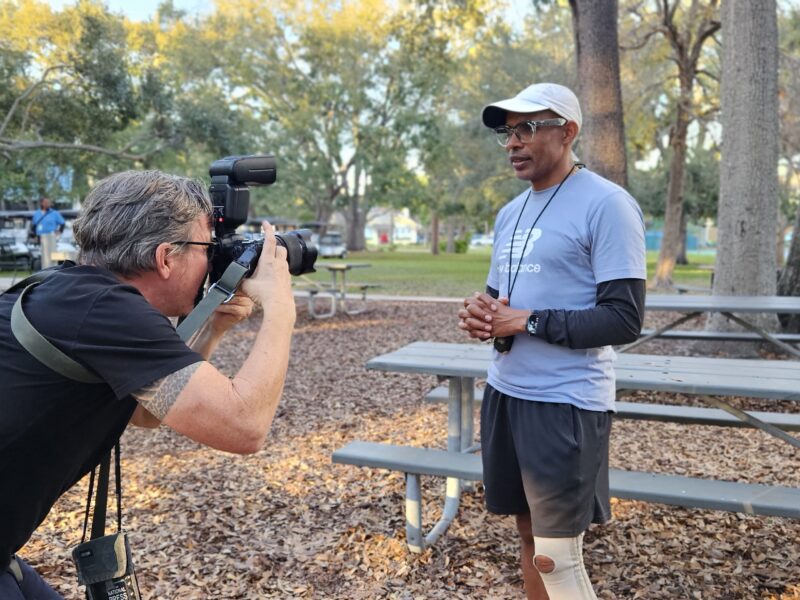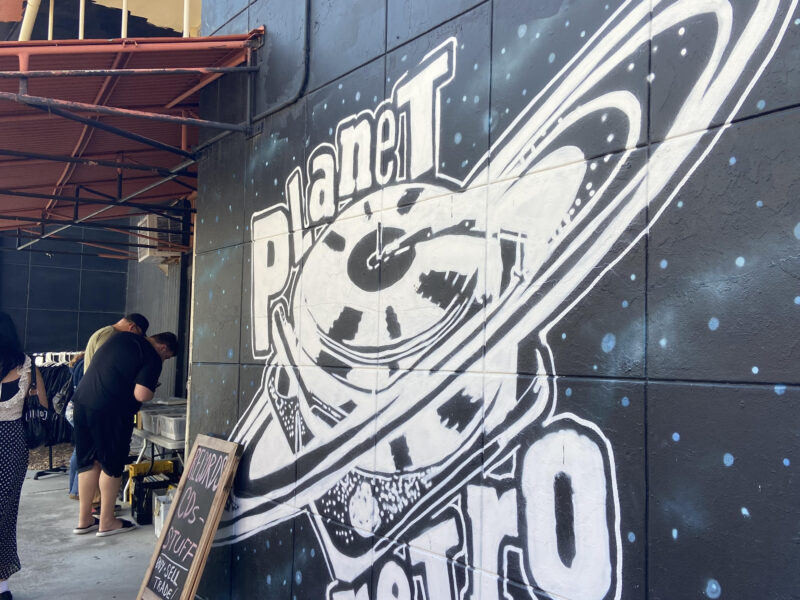
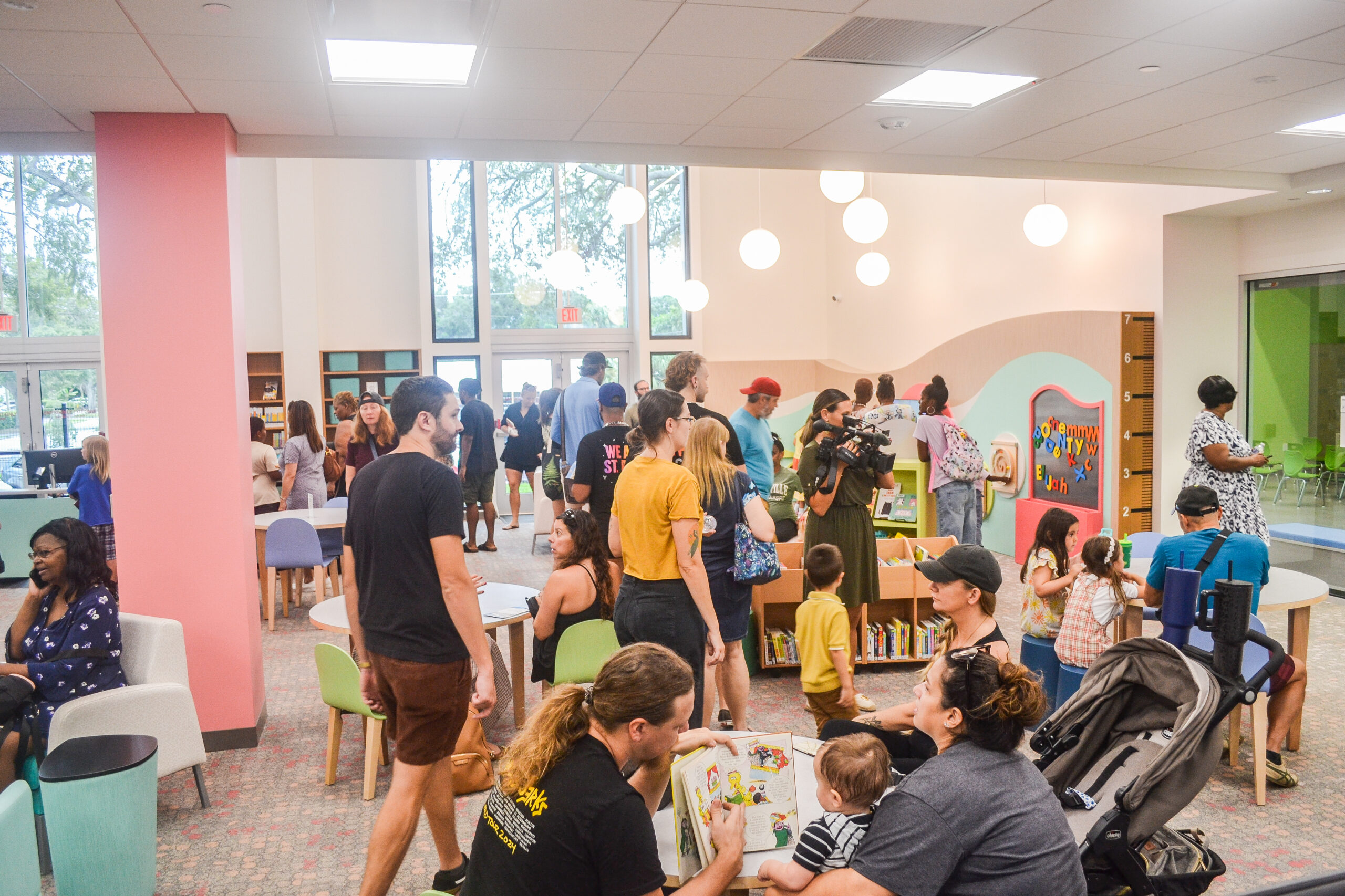
The President Barack Obama Main Library is one of many third spaces where the people of St. Petersburg can go to relax, learn, or socialize.
Photo by Makenna Wozniak | The Crow’s Nest
By Julia Birdsall
The first time Elise Prophete, the University of South Florida St. Petersburg campus’ student governor and a junior studying political science and sustainability studies, went to the library it blew her mind.
“I’ve always been a book person,” Prophete told The Crow’s Nest. “But not only just getting to see all the books I wanted, but even the computers there and the games, getting to be around these random kids that I’ve never seen before. The ability to just make friends organically that way was always so interesting to me.”
Estella Najera, a senior sustainability major and geographic information systems minor, used to spend quality time with her family at the library.
“My family and I would go [to the library] a lot and I would just hang out there for hours and read whatever they had to offer,” Najera said.
In this way, third spaces have benefitted students by giving them somewhere to learn, express themselves and make connections. Those spaces can continue to support them as they grow up.
Third spaces are “somewhere where you just get to be in community with others,” Prophete said. She went on to explain that they’re places where one can do work, catch up with people or just lounge about for free.
Najera agreed.
“A third space is just somewhere that I enjoy going to that’s away from school or my house,” she said. “I feel like I can consider the gym a third space because I don’t really have to pay for that, and it’s just like a place I go. Or the lap pool; I feel like I consider it a third space. Even on my bike, I think I would consider that a third space because it’s a place that I can go to relax.”
The term third space, or third place as they’re also referred to, was first used by the sociologist Ray Oldenburg in 1989.
He claimed that Americans lack community and “are not a contented people” on account of this.
His solution: a space outside the realm of home and work, where one could form social connections.
“…daily life, in order to be relaxed and fulfilling, must find its balance in three realms of experience. One is domestic, a second is gainful or productive, and the third is inclusively sociable, offering both the basis of community and the celebration of it,” Oldenburg wrote.
By engaging in these spaces, Oldenburg claimed, people will achieve personal growth and satisfaction, which will ultimately benefit their community and society as a whole by improving relationships and social interactions.
In an Instagram survey, one student told The Crow’s Nest that third spaces are “needed more than ever on campus.”
These spaces are especially beneficial for college students, who may be new to the city that they are living in and looking for connection or overwhelmed by the obligations of school and work.
“Having nothing expected of us in a place that we choose to go to, it gives us that personhood back when we feel like little producers,” Prophete said.
Najera and Prophete both felt that St. Petersburg has accessible third spaces for people to enjoy — including the Nelson Poynter Memorial Library, the harborside lawn, the Campus Grind, the university student center and the Judy Genshaft Student Life Center — but have noticed that this is not the case in other places.
Najera noted that her hometown implements age-based curfews might hinder some young people from engaging with third spaces and Prophete stated that she noticed a growing number of cafes are having to ban people from bringing their laptops inside because of the number of people who do their virtual work inside.
A possible reason that St. Petersburg’s third spaces are more accessible than other places may be because of the variety of spaces offered.
There are parks, like Vinoy Park, cafes, like Black Crow Coffee, bookstores, like The Book Lounge or Tombolo Books, and community spaces, like those Queer Expression provides.
Student respondents to the Instagram survey, as well as Prophete and Najera stated that they want to see third spaces grow and receive more resources in the future so that “the city of third spaces,” as Prophete referred to St. Petersburg, can flourish.