
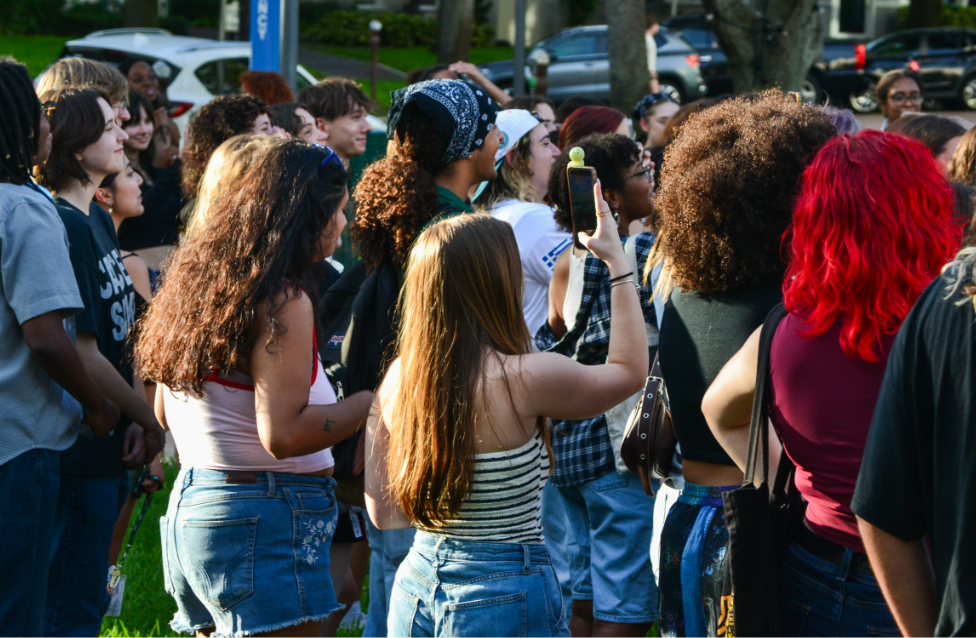
Brainrot was first used in Henry David Thoreau’s 1854 book “Walden” to describe how one’s ability to think declines while focusing on trivial matters. Photo by Makenna Wozniak | The Crow’s Nest
By Julia Birdsall
If there was one cultural phenomenon that defined 2025, it would be two numbers.
Six and seven.
This is part of a new wave of social media trends known as brainrot.
An anonymous junior described brainrot as “content on social media that’s designed to immediately and quickly capture people’s attention for as long as possible.”
For the most part, it manifests itself as videos on TikTok or Instagram that are full of internet jargon that could only be understood by someone with a high screentime.
Junior English majors Sarah Oliver and Zoey Earles theorize that the growing popularity of brainrot content is in part because of decreasing attention spans and in part because of its ability to distract people.
“It kind of reminds me of Dadaism,” Oliver told The Crow’s Nest. “It’s just nonsense that’s supposed to make you feel better somehow.”
Dadaism is an art movement multimodal art movement that focused on “chance, spontaneity, and irreverence” and began “in response to the disasters of World War I,” according to the Museum of Modern Art (MoMA).
In this sense, brainrot might be better labeled as an indicator of poor social conditions that people feel the need to distract themselves from with content that the anonymous junior described as lacking “substance.”
All three interviewees predict that brain rot will continue to grow into popularity and evolve, like Dadaism, into something new. Similar, but with a different name and cultural context.
However, they fear it might have an impact on younger generations’ ability to think critically.
“If it’s impacting the critical thinking of people at our age, I can only imagine that it’s worse for younger people,” the anonymous junior stated.
Earles agreed.
“I mean the term itself — ‘Brain Rot’ — [is] like your brain is rotting because you’re not consuming anything intelligent or anything that teaches you anything,” they said. “So, I don’t think it’s the worst thing, but I think it’s not helping anyone.”
Avoiding brainrot content is extremely difficult with how pervasive it is, Oliver and Earles told The Crow’s Nest.
However, there are many ways that people can separate themselves from brainrot content and social media.
A physical media renaissance is beginning to gain traction with college students, which could indicate that people are trying to be more present.