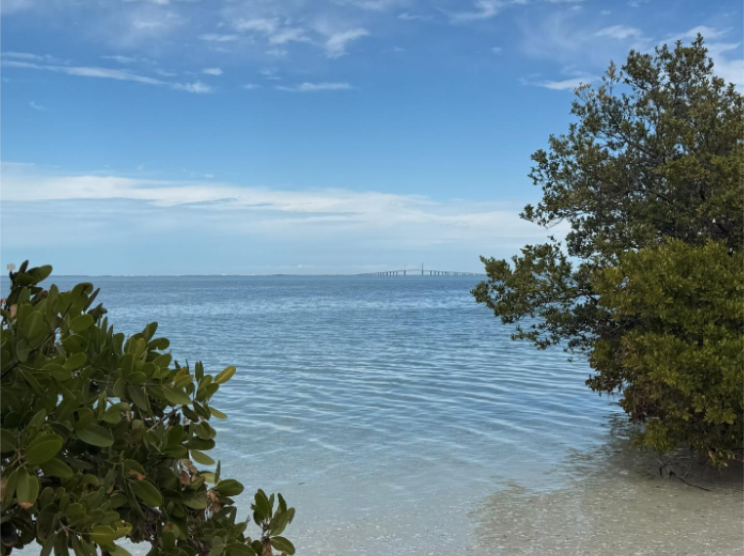
Shoreline of Emerson Point Preserve near Terra Ceia Bay. Pictured in the background is the Sunshine Skyway Bridge, roughly 1.5 miles from the proposed cruise port site.
Photo by Delilah Scheiber | The Crow’s Nest
By Delilah Scheiber
Lining the perimeters of Tampa Bay in luscious green rows, a colony of mangroves stands firm as a symbol of shelter to the estuary’s rich marine ecosystem and of strength as a natural storm surge protector for neighboring Terra Ceia residents.
But a recent proposal among Tampa’s business partners may threaten that.
Announced this year, SSA Marine, a leading marine terminal and stevedoring company, introduced its partnership with Slip Knott LLC, a holding company based in Tampa. They plan to construct a cruise terminal on the 328-acre property adjacent to the Sunshine Skyway Bridge known as the Knott Cowen Tract.
The proposal aims to accommodate newer and larger cruise ship vessels that previously could not pass through Tampa Bay’s Sunshine Skyway Bridge.
According to SSA Marine, the cruise port terminal would create over 31,000 jobs in both the port’s construction and permanent operation in the West Central Florida region.
Following the proposal, SSA Marine purchased Rattlesnake Key, a 720-acre island previously protected under the Florida Forever Priority List, the state’s annually updated list of natural land conservation projects, ranging in vulnerability.
SSA Marine ensures full environmental stewardship to uphold the natural landscape of the island for local habitats and Manatee County residents.
Future use of the land remains inconclusive.
Across Tampa Bay, this proposal has garnered significant dissent from organizations and individuals that advocate for the health and conservation of the Gulf Coast’s watersheds.
Maya Burke, assistant director of the Tampa Bay Estuary Program, emphasized the ecological significance of the volatile estuary that the proposed cruise port would feed into.
“Terra Ceia Aquatic Preserve is one of the least developed portions of Tampa Bay. It is teaming with life, including hundreds of fish and invertebrates, and a mosaic of natural habitats,” Burke told The Crow’s Nest.
Oliver Laczko, vice chair for the Student Green Energy Fund at the University of South Florida St. Petersburg, is also concerned about the implications of a possible cruise port in Tampa Bay.
“The environmental impact to this would be incredibly detrimental, not only to the health of the bay in that region, but it would also set a precedent for unchecked development and growth as well,” Laczko said.
In conjunction with rising environmental concerns, Justin Tramble, executive director of the Tampa Bay Waterkeeper, emphasizes the economic importance of conserving the Terra Ceia Aquatic Preserve.
“One in ten jobs in our region is supported by a healthy Tampa Bay estuary,” Tramble told The Crow’s Nest.
Abbey Tyrna, executive director with the Suncoast Waterkeepers, further cements the connection between the ecological and economic concerns at hand.
“It’s hard to talk about the economics without talking about the environment too, because the economics are certainly tied to the state of our environment,” Tyrna said. “It would be taking away the livelihoods of many to economically benefit a few.”
According to the 2023 Economic Valuation of Tampa Bay, a study conducted by the Tampa Bay Regional Council, Tampa Bay habitats support a large portion of the region’s economic prosperity, contributing $32.1 billion per year to the local economy through its role in sustaining various industries, storing carbon, reducing nutrients, and mitigating flood and storm surge impacts.
In support of the surrounding communities with a valuable stake in the untouched Tampa Bay estuaries, Tremble provided insight into the fight to stop the proposal from going through.
“Tampa Bay and the community here, overwhelmingly on both sides of the political aisle, view this as something that would be a significant encroachment on our way of life,” Tramble said. “The very few remaining places that we hold on to that are unique to Florida, we need to protect.”