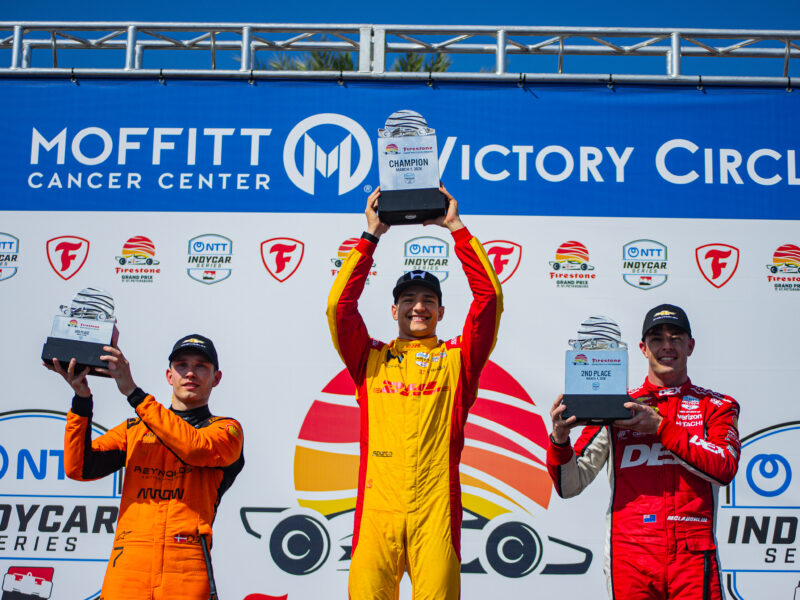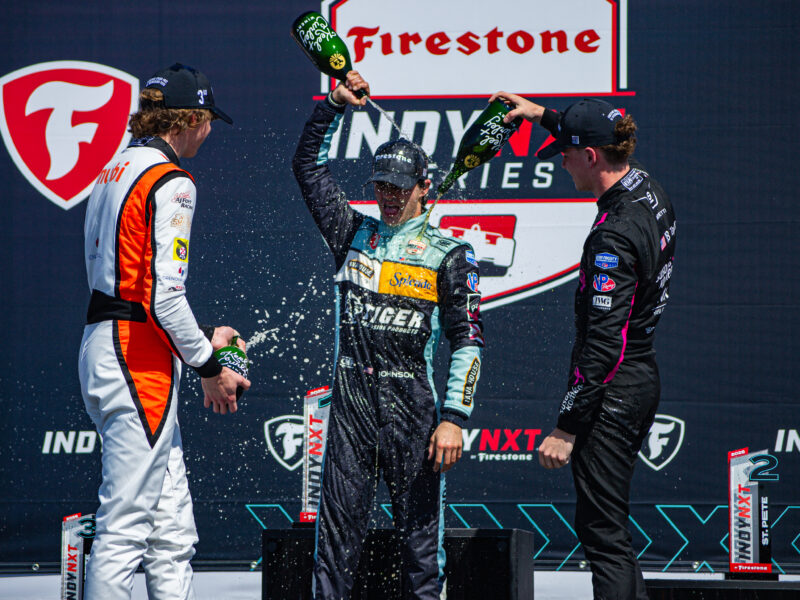
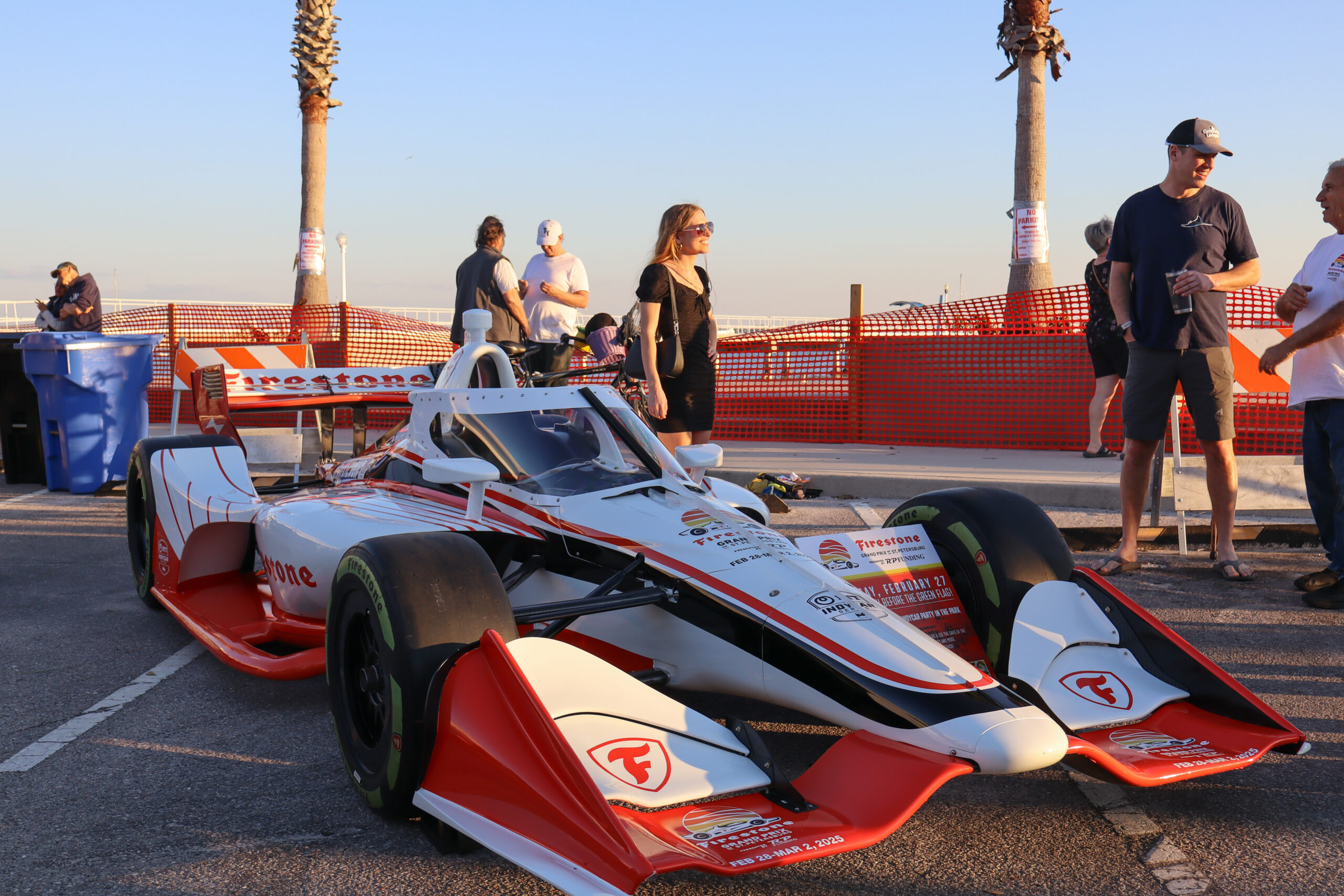
Seasoned drivers and rookies have made their mark at the Firestone Grand Prix of St. Petersburg, including local drivers like Nikita Johnson and Florida natives like Kyle Kirkwood, Alessandro de Tullio and Max Garcia.
Photo by Mahika Kukday | The Crow’s Nest
By Julia Birdsall
2026 will mark the Firestone Grand Prix of St. Petersburg’s 22nd year in St. Petersburg. However, IndyCar and racing culture have existed in the city for much longer than that.
Drivers and fans began flocking to St. Petersburg in 1985, when the first St. Petersburg inaugural Grand Prix was hosted on the Bayfront streets.
Competing in the races were drivers from the Trans Am Series — “the longest-running professional road racing series in North America,” according to the series’ website
— and the Can-Am Series — an iconic racing series that ran from 1966 – 1974.
Trans Am includes cars like Mustangs and Corvettes, which are known for being sleek and speedy.
Can-Am was known for featuring well-known brands like McLaren and Ferrari.
Willy T. Ribbs — the first African American man to test a Formula 1 car and compete in the Indianapolis 500 — was the winner of the St. Petersburg’s first Trans Am Series race.
“I was at that race,” commented Larry T. Vaughn on Facebook. “Seeing a Black guy whipping everyone’s butt was cool.”
Lou Sell — another notable driver — won the Can-AM Series race.
The Trans Am and Can-AM series’ Grand Prix continued to be held in St. Petersburg for five years before being discontinued because of financial issues and noise complaints from local business owners.
In 1996, the series race was brought back to St. Petersburg.
It drew 76,000 fans to the city to watch drivers race on a course that circled Tropicana Field — known as the Thunderdome at the time.
Despite its popularity, the event was canceled shortly before the 1998 race following the loss of Grand Prix title sponsor, Kash n’ Kerry.
“I don’t consider it a setback, more a bump in the road,” Tom Begley, the businessman who brought the Grand Prix back to St. Petersburg in 1996, told the Tampa Bay Times.
It turned out to be more of a hill than a bump, but St. Petersburg eventually managed to begin hosting the Grand Prix again in 2003.
Championship Auto Racing Teams (CART), an open-wheel racing sanctioning body that operated from 1979 – 2003, was the company that backed this venture and once again enabled drivers to compete on a Bayside track.
Shortly after this, however, CART went bankrupt.
Many of the company’s assets were transferred to Champ Car World Series (CCWS), who were attempting to continue hosting the Grand Prix in St. Petersburg.
CCWS was unable to fulfill this goal and St. Petersburg officials made the decision to work with CART and CCWS rival, Indy Racing League (IRS) — which eventually became IndyCar — in 2005.
The NTT IndyCar series is one of the most prominent open-wheel racing classes in the United States.
Since 2005, St. Petersburg has been the location for NTT IndyCar’s season opening race, the Firestone Grand Prix of St. Petersburg.
For over 20 years now, drivers have made the first moves of the racing season alongside the waterfront district.
2026 will continue this trend, with practice races having begun on Feb. 27, qualifying races taking place on Feb. 28, and the official races kicking off on Mar. 1.
“The modern race carries forward the same excitement and waterfront spectacle that began in 1985,” wrote the St. Petersburg Museum of History on Facebook. “Linking St. Petersburg’s racing legacy to a global audience and reminding fans that speed, sound, and sunshine remain part of the city’s enduring story.