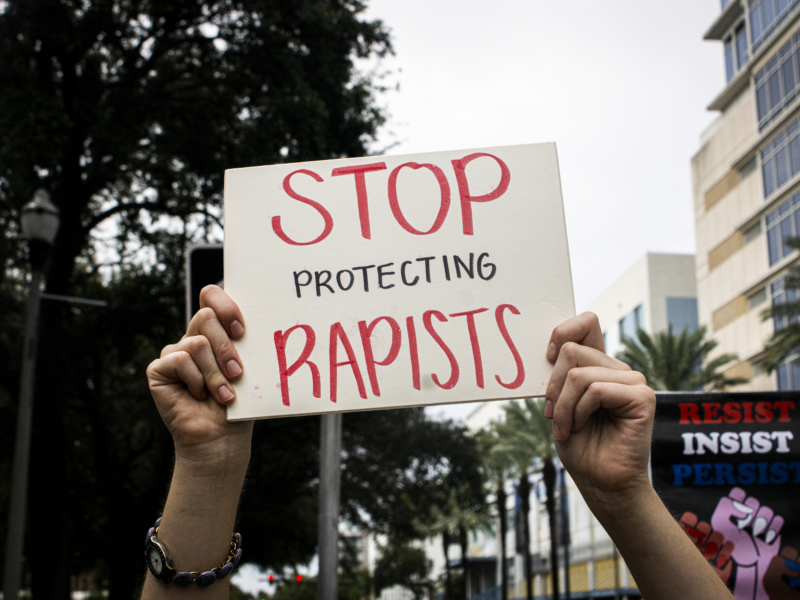

Photo by Mahika Kukday | The Crow’s Nest
By Mahika Kukday
The University of South Florida’s police department is set to sign on to the 287(g) program – a federal endeavor that involves local and state authorities receiving training from U.S. Immigration and Customs Enforcement (ICE) on matters like questioning and detaining undocumented immigrants.
When vetoing what Gov. Ron DeSantis saw as a bill that wasn’t “aggressive” enough to make Florida “the nation’s leader in immigration policy” earlier this year, he made it clear that the state would be taking an active role in enforcing the federal immigration crackdown. Now, that involves university police departments.
As of April 22, USF’s agreement is pending since it hasn’t yet been signed by ICE. However, major political groups at the university are divided on the implications of campus police being trained in immigration enforcement.
Campus culture and safety
“If international students are fearful that they’re going to get deported or what not, I don’t think it’s a justified fear,” said Michael Fusella, president of the USF College Republicans and junior finance major, adding that he doesn’t think the campus environment will change much.
He believes that if students have “done everything the right way” — meaning entering the country lawfully by following the visa process — then they will “be perfectly fine.”
The Associated Press reported on April 17 that about 1,024 higher education students across the country had their visas or legal immigration status revoked since late March.
Some high-profile cases include that of Rumesya Ozturk and Mahmoud Khalil. Ozturk is an international doctoral student whose op-ed in her university’s student newspaper criticizing the conflict in Gaza was deemed anti-Israel rhetoric. She is now facing deportation for the same reason. Khalil a green card holder who led Columbia University’s large-scale protests in support of Palestine last year has been detained since March 8. He was denied temporary release to be present for the birth of his son today, according to the Associated Press.
The Department of State’s Foreign Affairs Manual clarifies that a criminal charge is not required to revoke a visa. A provision called “prudential revocation” holds that the department “may revoke a visa if an ineligibility or lack of entitlement is suspected, when an individual would not meet requirements for admission, or in other situations where warranted.”
In contrast to Fusella, Alexa Matos, a political science senior and the outgoing president of the USF St. Petersburg College Democrats, thinks that campus culture has already changed under President Trump’s administration and that it will continue to do so once the ICE agreement is signed.
“I had a fellow student threaten to call ICE on me because they thought I was an illegal immigrant and they requested to see my papers,” Matos said. “So now, with USF signing on to the 287(g) program, it validates those who are perpetuating hate on campus.”
She believes the USF community will start to feel more unsafe, especially since high-profile encounters between student protesters and campus police last year has already decreased public trust in university law enforcement.
The extent of UPD’s ICE-designated powers
UPD declined The Crow’s Nest’s request for comment. An emailed statement from records supervisor Colleen Gargon said that ICE hasn’t provided a timeline on when they will sign the agreement.
The partially signed Memorandum of Agreement outlines some of powers that would be granted to participating officers, including the authority to “arrest without warrant…” any alien that the officer “has reason to believe” is in the country in violation of law and might escape before a warrant is obtained.
The U.S. Citizenship and Immigration Services defines “alien” as anyone who is not a U.S. citizen or national, synonymous with “foreign national.”
The signed contract would also empower participating UPD officers to “interrogate any alien or person believed to be an alien as to his right or remain in the United States.”
USFPD-287g-AgreementUSF signed the 287(g) Memorandum of Agreement on March 24, which won’t be in effect until ICE signs.
Courtesy of Colleen Gagnon
Fusella said he firmly believes in due process and respecting procedure. He hopes that the participating officers won’t arrest or detain students at random and he doesn’t think the chances of that happening are high.
“The good thing is if someone’s already committing illegal activity and then they get arrested and then you find out that they’re an illegal immigrant, that makes total sense,” Fusella said.
While the U.S. Constitution doesn’t explicitly mention immigration, the Supreme Court has long interpreted congress as having “plenary power” over foreign nationals in the country.
Matos believes the 287(g) program is an unnecessary extension of federal authority.
According to her, designating ICE powers to UPD is a form of “continuous overreach from the federal government into local communities and now colleges.”
Fusella agrees that it’s an unprecedented situation, but state and local governments are getting more involved because “the federal government can’t do everything.”
USF’s responsibility to protect all of its students
Both Fusella and Matos believe that universities are responsible for protecting all student and staff populations equally.
“Colleges aren’t just to get that piece of paper at the end, you want to explore yourself and your perspectives and you want to have a safe environment,” Fusella said. He mentioned that “a lot” of his club members are uncomfortable speaking up about certain topics publicly, but the USF College Republicans provides a safe space for them to share.
Matos echoes the sentiment of university being a place of self-expression and growth, but thinks the ICE agreement is “destroying” USF’s sense of campus security.
“Some of our most vocal members have been international students who are now leaving the club, and they don’t even feel safe following us on social media,” she said. “They’re scared that when they return from their country their phones will be checked and they’ll have their visas revoked.”
USF Provost Prasant Mohapatra sent all currently enrolled international students an email on April 22 intended to reassure them of their value in the university community.
He said that the USF World team “proactively monitors” the Student Exchange and Visitor Program database through which all international and exchange students are enrolled to check for changes in status.
Mohapatra confirmed that the ICE agreement would not go into effect immediately, as UPD officers would have to be trained in the program.
Immigration: political or human rights issue?
Fusella said he can “see immigration being somewhat of a human rights issue,” but he believes that it’s mainly a political matter.
He said that he’s grateful to President Donald Trump for addressing what he sees as an urgent and extensive goal.
“I think the administration is focusing on the criminal elements… the illegals who come here and abuse the system and create absolute chaos and just commit crimes,” Fusella said. “It was and still is hurting everyday Americans.”
Fusella added that he firmly supports legal immigration, and those foreign nationals who came to the U.S. lawfully “shouldn’t be too happy” about those who “skip the line.” According to him, whether the visa process needs reform or not is an unrelated topic.
Matos, however, thinks it’s “very clear that this is now a human rights issue.”
“I think it’s ultimately being polarized by politicians as a fear tactic that these immigrants are coming in and taking your jobs and they’re villainizing these people who are trying to give their families a better life,” she said.
For her, the fact that religious leaders like the late Pope Francis have come out against Trump’s administration is evidence that human rights are more important now than ever.
“This country promotes itself as a place where anyone can come here and make a name for themselves and be successful, then you’re surprised when people show up and want to come here,” she added.
An emailed statement from UPD reads, in part, that campus police “do not have any additional information about the process,” since ICE has not yet signed the agreement.