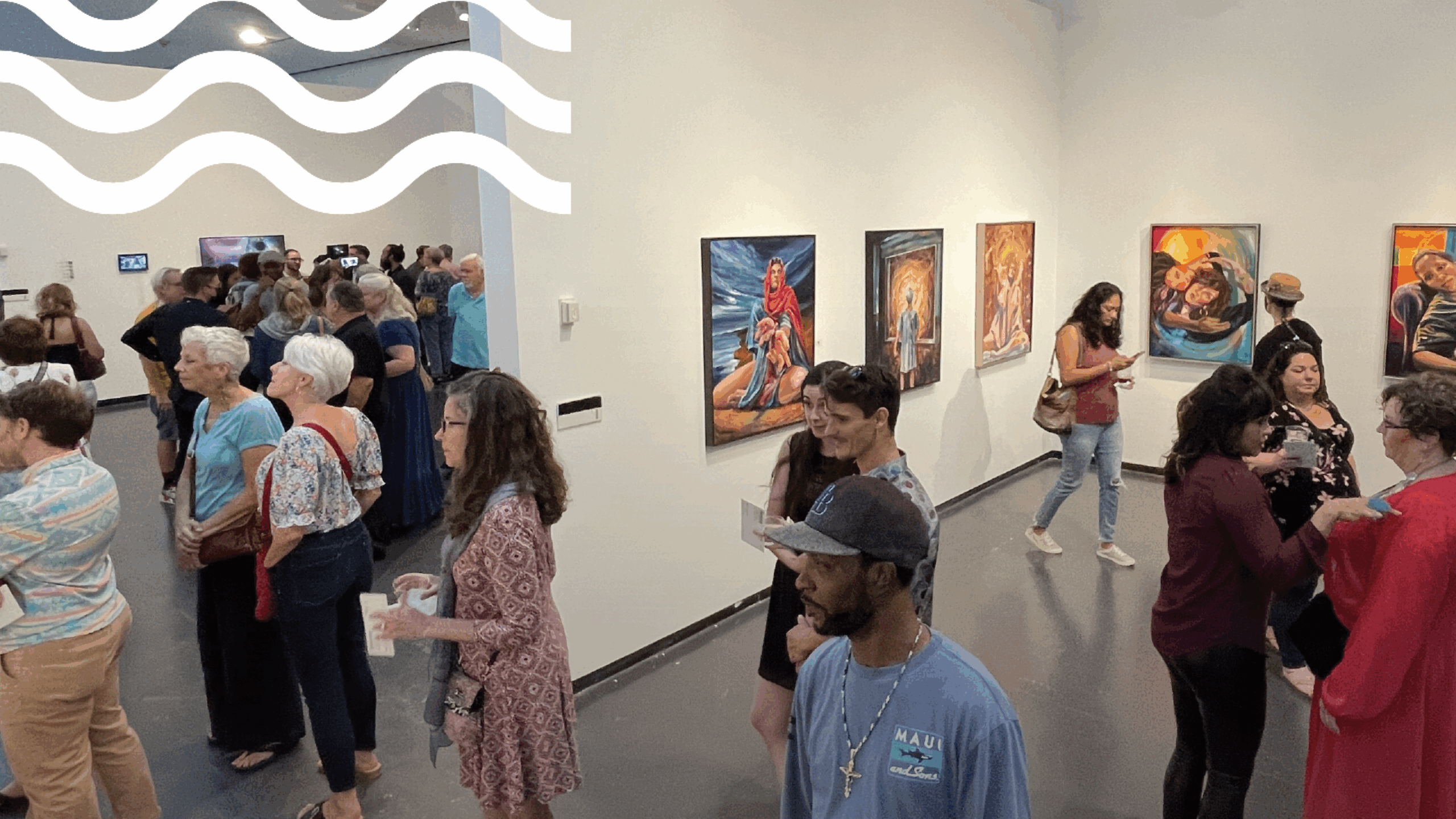
Guests attending the 2023 Emerging Artist Exhibition at Creative Pinellas. Photo Courtesy of Creative Pinellas.
Photo courtesy of Creative Pinellas
By Jasmin Parrado and Julia Ferrara
On Sept. 4, the Pinellas County Board of Commissioners cast a 5-2 preliminary vote to cut funding for Creative Pinellas, the county-designated nonprofit arts agency in Ridgecrest by almost $1 million.
The decision has troubled residents and proponents of Tampa Bay’s art scene.
The board addressed the backlash it received from supporters of Creative Pinellas, affirming its majority decision to reallocate the funds despite negative responses.
“I just feel that [Creative Pinellas] really missed their mission,” said Commission Chair Brian Scott during the meeting. “They haven’t really delivered on that. We need to make sure we fund impact and results and not feelings.”
Scott recalled a prior meeting in which he proposed the reallocation of $861,000 toward the Tourism Development Council (TDC) in place of Creative Pinellas, based off concerns that the latter party was engaging in “noncompliant use of TDC funds” by using the bulk of its budget for its payroll.
Additionally, Scott proposed a $500,000 portion of the TDC redistribution for a Visit St. Pete-Clearwater grant program directed toward arts and culture tourism in an attempt to mitigate the cuts to Creative Pinellas. The plan hasn’t been further discussed yet.
Vice-chair Dave Eggers and Commissioner Rene Flowers voted against the budget change.
Eggers commented that the decision was unfairly abrupt and that the conversation felt “out of place,” considering there would later be a public hearing discussing and workshopping the organization’s funding.
Meanwhile, Flowers stated that while she understood the concerns with organizational budgets and how Creative Pinellas should operate under an equal standard, the board should consider its direction with funding the art scene and the larger impact that could have.
Despite the public outcry preceding the meeting, the decision was deemed necessary in order to secure better financial prospects and competition within the tourism sector of the community, Scott explained.
“I think sometimes you just have to shake things up and see where the chips fall as they may and foster some innovation and competition,” Scott said.
Erica Sutherlin, artistic executive director for The Studio@620, finds the ambiguity of the commissioners’ tourism initiative to be a major problem. She believes that it’s important to understand Creative Pinellas’s funding loyalties and purpose.
“Creative Pinellas is not an organization that funds other organizations,” Sutherlin said. “Their mission is to fund and support our arts community, which is beautiful.”
For Sutherlin, the issue highlights a broader national problem, given the federal government’s fluctuating treatment of arts establishments.
“How do we move forward as a collective national community in representing, creating and celebrating arts?” Sutherlin said. “Why do we revert back to this beginning of having to prove why art is important, and why do we continue to have that cycle?”
The organization’s fund cut points to a larger trend of defunding the arts. National concern rose substantially after President Donald Trump’s administration began canceling grants for the National Endowment for the Arts (NEA) in May.
Sutherlin feels that the county’s financial evaluation of tourism does not take into account the experience and culture that visitors appreciate with local art.
“Unfortunately, we live in a measurable society,” Sutherlin said. “We go back to the numbers. That is the way, right? So, we have to figure out collectively how to measure that experience. And that’s not easy.”
Leslie Elsasser, director of the Wild Space Gallery, also believes artists need to find a way to capture the value of the arts in a quantifiable manner – and that there are leaders capable of stepping up to that mission.
“It all depends on who is in charge,” Elsasser said. “It is possible to get creative and find money, but it depends on who is running capital campaigns.”
“I’m always hopeful,” Elsasser told The Crow’s Nest. “The [arts] community has grown so much and become even more robust in the time I’ve spent here.”
For 30 years, Elsasser has been a part of Florida’s arts community. She first arrived to the state as a professor at Ringling College of Art and Design before her tenure as a former professor and curator of education at the University of South Florida’s Contemporary Art Museum.
Elsasser has been witness to the arts community’s substantial growth, and she finds the support network from local residents and visitors to be key to the survival of organizations like Creative Pinellas.
“In the age of crowdsourcing, I think there is a lot of hope there,” Elsasser said. “We saw how deeply people care at the meeting the other night, so that shows you where some of the funding may be able to come from.”
Sutherlin also believes that this financial support is key to the survival of organizations like Creative Pinellas – and that it must endure in the long term to be effective.
What makes it difficult for this support to endure is the daunting question of what supporters can do to truly uphold the arts community, she told The Crow’s Nest.
“What happens is, it’s so overwhelming and so consuming that we don’t act,” Sutherlin said.
If it isn’t the lack of action, it is the eventual drop-off of an initial support system that leaves art establishments and movements just as vulnerable, she explained.
“It’s one thing to get that galvanized energy at the beginning, but how do we sustain?” Sutherlin said. “It’s not about the initial blow. It’s like, ‘Yes, that’s the energy we need, but I need that energy six months, seven months from now.’”