
The committee clarified that students and faculty currently involved in the targeted programs will be able to finish teach-out arrangements and will be “absorbed” into new curriculum models.
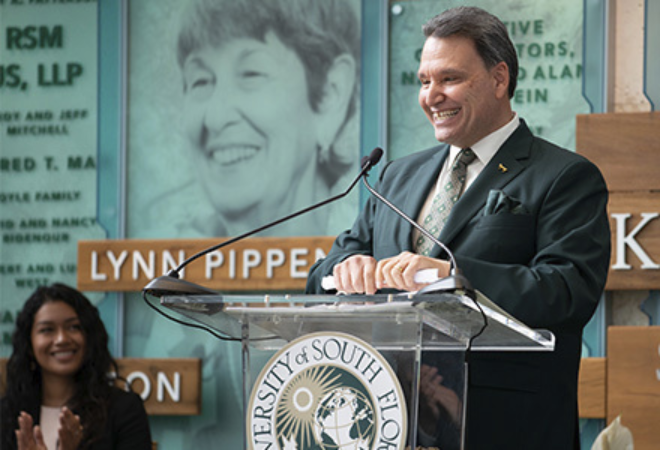
Photo by Aubrey Carr | The Crow’s Nest
By Jasmin Parrado
The University of South Florida Board of Trustees’ Academic and Campus Environment committee voted to remove four degree programs from its curriculum within the next two years, and two proposed program additions are underway.
The decision was made unanimously during the committee’s Feb. 17 meeting, but the full board must present a final vote on March 10.
If approved, the university’s bachelor’s program in aging sciences and master’s program in STEM education will end this fall, while the master’s programs in mathematics education and social science education will end in fall 2027.
Additionally, the PhD program in social work will be suspended in fall 2026 for internal program improvements and will start enrolling students again as late as fall 2029.
During the meeting, the committee claimed that data from the university’s annual degree productivity report revealed 37 programs did not meet the Board of Governors’ productivity threshold. A separate analysis from USF flagged 36 programs in need of review.
The final review reportedly identified 15 programs to consider for termination, composed of five bachelor’s degrees, eight master’s degrees, one PhD program and one specialist program.
Bill Black, associate dean of graduate studies at USF’s College of Education, said the extensive program terminations are part of an administrative restructuring within the college. The approval was meant to make way for a “single, unified Secondary Education M.A.T. major.”
“In order to implement the new major, we needed to terminate the old majors,” Black told The Crow’s Nest. “This change does not close or eliminate secondary teacher preparation at USF. Instead, it streamlines multiple standalone majors into one coordinated program designed to simplify advising, scheduling and certification pathways.”
Black-listed numerous benefits for both students and faculty in light of the restructuring, including flexible scheduling and a more convenient admission and advising structure with “one coordinated entry point.”
The committee clarified during the meeting that “no departmental or faculty eliminations are expected in these cases” and that students currently enrolled in the affected programs will be able to finish their current semester set-ups and transition seamlessly into the remainder of their education in the new model. Faculty and their courses would also be “absorbed” into the new programs.
In the same meeting, the committee discussed the College of Design, Art and Performance’s proposal for a bachelor’s degree in architecture, which would be implemented fall 2026 and would include various courses in architectural history, urban design and construction.
“Urban architecture and related topics are emphasized to take advantage of the diverse and growing metropolitan setting in Florida’s Tampa Bay area,” the executive summary for the proposal read.
Ron Dulaney, director at the USF School of Architecture and Community Design, said the prospect of an undergraduate degree is exciting.
Dulaney believes the change is a major improvement from the previous “two-plus-four” model of the school’s graduate program, which was previously the only program offered for architectural interests at USF since 1986
That two-plus-four model entailed pre-architecture education for two years followed by a four-year master’s program, amounting to 168 credit hours. Switching to a traditional four-year undergraduate program with a pathway into a two-year master’s degree allows for the same amount of time — but with an opportunity to breathe, Dulaney explained.
“In some cases, students may get down the path, and they may be sort of halfway in, or more than halfway in and they’re just not sure,” Dulaney said. “And sometimes they just want to finish. Sometimes they might decide to do something else. This kind of gives them a place where they can kind of pause.”
Students in architecture would also receive the benefit of reduced tuition costs, given that they previously had to pay graduate tuition while maintaining an undergraduate status in their first academic years, Dulaney told The Crow’s Nest.
“Right now, we are pretty constrained in terms of space,” Dulaney added. “Our program is extremely competitive. We’re hopeful there’s a conversation just really beginning that perhaps, in the not-too-distant future, we can really begin to think concretely about a new building for the school.”
The BOT committee also presented the Muma College of Business’s proposal for a bachelor’s degree in fintech, or financial technology, also to be implemented this fall. The master’s fintech program was introduced in fall 2025.
The proposed four-year program consists of coursework in subjects like economics, business and managerial systems, computing and data analytics.
The proposal presentation stated that the program “responds to the industry’s strong demand for professionals skilled in financial technologies, including blockchain, AI, machine learning,
quantitative analysis and payment technologies” — all industries where Tampa Bay area is emerging, especially with recurring Fintech | X accelerator launches from USF and Tampa Bay Wave.
Dulaney looks forward to the university’s proposed changes, even as academic structures will shift and rearrange.
“I think we’ll have a couple of years of transition where we’ll have some challenges,” Dulaney said. “But I think once we get to the other side of this, it’s going to be really good for our students, and good for our school.”