
Photo Courtesy of Zariya Bankston
By Zariya Bankston
St. Petersburg, Florida is known for its walkability. The most popular and beloved street in the city is Central Avenue, which is known as the city’s hotspot for local small businesses, restaurants and shops that people can walk through with ease.
However, when Rebecca Liebson, a real estate reporter for Tampa Bay Times, put its walkability to the test by taking a nine-mile walk down the avenue from its start to its end, she found that it wasn’t as pedestrian-friendly as it’s made out to be.
On Nov. 12 at the Nelson Poynter Memorial Library at USF St. Petersburg, Liebson delivered a speech to local residents to express that the city should consider pedestrians when going about urban development.
The event was apart of PlaceMattersSP, a lecture series by Preserve the ‘Burg, a St. Petersburg non-profit organization that works to preserve the city’s historic areas. Co-hosting with Liebson was the executive director of the organization, Emanuel Leto.
Liebson was inspired to go on the more than three-hour expedition by her favorite TV show called “Broad City”. In the show, the two main characters go on a 14-mile walk through Manhattan. She wanted a down-to-earth way to explore St. Petersburg’s most beloved street without having to rely on transportation.
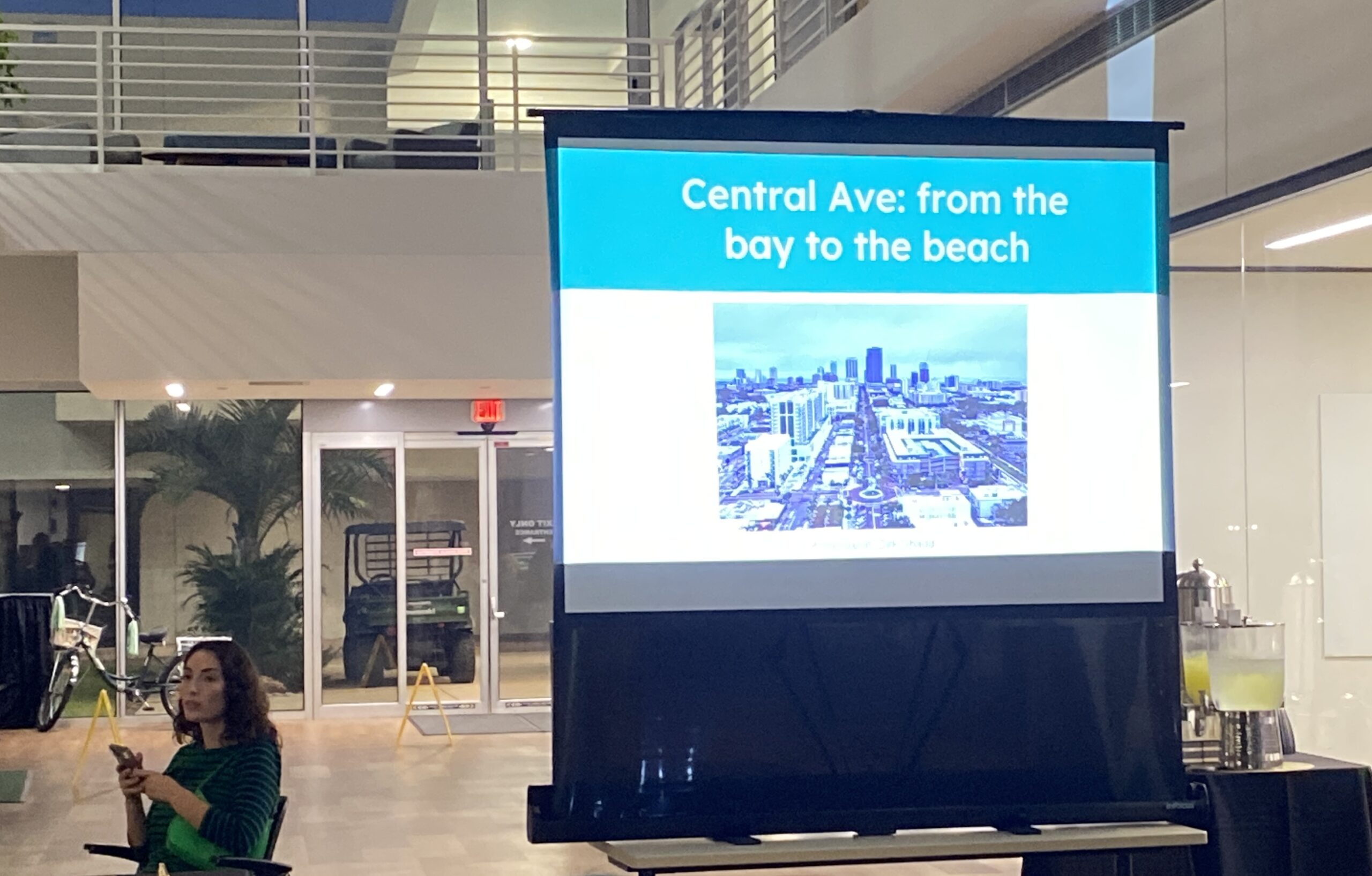
As she presented her speech, Liebson narrated her walk down Central Avenue with a slideshow containing photos she had taken during it. With a few friends, she started her trip at the Bay Shore waterfront and marched through the Grand Central district.
She recounted the endless shops, restaurants and cafes that made St. Petersburg the vibrant city it is. However, as she left the district’s urban bubble, the avenue’s safety issues for pedestrians became clear.
Liebson and her team encountered dangerous intersections, heavy traffic and vacant areas with not a soul or vibrant business in sight. To successfully reach their endpoint, Treasure Island Beach, they had to trudge through grass due to the sidewalk ending.
After her presentation, Leto and Liebson discussed how historic preservation and urban development play a role in St. Petersburg’s walkability. As she pointed out the barriers to her walking convenience, Liebson identified an urban creation called a “stroad.”
“A stroad is this term … to describe sort of a weird Frankenstein mash up between a street and a road,” Liebson said.
“A street is kind of more of what we think of as being like in the central district where there’s these wide sidewalks, slower vehicle traffic, it’s more pedestrian friendly. And then a road is kind of higher traffic, we’ve got more lanes on both sides, fewer places to cross,” she continued.
“… I think just everything about the way the stroad feels, it’s like ‘I shouldn’t be here’, like ‘I’m in danger a little bit,” she said.
Liebson said that she encountered a stroad on 31st Street, and in addition to making her walk feel more dangerous, she claimed that it made it feel tedious and unamusing.
This is because she couldn’t stop anywhere for entertainment due to there being no businesses along these stroads because of their unwalkable nature. Adding to the unamusing aspect of Liebson’s walk were the vacant areas of land she encountered.
“When you see these sort of areas that feel like they’re not being utilized to the fullest of their capabilities, I think there’s a lot that goes into planning and actually making these spaces vibrant that requires a lot of input from the community,” Liebson said.
“… All of these sort of zoning meetings that nobody wants to go to as we’ve said and I think that’s a lot of the time why these spaces are underutilized,” she said.
Central Avenue is one of the driving forces for the city’s economy, with the street’s available jobs increasing by 52%, as well as a 30% increase in newly opened businesses from 2010 to 2020, according to an April 2024 report by PlaceEconomics commissioned by Preserve the ‘Burg. It turns out that 99% percent of street level local businesses reside on the ground floor of the older buildings on the avenue.
In the same report, it made the connection that these historic buildings contribute to the avenue’s walkability that 80% of St. Petersburg residents valued most about the street. Residents value being able to walk on the avenue due to needing a way to travel to their jobs and shop in a convenient, non-costly way which can be achieved on foot.
“… The biggest thing that the city can do to kind of preserve the character is provide some sort of resources for small businesses or provide some sort of incentives for landlords to keep their commercial rents lower,” Liebson said.
“… Because that street is so popular and because there’s so much foot traffic, it’s just like, the rent there has completely exploded and it’s difficult for any sort of small business owner to keep the lights on in there,” she said.
Liebson and Leto also discussed how the growing urban development of the city has played a role in impeding St. Petersburg residents from access to affordable housing, walkable housing.
Leto described his organization’s unsuccessful efforts to preserve the city’s 1920s Ventnor apartments, now known as the “pink apartments”, which provided St. Petersburg affordable, walkable housing that connected residents to St. Petersburg’s vibrancy.
Located on 4th St. South in the downtown area, these historic apartments were painted bright pink to advertise the condo apartments that are going to replace them. Leto asked Liebson about the possibility of development becoming more prominent on West Central Avenue.
‘I think it’s only a matter of time until development sort of creeps westward; you’re already starting to see it to a smaller degree. I think there’s a lot of these townhomes that are popping up…” Liebson said.
“I hope that there’s a way to, as that development creeps further west, make that section feel a little bit more walkable and a little bit more vibrant in the more,” she said.
The PlaceEconomics report detailed the impact that these historic housing buildings have on St. Petersburg residents. In its “Affordability” section, it states,
“Particularly noteworthy are neighborhoods with a concentration of older housing and low-income households, where housing costs remain significantly lower than the city median, promoting economic inclusivity.”
Leto emphasized that the redevelopment of these older housing units takes away available housing options for the locals who need a simple, low-cost place to live.
Liebson ended the event answering questions from the crowd. One guest added to the conversation, describing their own personal experience walking along the avenue.
They explained that the avenue’s vibrancy gets interrupted due to new housing buildings being constructed so close to the sidewalks, which caused them to run into the building’s unappealing alleyways.
Another guest asked how the redevelopment of St. Petersburg’s Historic Gas Plant District will affect Central Avenue’s prosperity.
“… It will change everything,” Liebson said to the guest. “I think that will open up an entire new neighborhood of possibilities … I think it will benefit Central Avenue. I think the two will bounce off of each other, we’re gonna see even more development going further south with that as well.”
Liebson’s trip down Central Avenue revealed more than just the issues that pedestrians may face, but also the importance of having walkable streets.
“… The consequences I would say it’s more expensive for people to get around, you need a car, you need parking.” Liebson told The Crow’s Nest. “If it were easier for people to walk places we would all go out and do more also … I think there are a lot of positives to having walkability, it makes us feel more connected.” she said.