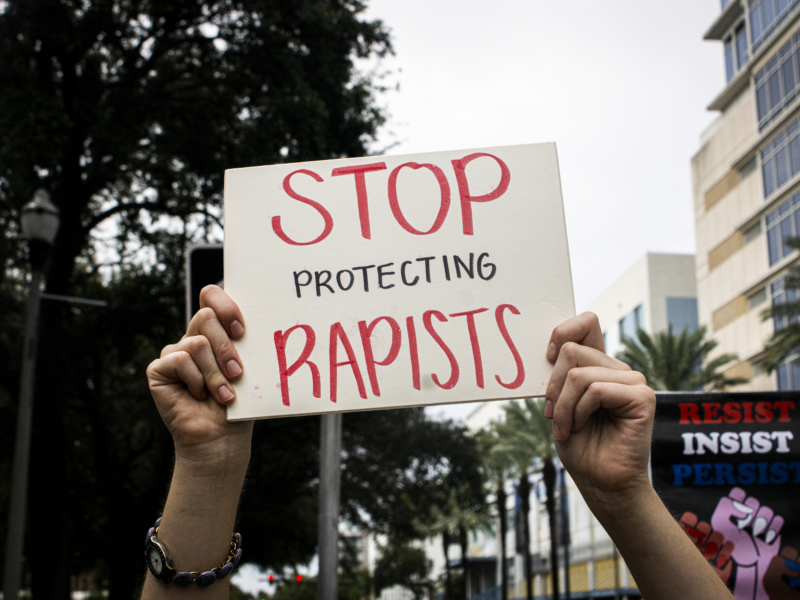
Grace Tabor (pictured left), president of USFSP’s Turning Point USA chapter, wasn’t just the co-host of the event — she also stood at the podium and joined the conversation as a debater.
Photo by Dominic Feo | The Crow’s Nest
By Jasmin Parrado
Rosaries clutched in raised hands, slogans strung on baseball caps and T-shirts, a choir of heckling and tongues ready to cite scripture and Constitutional amendments across two podiums.
Political discourse materialized at the Left vs. Right: Ultimate Student Debate, held on Nov. 3 at the University of South Florida St. Petersburg’s University Student Center Ballrooms.
The event was a joint effort between the campus’s College Democrats and chapter of Turning Point USA (TPUSA) to facilitate candid discussions in review of today’s political climate.
“I realized that one way we could get students involved in politics on campus is by hosting debates like this in an open forum, that way students can be able to speak their minds,” College Democrats president Tyler Williams told The Crow’s Nest.
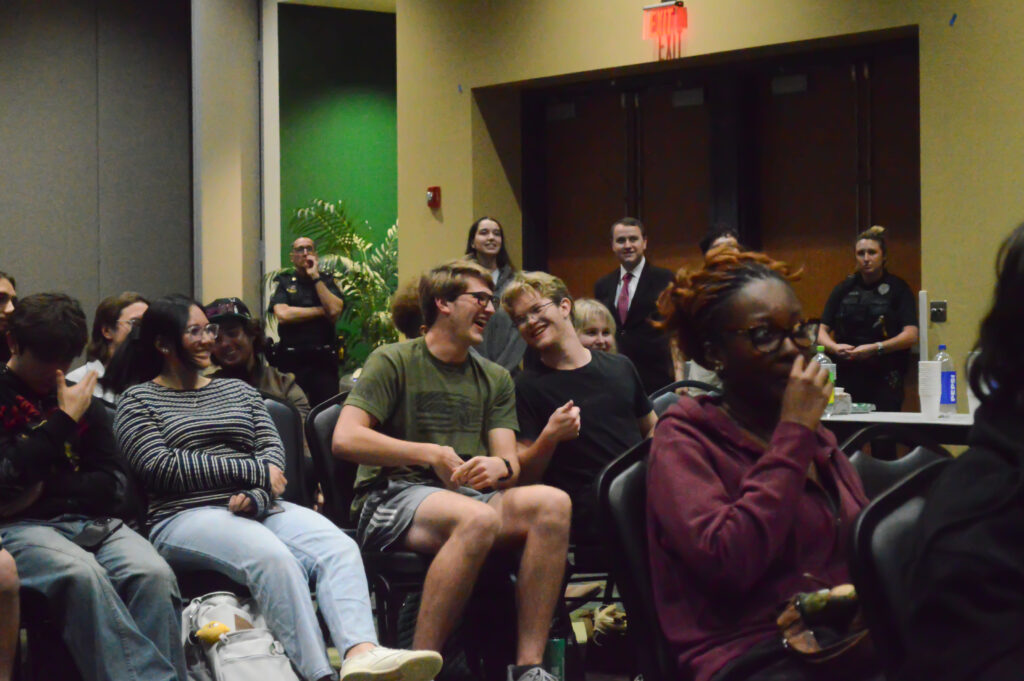
The event received an unanticipated turnout of 140 attendees, exceeding its initial 100-seat cap for the night. The complementary pizza and soda provisions ran dry and the organizations had to hastily increase the event’s seating capacity by expanding the ballroom unit.
Williams believes the overwhelming reception was a sign of students’ desires to address politics on behalf of both parties — and the debate gave them the space to do it.
“I think today we saw that,” Williams said after the event. “Proof beyond imagination for me. It just made me so happy to see this many interested people from left and right.”
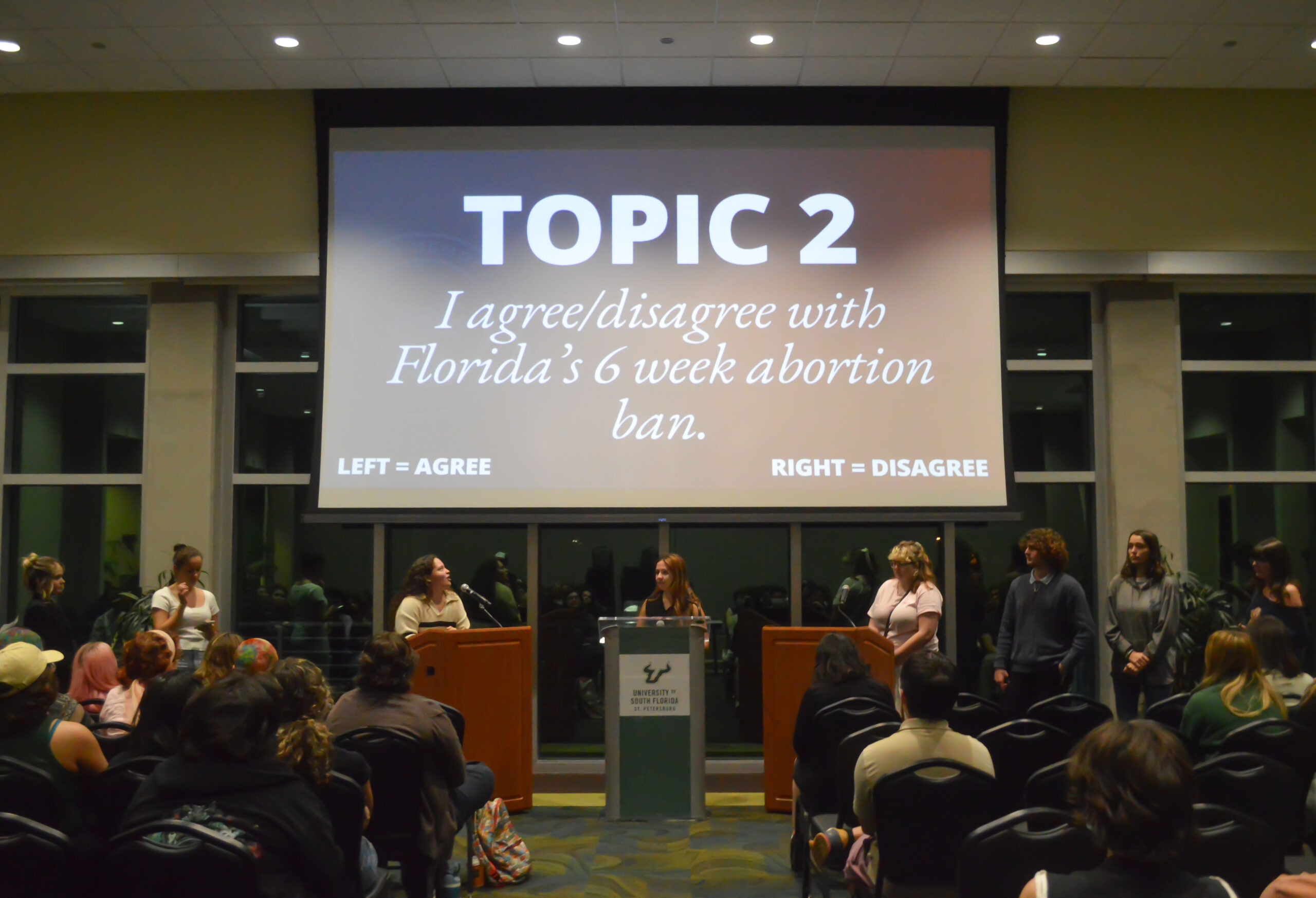
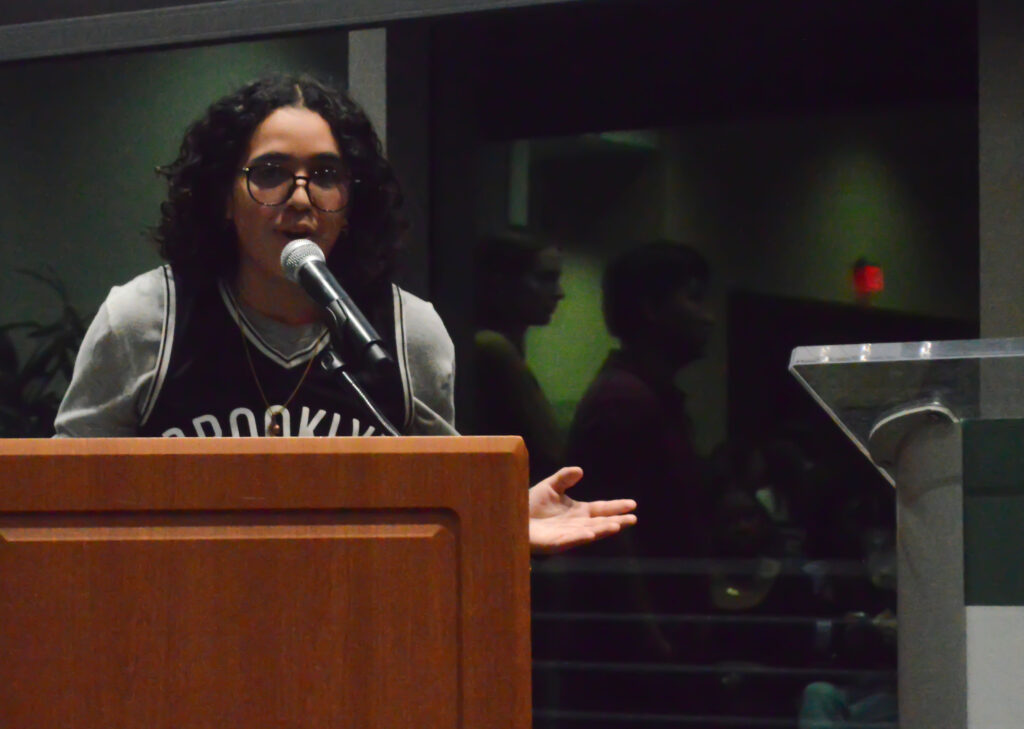
The stage was divided into two sides: agree or disagree. With a podium representing each opinion, participants responded to prepared prompts by approaching either podium. Each student was allowed 45 seconds to speak and 15 seconds to rebut.
A total of eight selected topics were introduced. In order, these topics included the state of the economy, abortion, mass deportations, gun reform, the United States’ involvement in the Israel-Palestine conflict, climate change, national guard deployment, vaccine mandates and diversity, equity and inclusion (DEI).
Each topic was allowed 10 minutes total for discussion.
Nicole Lobato, a junior double-majoring in economics and political science, moderated the event. As president of USF St. Petersburg’s Ethics and Debate club, she felt it made sense that she was asked to take on the task.
“It was very interesting,” Lobato told The Crow’s Nest. “I feel like there was some discourse that was more logically prepared. Some was purely based on logic, and others had a lot of passion involved — and some had both.”
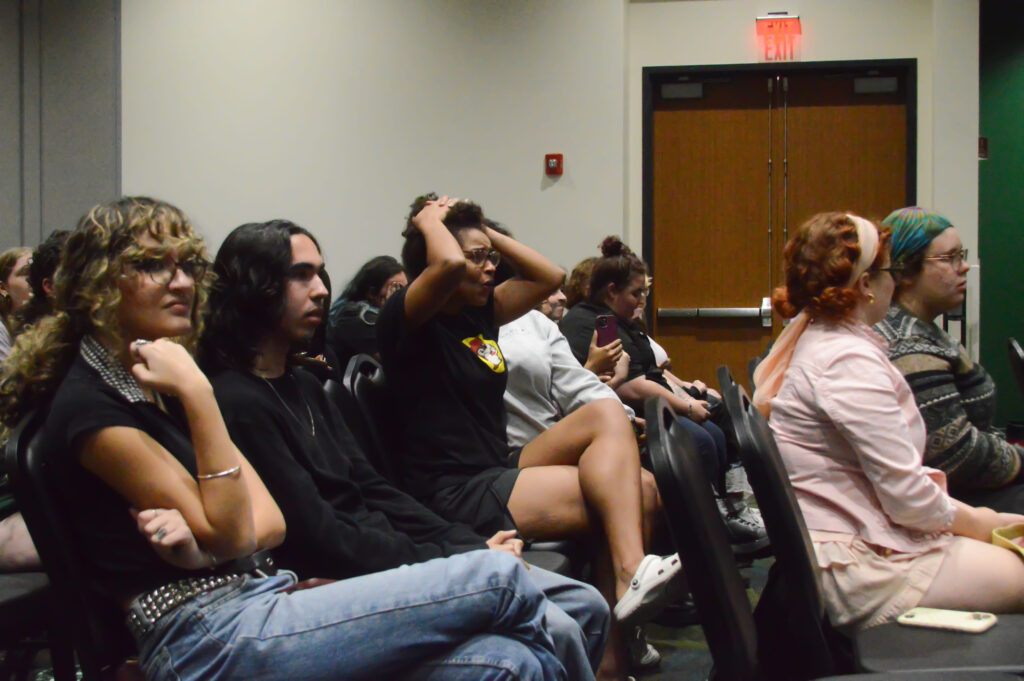
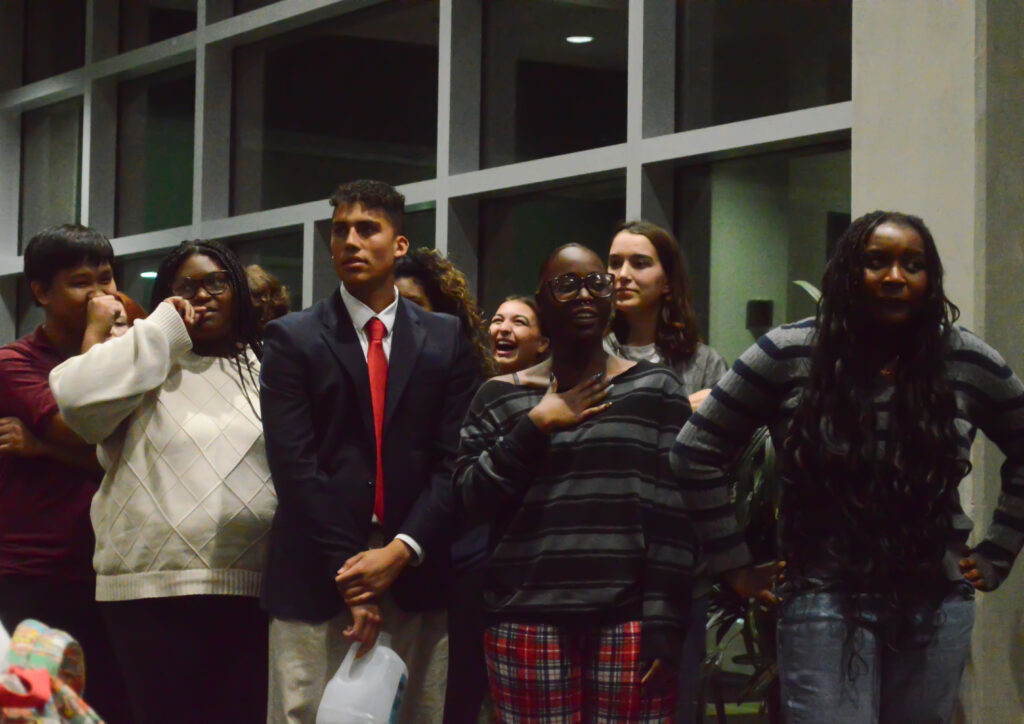
The substantial differences in the line queues represented the campus’s political standing, which is perceived to skew left with more students aligning with traditionally left-leaning beliefs.
One debater, Nickolas Peter Correia Soussa Perisse, a freshman in health sciences and TPUSA’s events coordinator, was a prevalent speaker on all topics during the event. He expressed that he was disappointed by the heckling that he received for most of his statements during the debate, but he wasn’t surprised — and he was pleased to be a part of it.
“I knew that was going to happen,” Perisse said. “I knew I was going behind enemy lines. This is a very liberal campus. But again, I don’t care what your political affiliation is. I love to have civil dialogues with everybody, with every single person. And honestly, this is why I’m staying here right now.”
Though some students pointed out that they felt the event did not give sufficient time for debaters to fully present their arguments, all expressed that they were pleased with the event.
Liv Doura, an environmental science and policy major who also spoke frequently during the debate, said she enjoyed the chance to speak on issues she feels are important. If the event were happening every week, she’d be there, she said.
“I genuinely love having spaces for this and allowing students to speak their mind and share their ideas with one another,” Doura told The Crow’s Nest. “I feel like that is the only way that we can build community and actually get to know one another and stay connected.”
Doura also noted, alongside other debaters, that she was able to reflect on certain policies, such as the U.S. embargo on Cuba, during conversations with opponents after the event.
As the event’s co-host, Williams enjoyed getting to watch debaters engage in conversation and what pleased him was how certain students ventured between sides on various policies, showing a capacity to interpret topics without solely relying on partisanship.
Williams also observed that students found more nuance and middle ground in their stances on certain issues such as the Israel-Palestine conflict, which was interesting to note, he said.
Grace Tabor, the vice president of USF St. Petersburg’s TPUSA chapter, told The Crow’s Nest that she enjoyed the opportunity to help coordinate the event and partake in it. She expressed that it was also beneficial to give space to those who felt ostracized based on their beliefs.
“The more that each political side doesn’t talk, the more polarizing things get, and I think we all need to learn how to talk to each other and be able to do that with respect and grace,” Tabor told The Crow’s Nest.
Clemence Sawadogo, a junior majoring in health sciences, shared a similar sentiment.
“I feel like enforcing the importance of ethical behavior and respect to one another is very important,” Sawadogo said. “And it’s very interesting to talk about those issues. They can be talked about in a way that’s entertaining, and it’s not harming other people.”
Sawadogo feels that partisanship has exploited and divided groups on matters that actively affect their communities and politicians must understand the responsibilities they are held to. So, this event was a great opportunity to bring those responsibilities to light, she believes.
“I think that for people in office, there needs to be a reset, to remember why you’re in this game in the first place,” Sawadogo said. “It’s not to say you have the most powerful voice in the world. It’s to give a voice to the voiceless.”
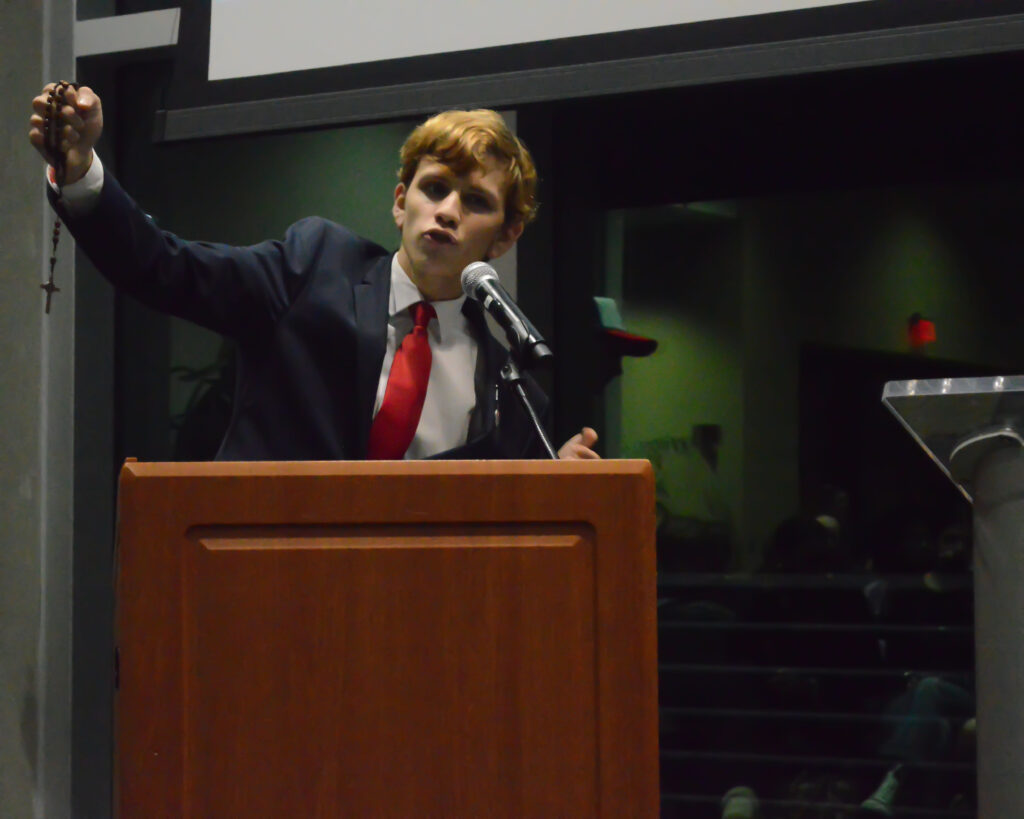
Photo by Dominic Feo | The Crow’s Nest
Here is what USF St. Petersburg students thought about the nation’s most contentious political questions.
The economy
On the issue of America’s economic status, there were disagreements on the state of affordable housing, gas prices and opportunities for financial growth under President Donald Trump’s administration. The majority of debaters disagreed with the statement that the economy is in a good state.
Those who disagreed affirmed that limited access to resources has impeded on basic human rights and that American capitalism systemically marginalizes groups.
Meanwhile, those in agreement with the country’s current economy asserted that capitalism is an optimal route for citizens to thrive in their respective financial pursuits. Additionally, debaters like Perisse distinguished that the economy is not in its ideal state right now but is improving under Trump’s administration.
“If we argue about if the economy is improving from the standpoint that the American people are paying less for what they’re getting, they’re earning more for what they’re working for, but most importantly, they’re able to afford housing, then it is, absolutely,” Perisse said during the debate.
The issue sparked audience reactions mostly in criticisms of politicians on both sides, from Trump’s personal investment in the White House’s ballroom project during the ongoing federal government shutdown to Democratic politicians’ agendas, such as those of Zohran Mamdani, New York City’s mayor-elect and state representative.
The six-week abortion ban
On the issue of abortion, religion was heavily cited as a moral premise for those in support of the ban — and the consensus that life begins at conception. Those opposing the ban argued that even in the context of life, women’s rights to bodily autonomy prevail over religious beliefs or legal oversight.
Gabriele Concepcion, a junior double-majoring in political science and criminology who argued against the abortion ban, also referenced studies that challenged the notion of the six-week heartbeat detection in ultrasounds. She said the topic got her to talk, despite her attending just to watch.
“I did my [honors] thesis paper last year about abortion legislation and what is appropriate legislation that’s most humanitarian and utilitarian for the American people,” Concepcion said. “So, obviously, hearing a question talking about the six-week abortion ban and how they mentioned fetal heartbeat, that was a big thing for me.”
Debaters on both sides also expressed that there is a need for access to resources and sex education to aid in fundamentally avoiding the scenario altogether.
Photos by Dominic Feo | The Crow’s Nest
Mass deportations
Debaters then turned to the issue of mass deportations of immigrants under policies instated by Trump’s administration.
Debaters agreeing with those policies affirmed that the administration does not intend to target legal immigrants and is solely enacted to locate criminal individuals that may have entered the country while providing a fair environment for those that entered legally.
Those in disagreement argued that in practice, Immigration Customs and Enforcement (ICE) has inhumanely treated and arrested individuals on the basis of racial profiling. Furthermore, debaters said that many of those detained were already undergoing legal residency or citizenship efforts and that the citizenship process has become substantially more difficult.
“Obviously you want criminals out of this country,” Lauren Gomez, a freshman in political science, said at the podium during the debate. “But I believe there are so many more precise ways we can do that than just racially profiling. It is racial profiling — and I hate to say that is what it has come to in this country.”
Gun reform
“Let the games begin,” Lobato said to a wooing crowd as debaters prepared to speak at the podiums.
The gun reform topic was considered especially heavy in light of right-wing political activist and Turning Point USA founder Charlie Kirk’s death, after he was shot at Utah Valley University on Sept. 10.
In fact, Kirk’s influence before and after his death brought some debaters to the event, including senior economics major Camden Bedinghaus.
“I really looked up to [Charlie Kirk], and he was assassinated for his views,” Bedinghaus said. “So, it inspired me to start standing up for my own. And regardless of people’s views, free speech is something we all agree should be a thing.”
Those who agreed with strengthening gun reforms stated that what happened to Kirk, as well as to students killed the same day in a shooting at Evergreen High School in Colorado, should never have occurred — and that the broader rhetoric that Kirk subscribed to on leniency toward gun laws ultimately conditioned a more conducive environment for gun-related deaths.
Those who spoke against gun reforms countered that Kirk’s speech was misconstrued and that he was rather emphasizing that legislation around guns won’t realistically prevent gun violence in practice.
Both sides emphasized that increasing and focusing on mental health resources would be beneficial to consider in future policies.
The Israel-Palestine conflict
The topic on U.S. involvement in Israel’s occupation of Palestinian territories, including the Gaza Strip, stirred the audience further as issues of international law, human rights and foreign policy initiatives were spotlighted.
Those in favor of the United States’ aid toward Israel and of Trump’s 20-point peace plan asserted Israel’s right to existence and that its occupation of Palestine was acceptable in an international legal context, due to threats it suffered during the Six-Day War in 1967.
Meanwhile, those against Israel’s occupation countered that Palestine also has the right to exist and that civilians suffer disproportionate violence and human rights violations in what is monitored via the international community as a genocide. They also emphasized that the stance against Israel is not anti-Jewish but rather anti-Zionist.
Debaters like Gomez lightly agreed on both sides that the United States’ taxpaying dollars and resources are unreasonably funneled toward Israel while remaining unapplied to its own citizens’ interests.
“We don’t send money anywhere except to Israel,” Gomez declared at the podium. “They have free healthcare. They go to college for $2,000 in total. They are reaping the benefits of American citizens’ taxpaying dollars, and it’s time we stop paying money to fund a genocide.”
With the heavy lineup of students on the first five topics, time ran short, and Lobato asked that one last topic be chosen through a vote on the remaining options. The audience overwhelmingly raised the most hands for DEI.
DEI
USF, among other universities across Florida and the nation, has seen the removal of its DEI programs and offices over the past couple of years. So, students were eager to express their opinions on the policy framework.
Those who agreed with DEI policies argued that they exist simply to encourage equity for marginalized groups that may not have the same circumstances for success and that these policies do not impede on the opportunities of citizens that have been historically favored.
Those who disagreed affirmed that DEI is inherently discriminatory toward citizens as it undermines progress based on merit.
In his stance against DEI, Bedinghaus recited Martin Luther King Jr.’s “I have a dream” prompting a large reaction from the audience, quoting specifically King’s initiative that “children will one day live in a nation where they are not judged by the color of their skin, but by the content of their character.”
Reflections
Despite how vocal the crowd was, Williams was impressed by how debaters and audience members conducted themselves throughout the event.
“It definitely got heated,” Williams said. “But it didn’t get disrespectful. And that made me very happy, because I was going to draw my very clear line once we reached into ad hominem attacks. But I think the atmosphere was productive.”
Tabor agreed, stating that she enjoyed the opportunity to speak with those who disagreed with her and getting to see where everyone stood.
“Hopefully we can continue to grow this event so it can become bigger and sort of a tradition here on campus,” Tabor said.
Williams is set on making that happen. He said he looks forward to co-hosting another debate next semester.
“I want the student body to remain engaged,” he told The Crow’s Nest. “This is something we’re going to continue to do more. I’m really interested to see the way it plays out next semester.”