
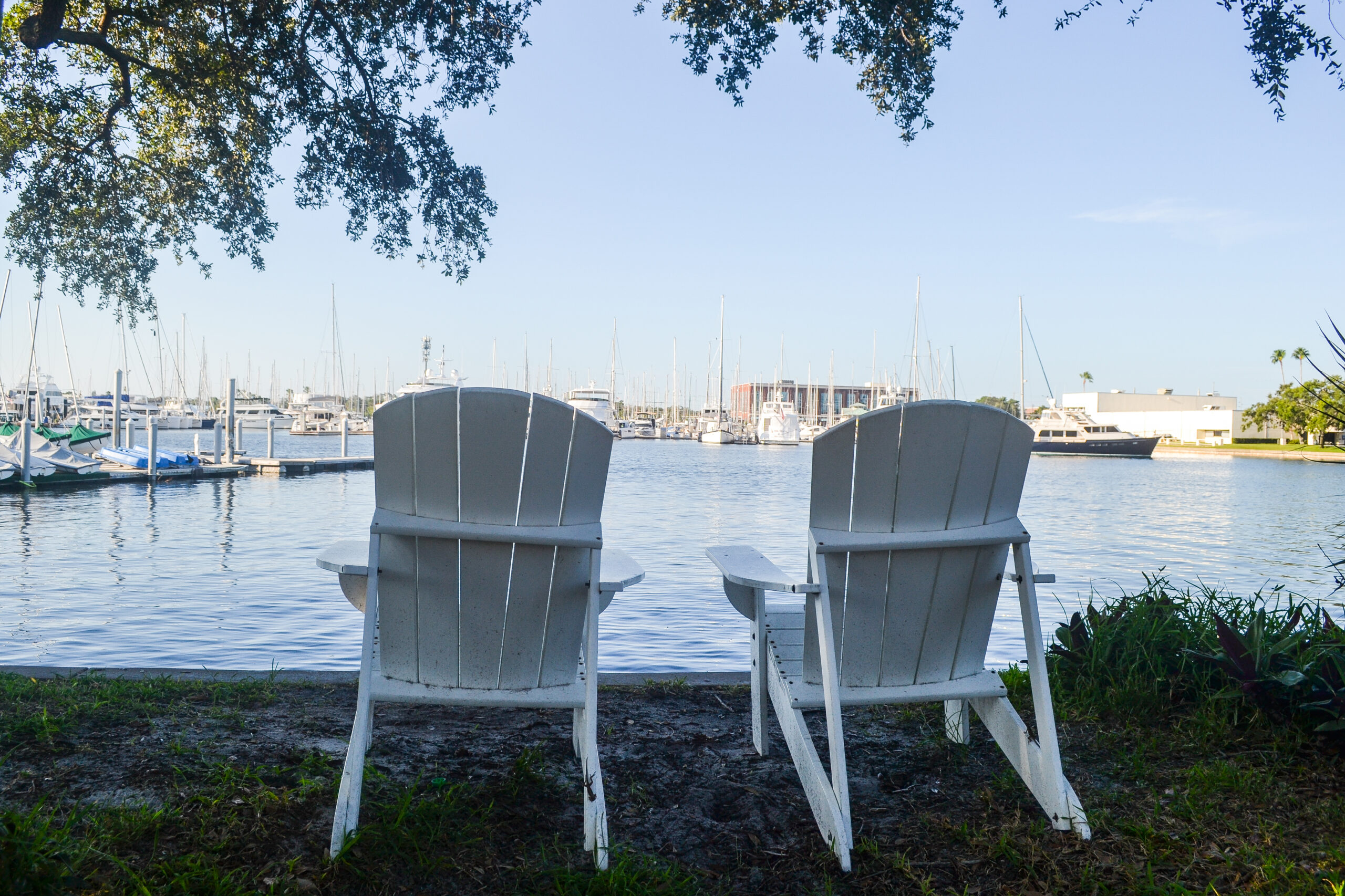
Bayboro Harbor was first dredged in 1907, chasing away much of the area’s native wildlife and destroying the salt marshes, mudflats, and bayous that existed.
Photo by Makenna Wozniak | The Crow’s Nest
By Julia Birdsall
On March 24, students were invited to imagine the past, visualize the present and rethink the future of Bayboro Harbor during a guided shoreline walk hosted by the honors program and Gulf Scholars — a multi-state program that focuses on creating positive change in the Gulf of Mexico and will begin at the University of South Florida St. Petersburg in Fall 2026.
Immediately following the event, Preserve the Burg and the Judy Genshaft Honors College (JGHC) hosted Harboring Resilience: the Past, Present, and Future of Bayboro Harbor in the Nelson Poynter Memorial Library, where senior environmental science and policy major and vice chair of the Student Green Energy Fund (SGEF), Oliver Laczko, detailed the research behind his senior thesis, which describes the history of Bayboro Harbor’s development.
Both events were part of USF’s fifth annual climate teach-in, which is part of the global initiative: Worldwide Climate and Justice Education Week.
The initiative aims “to inspire and involve students in a conversation about climate solutions,” wrote the Judy Genshaft Honors College on their website.
During the guided shoreline walk, speakers discussed past and current projects focused on improving the quality of Bayboro Harbor.
Laczko discussed the progress of the living shoreline that SGEF installed on the USF St. Petersburg’s campus beach in November 2025.
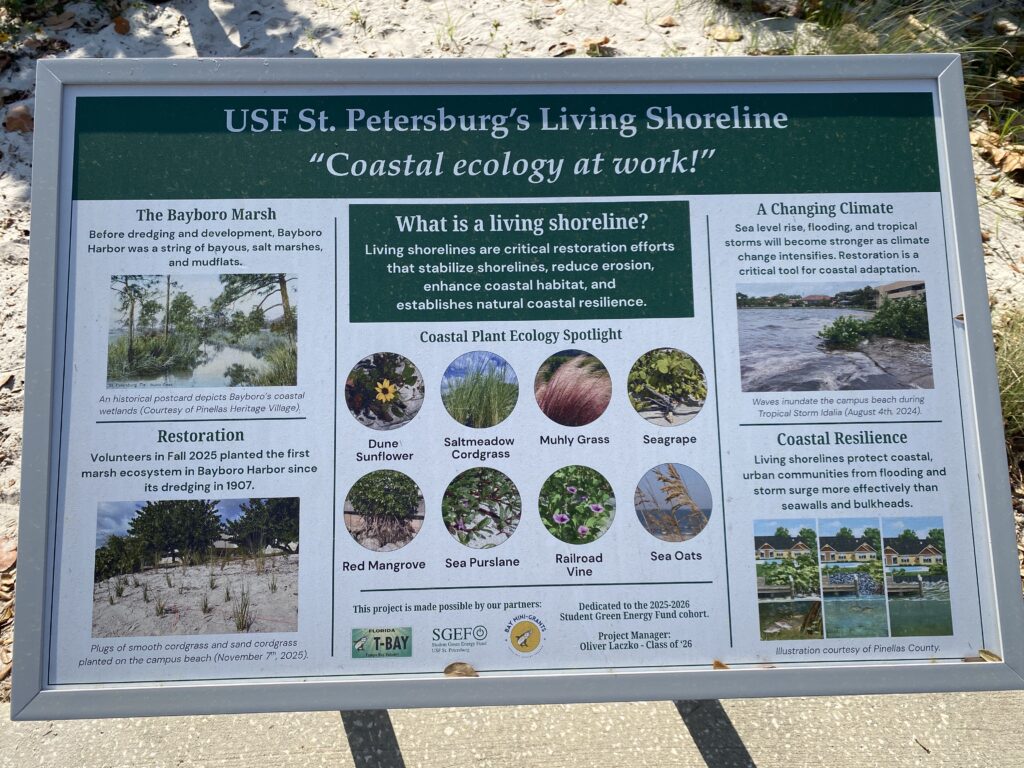
Later, during Laczko’s presentation, he proposed an expansion of the current living shoreline that would entirely replace the seawalls currently surrounding Bayboro Harbor.
“We need to rethink the utility of the seawall that borders much of our waterfront,” Laczko said in the closing minutes of his presentation. “What ecological value does a seawall bring us? What protection does a seawall bring us against storms and storm surge?”
The living shoreline that currently exists and the expansion that Laczko proposed would strengthen the sediment of the land so that it does not erode as severely as it did when hurricanes Helene and Milton hit the area in the Fall of 2024, he said. It would also restore some of the native plant life that was destroyed during Bayboro Harbor’s initial dredging.
“We need to use natural history as a blueprint, not just as an archive,” Laczko said. “Responsible development for the future is absolutely critical.”
This is a sentiment that is put into practice by two JGHC and College of Arts and Sciences classes taught by professors Tina Piracci, Taylor Crosslund and William Ellis.
As a part of the classes, students helped to design and install clay Oyster Restoration Brick Structures (ORBS) in Bayboro Harbor to promote Eastern oyster population growth.
As part of the guided shoreline walk, Piracci and one of her students, marine biology senior Ines Rosales, discussed the oyster restoration project.
“In areas where we don’t see any oyster, we see the water quality getting really bad,” Piracci said during the tour. “We want to find ways that we can grow them in healthy environments and then transplant them.”
Piracci, her colleagues and her students hope to expand this project from Bayboro Harbor, as well as the bricks installed at St. Raphael Middle School, to other locations with a need for oysters.
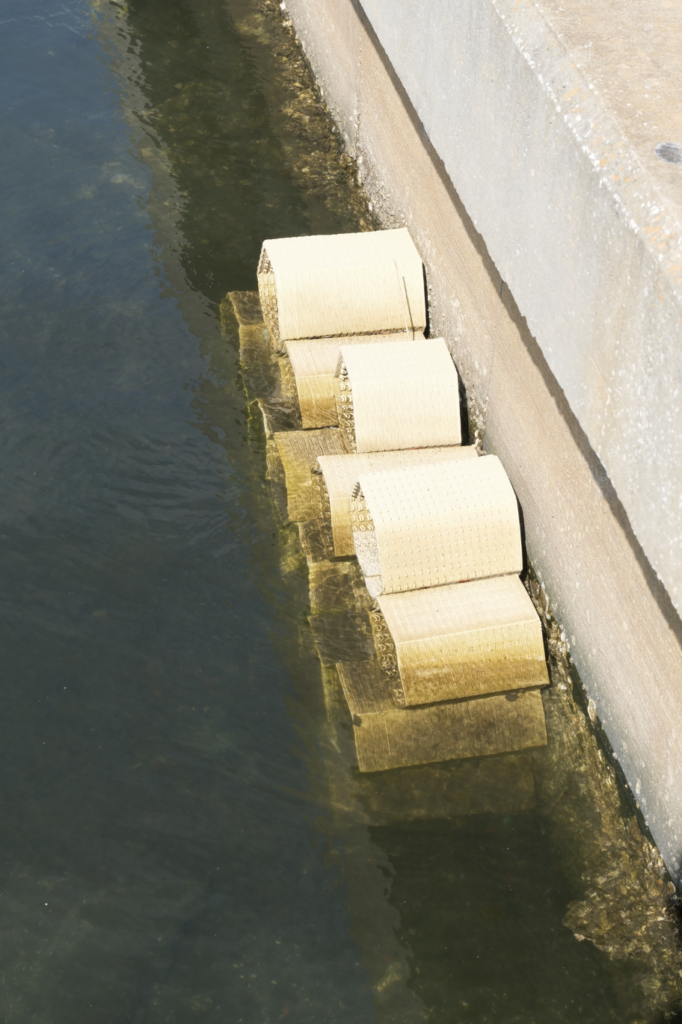
Photo courtesy of Gabriel Ballester-Rivera
“Globally, 85 percent of oyster reefs have been lost, making them the most severely impacted marine habitat on Earth,” according to the Nature Conservancy.
Oysters, a keystone species, are integral to creating a thriving ecosystem because of their ability to filter water and strengthen a shoreline’s integrity.
“The overall goal is to reverse the decline of oyster populations in Tampa Bay that have plummeted due to development and as more seawalls with synthetic materials are constructed,” Piracci told USF.
While it is too early to determine how the oyster population will grow within Bayboro Harbor and what impact it will have on the ecosystem, students will monitor the surrounding environment and sea life for changes and the bricks at St. Raphael Middle School have seen success.
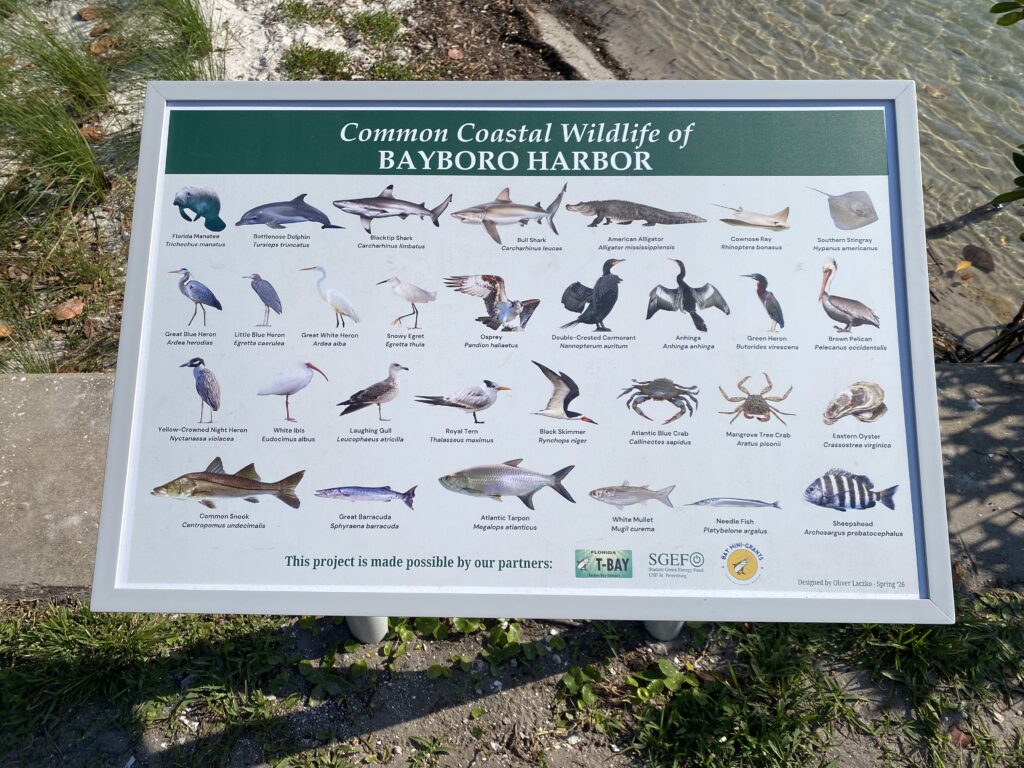
Photo by Julia Birdsall | The Crow’s Nest
Rosales told The Crow’s Nest that the oyster restoration project has gained momentum and inspired similar efforts from institutions such as Shorecrest Preparatory School and Eckard College, which gives her hope that oyster restoration efforts will grow.
Piracci agreed.
“My hopes for the project would be to continue to increase the amount of oyster in the area, but to also increase opportunities for other people to participate,” she said, as there is a role available for anyone looking to get involved.
Senior environmental science major and SGEF’s proposal advisor, Audrey Everett, felt that this project could work in tandem with SGEF’s living shoreline installation to create positive change in Bayboro Harbor’s ecosystem.
“All environmental issues are interconnected, so we can’t fix Bayboro Harbor just by having oysters there,” she told The Crow’s Nest after the shoreline walk.
She continued on to say that SGEF’s efforts to create “a more resilient beachfront” by planting mangroves, which sequester carbon and can help the oysters in improving Bayboro Harbor’s water quality, has led to the repopulation and growth of several marine species.
Aside from a potentially positive environmental impact, one thing that the Gulf Scholars Program, Laczko’s thesis proposal and the oyster restoration project have in common is their use of interdisciplinary models of thinking.
Rosales and Everett were both drawn to the oyster restoration project because of the combination of art and technology.
“It’s just very inspiring to me to see how industry, scientists and artists can collaborate to not only improve the environment, but also create something beautiful,” Everett said.
Throughout the guided shoreline walking tour, Gulf Scholars Program associates, such as Audrey Brandt, a USF alum and honors college employee, encouraged participants to think about the history and future of Bayboro Harbor through an interdisciplinary lens.
“An interdisciplinary pathway that interacts with the Gulf is something that’s really fulfilling to me,” Brandt said. “Also seeing that positive change in our local community, which we’re already seeing before the program being really fully introduced, is really exciting.”
When people of different fields come together, Rosales said that innovative solutions to problems can be found.
Photo by Julia Birdsall | The Crow’s Nest
“I think it’s really cool to bring all those different perspectives together, when usually we have this idea that they are pretty separate and can’t really work together,” Rosales told The Crow’s Nest. “I think that will bring something new and maybe all these other innovative ideas for restoration.”
Laczko, for example, combined history and environmental science in his proposal for green infrastructure along Bayboro Harbor.
“I believe that by examining the ecology and habitats that once existed within Bayboro Harbor, the salt marshes, the mudflats, the bayous, we can use that ecological knowledge of archived data to further drive home our adaptation and resilience of the region,” Laczko said.
Laczko stated that there is still much research and planning needed in order to fully comprehend the damage done to Bayboro Harbor since the 1900s and devise solutions.
Everett believes that continuing to integrate students of different disciplines will yield creative and helpful ideas.
“This is a really great opportunity to kind of fix our wrongs of the past,” Everett said. “And to make the students who are involved…have a deeper understanding of how their work impacts the world around them.”