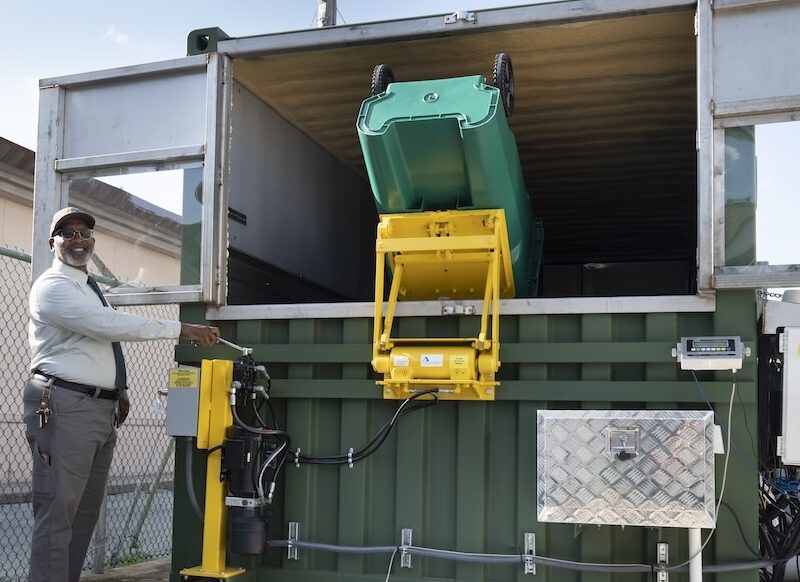
SGEF members on the St. Petersburg campus have been asked to start going over to the Tampa campus to create student work there.
Photo by Makenna Wozniak | The Crow’s Nest
By Julia Ferrara
The University of South Florida has not had a functional Office of Sustainability since 2022, and in the midst of demands for USF to reinstate the office, students are calling into question how the university is progressing in its sustainability efforts.
The last person to hold a position in the Office of Sustainability was Winnie Malumba, a 2019 USF graduate who was the executive director.
She led two sustainability collectives, Florida For Good and B Tourism.
Christian Wells, a professor of anthropology at USF, served as the founding director of the Office of Sustainability from 2009 to 2012. He shared that many of the office’s activities ceased in 2012.
During his time there, he was responsible for helping the Provost’s Office and the Graduate School launch the world’s first School of Global Sustainability, helping the university to gain national recognition, including Second Nature’s national Climate Leadership Award in 2012 and incorporating sustainability values into the University System Strategic Plan.
Wells also helped create a $1 million annual Student Green Energy Fund (SGEF) to overhaul energy infrastructure on campus and raised over $100k in gifts and other revenue.
Andrew Hargrove, a faculty member in the Judy Genshaft Honors College and the Director of the Climate Teach-In, said that the Office of Sustainability, ideally, would serve to ensure that USF is meeting its pledged goals of being net zero by 2070, by reducing its emissions by 70 percent by 2025.
“Ideally, the Office of Sustainability would be in charge of making sure that we are on track to reach those goals,” Hargrove said.
Some of these responsibilities would include taking inventory of our carbon emissions, directing the university towards initiatives, projects, infrastructure, and improvements that would move us towards the goal across all three campuses and bringing together different individuals, departments, and student organizations that are already doing sustainability work.
Oliver Lackzo, a senior environmental science and policy major and the vice chair of SGEF, said that the Office of Sustainability was intertwined with the facilities services.
“Oftentimes [sustainability] is infrastructure, conservation, landscaping, architecture and planning,” Lackzo said. “They operated out of the facilities office, and they helped push for renewable energy infrastructure, waste reduction initiatives, policies and measures and conservation efforts.”
Hargrove added that the Office of Sustainability has served as a resource for connection, bringing together groups working towards sustainable futures.
“The Office of Sustainability would kind of be the backbone of all the great sustainability work that’s already happening on campus, but that’s currently being done in these isolated pockets, in spaces where they don’t know about each other, in spaces where they don’t have institutional funding or institutional support,” Hargrove said.
Hargrove added that the office existed when the university started its Climate Action Plan in 2010 and closed when their funding ran out and they couldn’t afford to renew Wells’ position.
What used to be an office of people working together was reduced to just one, making it harder to complete their work, Lackzo said, citing the 2016 Climate Action Plan, which listed multiple team members from the USF Office of Sustainability.
Julianna Parisi, a senior environmental science and policy major and chair for SGEF, said that SGEF was told by the administration that the goal was for the St. Petersburg campus to be the hub for sustainability.
“We were then told there was no funding for the position and therefore no way to fill it,” Parisi said.
The lack of an Office of Sustainability puts a strain on SGEF and its progress — an experience that’s been exacerbated by SGEF’s consolidation in 2025.
As of last July, the funds from the Student Green Fee that fund SGEF projects was consolidated into one pool. Along with this, members on the St. Petersburg campus had to start reporting to greater council to access their budget.
Beyond that, SGEF is looking at its backlog of projects that need funding across One USF.
He thinks that while cooperation amongst council members has been positive, they aren’t meeting enough.
“I think that’s where the backlog has formed,” Lackzo said. “I think there may have been four to seven projects that weren’t able to get attention and as a result, a vote from last meeting.”
Lackzo added that some projects are coming back for the third or fourth time with numerous questions and no foreseeable completion date.
Parisi added that in terms of the green fee being consolidated last year, SGEF’s biggest challenge has been engaging with students.
“It’s a complicated process to explain and the barrier to entry of getting involved in SGEF is already so high – having to engage students who want to spend time to write an actual proposal, and having to explain the council just overwhelms students,” Parisi said.
There have been several solutions to this issue, Parisi mentions.
“I do think the increase in funding and access to Tampa resources has been very helpful,” Parisi said. “We have been able to talk about half a million-dollar projects, something unheard of before at USFSP.”
Lackzo also mentioned concerns that arose recently over House Bill 1217 that was filed in the legislature which prohibits governmental policies regulating greenhouse gases and threatens public institutions from using money to fund initiatives that reduce greenhouse gas emissions.
“There was some concern among council members that this could potentially impact the green fee,” Lackzo told The Crow’s Nest. “So, as a result, all the projects that received funding last meeting, they approved the funding but didn’t release the funds.”
To Lackzo, things are going fine, but there needs to be some changes.
“Things could be better; things are moving very slow, and the council just feels very disconnected from the student body,” Lackzo said.
Parisi spoke to the sustainability efforts by the university, saying that it is a mixed bag.
“This year especially, I have seen a new level of engagement and interest in student affairs from administration,” Parisi said. “It is much less hostile than before, and projects have been getting done a lot faster.”
Parisi added that if the people who care about sustainability within the university stay in the position to help, then students will be able to utilize SGEF to its full potential.
However, for upper administration, Parisi doesn’t think it’s a top priority.
“I think sustainability on a college campus looks like education and funding and there are very little instances of the university going out of their way to promote sustainable efforts,” Parisi said. “There are more roadblocks than anything that make these projects more difficult than they need to be if this was a true priority for them.”
Parisi added that the Office of Sustainability should be reinstated with the inclusion of student internships and extensive collaboration with SGEF and other student organizations.
“I believe sustainability is best done when focusing on community. I think the person in charge should be helping students who want to make a proposal, or see change, get in contact with the administration and be that facilitator,” Parisi said.
“They should make plans for the university to build that green infrastructure themselves and develop high-impact, long-term SGEF proposals.”
Hargrove spoke on what reinstating the office would look like, agreeing that they would need a dedicated director to run it, ideally a team.
“You need more than one person doing full-time work in order to get a 55,000-person institution to become net zero. So, it would mean dedicating staff lines,” Hargrove said. “That means every year you’re willing to pay that person’s salary and benefits in addition to some amount of budget funding for the operations of the office.”
Hargrove added that the given political climate doesn’t encourage an environment that is super supportive of the concept of sustainability, but it should still be a priority for an AAU university that champions science and research.
“I think that an Office of Sustainability is an important signal to the USF community, that its faculty, its staff, its students, that sustainability is a thing that USF values, cares about, and is actively working towards,” Hargrove said.
In their conversations with leadership, Hargrove says that they’ve always been assured that sustainability is woven into everything the university does; however, there has yet to be an indication from the administration that sustainability is something they care about and is actively working towards.
They continued saying that oftentimes their efforts feel unsupported, despite sustainability being an important aspect of being a top university in North America.
“For me, it feels like all of the hard work that I and my colleagues are doing – sustainability projects around USF, that are actively moving use towards being a more sustainable university, it feels like we’re doing all of this against the tide of the university, instead of with the tide of the university.”
Hargrove believes that with more university incentives, they’ll find that many people want to be more involved.
“If we have an institution that is actively rewarding sustainability work, you will find that many, many people want to be doing sustainability work, want to be shifting our campuses to being more sustainable, lowering our emissions, and making us more environmentally friendly,” Hargrove said.