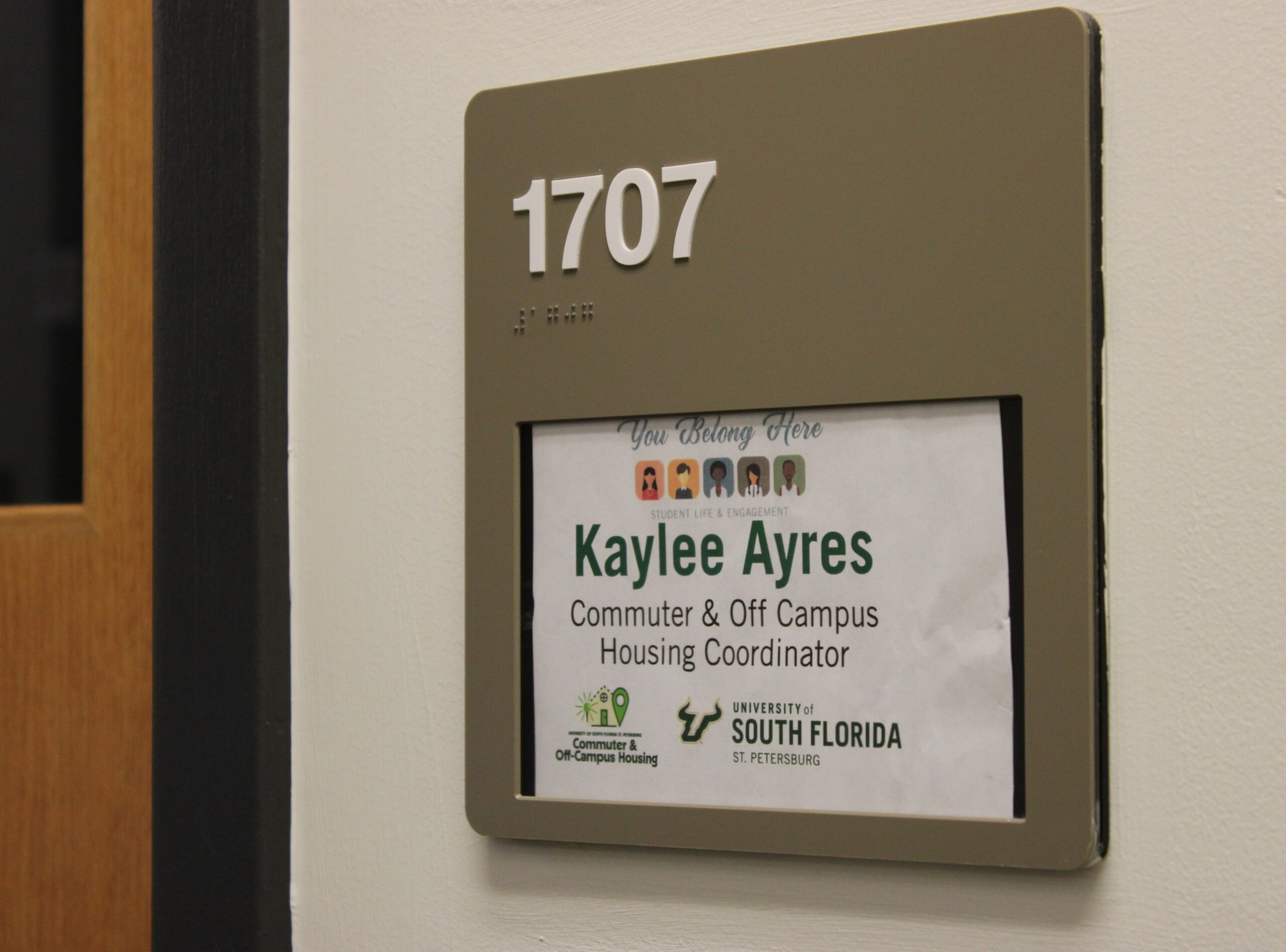
Located in office 1707 in the Judy Genshaft Student Life Center, Kaylee Ayres is available to speak with and assist commuter students throughout the week.
Photo by Jasmin Parrado | The Crow’s Nest
By Julia Birdsall
College campuses are a place where a strong sense of community can be formed among students, but many commuter students, like junior English major Zoey Earles, feel that they have fewer opportunities to form these connections.
“Positives [of being a commuter], I have my own apartment,” Earles said. “Negatives, I don’t make as [many] friends, and I don’t necessarily know about all the things that are happening on campus.”
Events hosted on campus are a great way to meet people and find that sense of community, but sustainability senior Estela Najera said that being aware of events is difficult.
“When you’re off campus, it’s a lot easier to not pay attention to the events that are going on,” she told The Crow’s Nest.
For the past eight months, it’s been the goal of the Commuter and Off-Campus Housing office — an addition to the Student Life and Engagement department that began programming in Fall 2025 — to bridge this gap and bring commuter students into the fold of the University of South Florida St. Petersburg’s campus life.
Commuter and Off-Campus Housing program coordinator Kaylee Ayres, who was a commuter herself in college, found that colleges did not cater towards off-campus students’ experiences in their programming.
“I love the intentionality of this role of being able to kind of create something from scratch,” she told The Crow’s Nest. “Kind of get in there, get to really talk to the students, see what’s missing, what they need and kind of working alongside them and alongside leadership and the rest of the team here to really develop those for students.”
However, there are a number of students who were unaware of the office’s existence.
Earles and fellow English junior Sarah Oliver, who have commuted to the St. Petersburg campus since fall 2025, had never heard of the Commuter and Off-Campus Housing office.
Both said that they didn’t feel they had much support as commuter students and would like to see some kind of marketing or newsletter that is specifically sent to commuter students’ emails so that they are aware of the resources they have.
Ayres told The Crow’s Nest that spreading awareness about the resources her office offers has been one of the biggest hurdles they’ve faced this school year, and they have been looking for ways to achieve effective outreach.
One of the most helpful solutions so far is speaking at campus orientations, which Ayres did for the first time during winter orientations. She said that this will ensure that incoming commuter students, at least, will be aware of the organization and know where to look in times of need.
Outside of this, the office markets its services through social media, flyers and events.
One of their most recent events was a campus flea market that took place on April 8 in the University Student Center (USC).
This event drew crowds of students who were able to purchase a variety of items from their peers, who were vendors at the event.
Many of the vendors and attendees were students living on campus, whom Ayres aims to encourage to spread more awareness about the office and be a resource if those students choose to move off campus in future semesters.
She said that all students are welcome to make appointments with her.
Kira Gibson, an English and digital communications and multimedia journalism double major, said that despite not ever being a commuter student herself, she sees the benefits that the flea market and similar events can have for commuters.
“I’ve heard a lot that commuters tend to feel very disconnected from campus and the students who live on campus,” she told The Crow’s Nest. “This is an opportunity for both of them to kind of…mingle and talk to one another, so [it] helps foster community.”
Marine biology senior Luis Ramos, who has been commuting to the St. Petersburg campus often for about two years and attended the flea market event, echoed this sentiment and said that events like the flea market are a great way to expose commuter students to campus-based and local groups.
“[It] is pretty hard to manage time to explore day to day when I’m commuting because I do have to make it back to the Tampa side, where I live most of the time, for work or whatever else,” he said. “So, I don’t always get to really interact with everything locally on the St. Pete side.”
Though he has had little interaction with the Commuter and Off-Campus Housing office since its inception, he believes that the programming they put on will be helpful for other students.
In the future, he said that he would like to see “any events that bring people together…to talk about how commuting has impacted [students,]” Ramos said. “Because it might not be the same for everybody.”
He also said that the Commuter and Off-Campus Housing office could do research into students’ schedules and consider this when event planning.
Ayres has already implemented this idea into her programming after looking into the times at which commuters are most often in class.
“We do also try to rotate when we do our events to make sure that…all students have an opportunity to attend our event at one point or another,” she told The Crow’s Nest.
The office has also hosted several “grab-and-go” events for holidays and important events so that commuter students can still participate in the festivities even if they are leaving campus.
While these events have the benefit of involving students in campus life, they do not extend their reach to everyone, said Erica Lauer Vose, a marine biology major who has been commuting to USF St. Petersburg since 2022.
As an older student, she found that many of the events hosted by the Commuter and Off-Campus Housing office are “not quite as relevant” to her.
“The age is not the defining characteristic,” she said. “It’s just, I’m interested in different things than [younger students] are. So, I don’t know that I’m a particularly relevant demographic for this.”
While older students do not make up a majority of the population of USF St. Petersburg, they are often present on campus for class and research opportunities.
Vose told The Crow’s Nest that some of the ways she and other older commuter students could benefit from Commuter and Off-Campus Housing’s resources is through carpooling services and a secure location where commuter students can leave their stuff while on campus.
“I don’t want to leave my computer and everything if I go to the bathroom [when] I’m sitting in the library,” she said. “I’m going to pack everything up and haul it with me and I feel like I spend a lot of time just like trekking my things around, especially this year.”
Storage for commuter students could become a possibility in the near future through the proposed commuter lounge that Ayres has been working to install.
Suggestions like these can be made through the various surveys that the Commuter and Off-Campus Housing office sends to students and can be used by commuter students to advocate for themselves and create change on campus.
“We’re here to kind of have those conversations with commuters,” Ayres said. “Any feedback that they give us [can be brought] back to leadership [and brought] back to whatever campus partners oversee those entities so we can try to find a good solution and compromise that works the best for everyone.”