
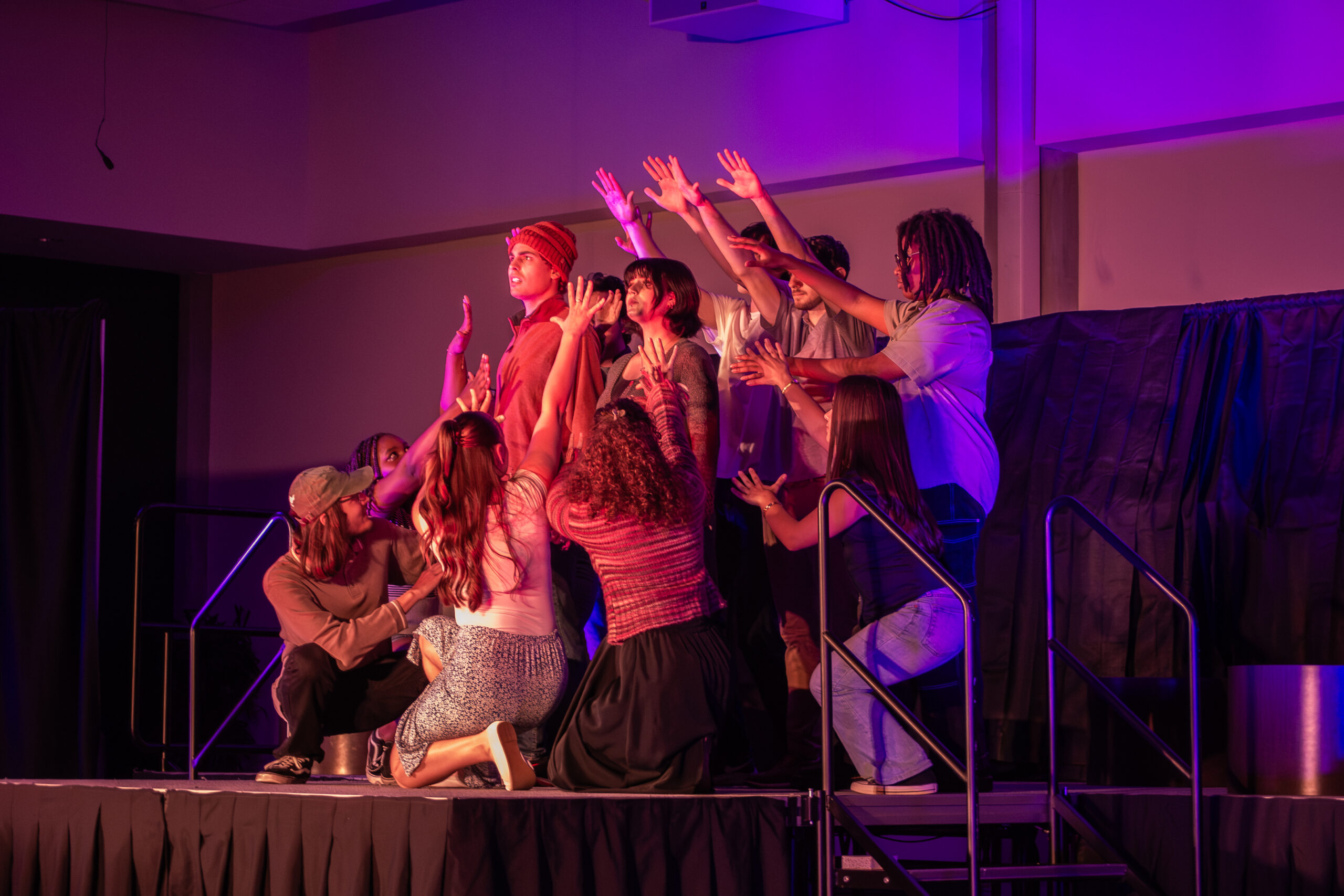
Photo by Makenna Wozniak | The Crow’s Nest
By Secilia Ruiz
When dealing with life-altering events and emotions that can feel inescapable, it’s easy to forget how much people’s lives affect one another. A small moment in a day of one’s life can completely alter the life of another.
This phenomenon is explored in the musical “Theory of Relativity.”
On April 19-20 and April 26, the new Musical Theatre Club at the University of South Florida St. Petersburg put on a student-directed production of “Theory of Relativity.”
“Theory of Relativity” is a musical written by Brian Hill with music and lyrics by Neil Bartram. The ensemble musical uses seemingly separate comedic and dramatic scenes that portray the complex situations that young adults experience and how they eventually connect to each other.
This cast had no shortage of talent, with actors fully embodying their characters.
A standout in this category was senior digital communication and multimedia journalism major Melanie Carnero as Monologue Catherine. Carnero’s portrayal of the anxious Catherine, who struggles with her fear of germs after her boyfriend baked her a cake, was outstanding and felt authentic.
Carnero remained committed to her character throughout each scene. As Catherine became increasingly anxious about eating the cake, Carnero’s skillful building kept the stakes high. Then, once Catherine went through an epiphany that encouraged her to finally eat the cake,
With some actors taking on the task of playing multiple different characters throughout different scenes, a distinction between each character is important.
Founder and president of the Musical Theatre Club, Anya Gorgas, accomplished this in her roles as Sara and Julie.
The character of Sara in the song “The End of the Line” begins as a classic “nerdy” character but transitions throughout the song into the classic “popular mean girl.”
In contrast, the character of Julie is a kind young woman who owns five cats that she has conversations with regularly. Gorgas embodied Julie with such ease and contrast from the way she played Sara that it truly felt like two different people.
After an intermission, it can sometimes be difficult to grab the audience’s attention again. However, the moment Uche Emetuche, a sophomore political science major and Musical Theatre Club officer, stepped onto the stage as Caroline in the song “Me & Ricky,” the audience was entranced and remained in awe with every note she sang.
Emetuche guided the audience through the journey of Caroline falling in love with and slowly getting taken advantage of by her lover, with raw talent and emotion in both her singing and acting that left everyone in the room as heartbroken as Caroline.
The comedic aspects of the scenes following this heart-wrenching performance were also effective, eliciting laughs from the entire audience.
Sophomore business analytics and information major Aidan Kaiser contributed to this comedic aspect in one of his scenes.
The song “Lipstick,” where the character Anthony, played by Kaiser, fantasizes about his interaction with Jenny, played by senior biology major Jocelyn Stowell, on the street as she applies lipstick, was a hilarious example of this.
As Anthony plays out the fantasy with an exaggerated version of Jenny, the over-the-top facial expressions from Kaiser, coupled with the dreamy high-pitched delivery from Stowell, left the audience clutching their sides in laughter.
The performances were elevated by freshman elementary education and teaching major Makenna Leak’s choreography, which remained grounded in the emotional songs to focus on the acting, while still being outlandishly fun in the comedic songs.
Although there were some moments where the movements the actors made while singing did not feel motivated by character, the entire stage was always being utilized in every scene. This aspect kept the choreography feeling fresh and interesting.
The costume design, by sophomore pre-med student Mona Nabil and senior finance major Natalia Powers, was stunning and fit the personalities of the characters wearing them.
With a production more grounded in reality in the way “Theory of Relativity” is, the designers had a lot of freedom with how they chose to dress each character, as extremely specific costumes weren’t required for characters.
The colorful striped turtleneck sported by Gorgas as the character Julie, the aforementioned cat-lover, felt like a statement piece Julie would have picked out of her closet, which helped bring the character to life.
This was true for every character, with each costume giving the audience a taste of their personalities before they said a single line.
With the abundance of characters, multiple of them being played by the same actors, there were a lot of costume changes required in the show. These were executed flawlessly, with no wardrobe malfunctions or seemingly missing costume pieces.
Some of the costume changes, however, created confusion about which characters were recurring throughout multiple scenes and which were newly introduced.
For example, the costume Stowell wore as Jenny in the song “The End of The Line” was drastically different than the costume worn in the song “Lipstick,” which made it difficult to realize this was the same character in both songs without reading the playbill.
The costume department nonetheless did an outstanding job at making each character feel like a real person that the audience could connect to, which matched the theme of the show perfectly.
It would be impossible to see the phenomenal costumes or hear the talented cast without the technical team led by the Stage Manager, senior English major Daniel Albertson Jr and the Producer/Technical Director, junior political science major Brianna Gutierrez.
The lighting design in this production, using two light trees positioned on either side of the room facing the stage, was very intentional.
One stand lit the background blue and purple, which is reminiscent of the colors of the galaxy and contributed to the science-influenced theme of the musical. The other light stand was used to light the actors onstage with a warm white, which aided in the intimate and often vulnerable nature of the production.
The sound design was also flawless. With multiple overhead microphones that hung from the ceiling, each actor could be heard clearly throughout the entire show.
The varying notes were also captured by the microphones perfectly and none of the high notes clipped the microphones, which can commonly occur and causes fuzzy audio.
These aspects all tied together to form the well-executed and heartwarming display of talent that was The USF St. Petersburg Musical Theatre Club’s production of “Theory of Relativity.”
In the coming semesters, it would be amazing to see more productions like this one on campus for some students to enjoy as audience members and for others to showcase their abilities.



![“[The 9/11 Memorial Stair Climb is] really to show our support and help build community and camaraderie with the first responders that are putting on this event at the Rowdies Stadium and to showcase our office and give the student veterans here and miliary-connected students something positive to do that day and a feeling of belonging,” veteran and junior personal financial planning major Thomas Wells said. Courtesy: Tampa Bay Rowdies](https://crowsneststpete.com/wp-content/uploads/2026/09/Stair-Climb-1.jpg)