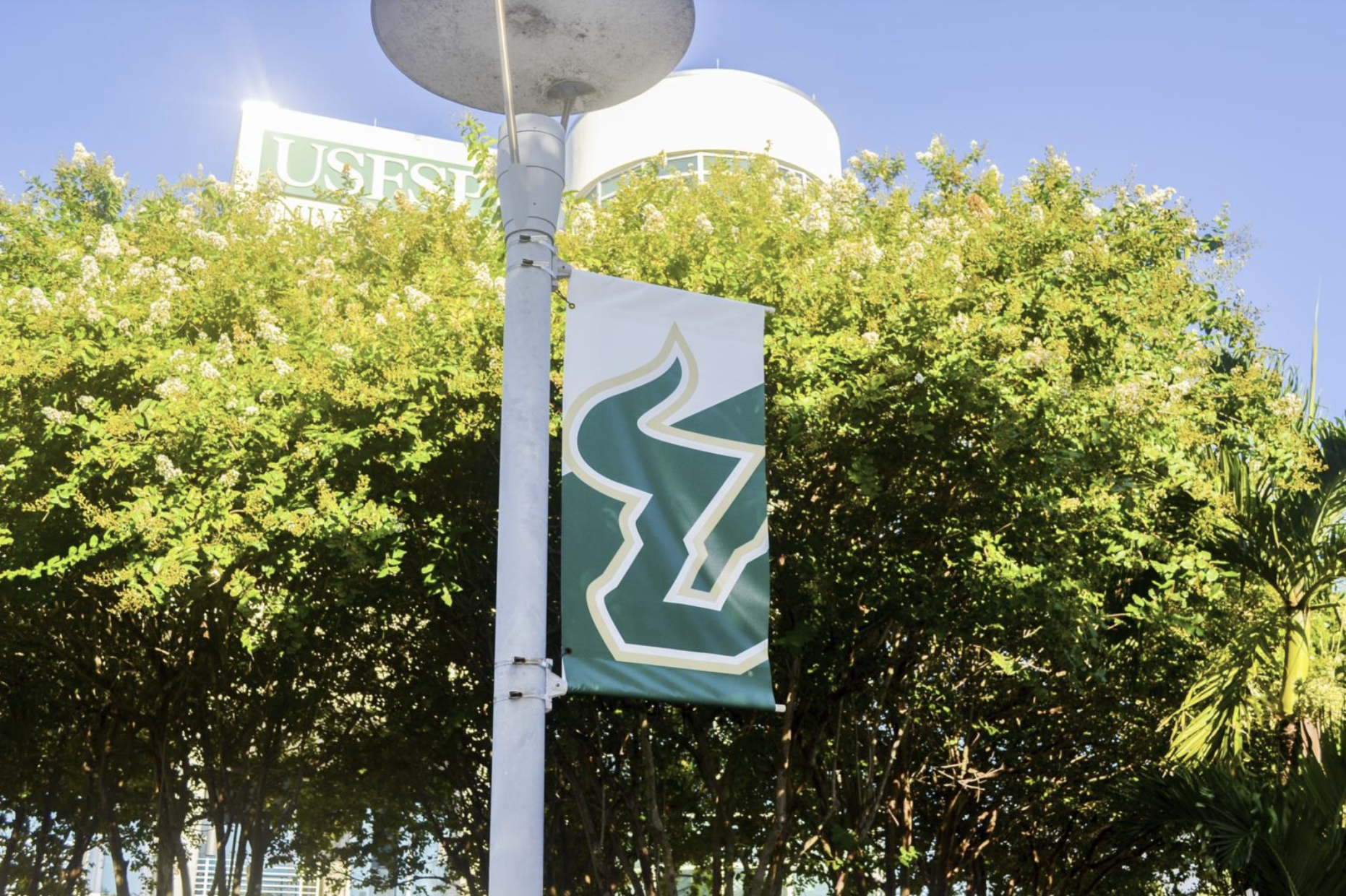
A look at spring on the University of South Florida St. Petersburg campus.
Photo Courtesy of University of South Florida
By Ashley Pena
The bright, green oak trees and sparkling Bayboro Harbor make walking along the University of South Florida St. Petersburg campus in the middle of spring seem like a dream come true for students. But the dream ends when huge piles of pollen come raining down.
This spring, allergy season kicked off early in March with pollen counts reaching their peak across Florida. A month later, USF St. Petersburg seems to be drowning in pollen.
Courtney Jean, a public health junior, didn’t feel the effects of seasonal allergies until her first semester on campus.
“When I started my freshman spring semester, my allergies seemed to flare up and became quite severe,” Jean told The Crow’s Nest. “I was sneezing constantly, my throat felt like sandpaper and my eyes would swell up from irritation.”
Now, Jean finds that her allergies have only worsened with the high pollen counts.
“The pollen definitely seems to be more potent during this allergy season, so my symptoms have been a bit more severe,” Jean said.
In addition to high pollen counts, last month was the warmest March in U.S. history. Rising temperatures lead to a longer growth season for pollinating trees, resulting in an aggressive allergy season that’s only beginning.
While there is a limited number of ways to combat seasonal allergies — staying indoors or taking allergy medicine — students like Morgan Niem, a junior graphic design major, see an opportunity to alleviate the allergy season through landscaping.
“Plant female trees,” Niem told The Crow’s Nest.
USF St. Petersburg is lined with male oak trees, which spew out pollen as opposed to female trees which release seeds. As the rising temperatures make it difficult to avoid longer growth seasons, a literal change in the scenery may be one of the only direct solutions there are.
Taylor Rand, a senior biology major with a concentration in evolution and ecology, finds that this spring’s hot weather is not only impacting pollen counts but insects as well.
“Rising temperatures as a result of global climate change has likely contributed to the reduction in insect populations and insect diversity we’re seeing around the world.”
Skye Smith, a psychology major senior, agrees that there is a noticeable difference in the number of bugs flying around.
“I used to hate going outside the last two years during the spring because of all the bugs,” Smith told The Crow’s Nest. “Now I’m worried because it’s no longer an issue and I rarely see the bugs I used to have so many issues with.”
Spring commonly brings out bugs seeking out warmth. Unfortunately, rising temperatures have made that nearly unviable for them.
“Global warming can have serious impacts on insect populations by altering resource availability and reproductive timing,” said Rand, “Many insect species are specialists, relying on one or two single plant species for food and timing of their reproductive cycle; when things like rising temperatures begin to affect local host plant populations, insect diversity will undoubtedly begin to decline.”
Rand emphasized that as insects experience habitat loss due to global warming, biodiversity is threatened as well.
“All of the ecosystem services that insects provide–pollination, acting as a food resource for birds and reptiles, controlling other pest insect populations, cleaning up organic debris–are essential to any healthy, stable ecosystem.”
It can be easy to dismiss insects as a nuisance or even gross, but insect diversity plays a key role for the ecosystem.
“Insects are deeply interconnected with our local ecosystems in ways that we often cannot even understand, until they are gone,” said Rand.
As temperatures continue to rise, this spring season may prove to be a rough one for bugs as well as anyone suffering with allergies.