
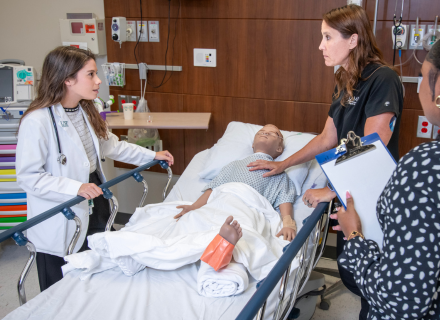
CAMLS director of clinical simulation Melissa Milner (center) engages with students during a simulation training.
Photo courtesy of USF
By Jasmin Parrado
The University of South Florida’s College of Public Health announced its launch of an undergraduate concentration in healthcare simulation operations in its Aug. 6 press release.
The program, deemed the first-ever university-based concentration of its kind, is slated to begin this fall.
Healthcare educators and students across Tampa Bay believe the program will be invaluable for resolving staff shortages and updating standards of simulation-based practice.
“There is a strong need for more trained professionals who understand both the clinical and technical aspects of simulation,” said Melissa Milner, director of clinical simulation at USF Health’s Center for Advanced Medical Learning and Simulation (CAMLS).
As it stands, clinics and hospitals currently struggle with staffing shortages, lack of simulation education and practical application, Milner told The Crow’s Nest.
“This concentration directly addresses those gaps by preparing students with both theoretical knowledge and applied skills,” Milner said.
The program includes five courses focused on the design and integration of simulation technology in the medical field, Milner explained. Topics like simulation anatomy, environmental setup and audiovisual systems are covered within these courses.
In order to create an optimal curriculum for simulation-based healthcare education, factors like accessibility, fidelity and realism were considered.
“This concentration is designed with those principles in mind, and it’s preparing the next generation of healthcare situationists,” Milner said.
News of the program has pleased healthcare practitioners and students across the Tampa Bay area. Alyssa McNab, nurse educator for the Cardiovascular Intervention Unit at Advent Health Tampa, claims that simulation is an essential part of healthcare education.
“Simulation bridges the gap between theory and practice,” McNab said. “For nursing education, it allows students to gain hands-on experience in a safe and structured way before transitioning into real patient care.”
McNab explained how using simulation training is especially useful for refining cardiovascular care, where heart health is sensitive to frequent changes. Instead of engaging in high-risk training with real patients, students can observe and adapt to learning based on mannequins.
“In my role, I also see how simulation contributes to patient safety,” McNab told The Crow’s Nest. “Staff who have practiced emergency responses in simulation are more effective and calm when faced with those same situations at the bedside.”
Michaela Courtney, senior nursing student at USF St. Petersburg, appreciates that the university is receiving more simulation technology and focus, especially after the laboratory she attended on the USF St. Petersburg campus suffered flood damage last hurricane season.
“It prepares you for real-world situations that could easily happen,” Courtney said. “Let’s say there were medical errors made or even signs and symptoms missed by a physician. It’s our job as nurses to catch errors and be patient advocates.”
Courtney feels fortunate to attend an institution where, to her, simulation training seems available and prioritized.
“Interpersonal practice will always be accessible,” Courtney said. “Hospitals will always be running with patients with one million cases each day. But simulation technology is expensive, and it’s not accessible to every university.”
An important way to learn the more challenging aspects of nursing is through simulation-based practice, she told The Crow’s Nest.
When she attended simulation classes at USF’s Shriner Hospital and the Johns Hopkins Simulation Center, Courtney experienced a variety of replicated scenarios and conditions, spanning treatments for CPR, asthma, blood loss and infant care, she recalled.
“Simulations force you to think, really assess your situation, trust your gut,” Courtney said. “I have been wrong and right in simulations, but it is all about the practice we all receive. You have to pay attention, even if it is a mannequin on the gurney.”