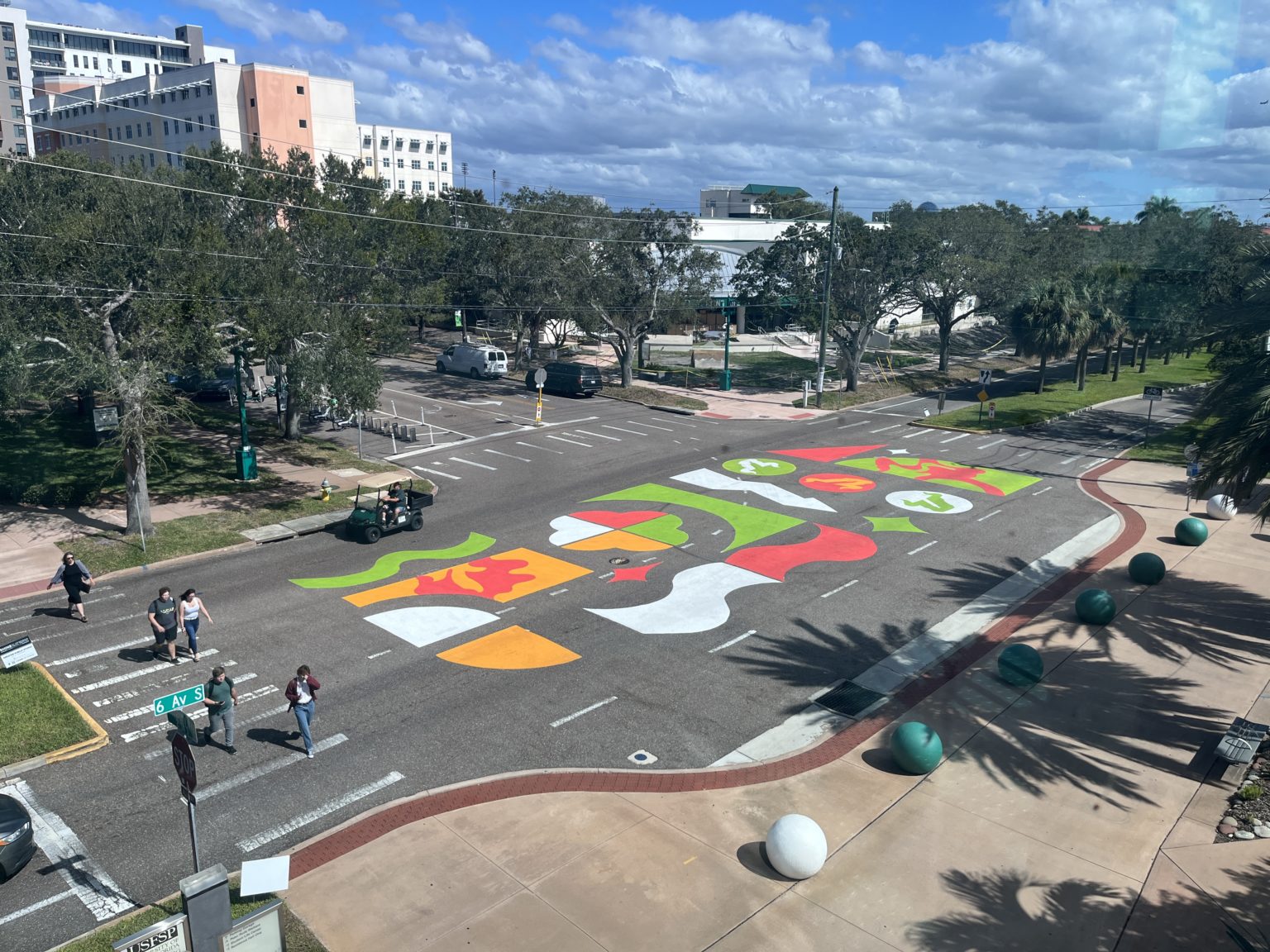
Fluid Structures mural painted by Jay Giroux and students on the USFSP campus.
Photo by Suzanne Townsend
By Julia Ferrara
On August 29, St. Petersburg Mayor Ken Welch visited USF’s St. Petersburg campus to see the mural “Fluid Structures” and speak with students — answering questions and providing information about the city’s next steps.
“What replaces those murals is going to be much more impactful for us going forward,” Welch told The Crow’s Nest.
Hours later, the Florida Department of Transportation (FDOT) arrived on the St. Petersburg campus to remove the mural.
That evening, FDOT removed the “Black History Matters” mural in front of the Woodson African American Museum.
Days after giving St. Petersburg a Sept. 4 deadline to remove all street murals following a months-long battle to keep them, FDOT initiated the murals’ removal process.
How it all started
On June 30, FDOT released an internal memo pushing state officials to comply with the current standards for pavement or surface art. If they didn’t, they could risk losing state funding.
FDOT Assistant Secretary Will Watts shared in the internal memo that non-compliant street art would include anything with “social, political, or ideological messages or images.”
“Permission to allow non-compliant traffic control devices or pavement marking to remain may be granted at the department’s discretion, if the public agency is able to demonstrate good cause for doing so,” Watts said.
Failure to remove pavement markings that aren’t compliant can be considered cause for withholding of state funds.
State officials had until Aug. 30 to send their list of intersections with markings to federal traffic leaders, and those locations must be addressed by the end of Sept. 2026.
Orlando was one of the first cities in Florida to comply, having crews remove the rainbow crosswalk near the Pulse Nightclub, which served as a memorial for the 49 people killed in the 2016 mass shooting.
The day after its removal, 200 people showed up to protest, and many recolored the crosswalk using chalk.
St. Pete reacts
Mayor Ken Welch shared in an address to the city on Aug. 25 that while they don’t plan to contest the ban, he wanted residents to know that they will respond by continuing to support the community.
“It’s always troubling when state or federal politicians attempt to usurp our local values and priorities and instead, mandate what our values should be,” Welch said.
“We made it clear that these murals are more than paint on pavement. They are expressions of our community identity and values.”
Last week, the state rejected St. Petersburg’s exemption request to keep several of its street murals, despite the city’s submission of data showing that safety doesn’t decrease with the presence of surface art.
After consulting with the City Attorney’s Office, Welch shared that challenging the state would only pose a risk for St. Petersburg in the long run and that how they choose to proceed will be deliberate.
St. Pete Pride Executive Director Bior Guigni said that these changes don’t alter the work they are doing.
“This legislation cannot – and will not – erase our rich culture, our loving presence, or our vibrant community,” Guigni said. “We will continue to celebrate Pride boldly, visibly, and unapologetically every day and everywhere we go.”
St. Pete Pride Board President Dr. Byron Green-Calisch shared in a press release that FDOT’s instruction is yet another effort to silence, exclude, and erase the LGBTQIA+ community’s presence in the city.
“Public art, including painting crosswalks, serves as a powerful symbol of inclusion, love, and solidarity,” Green-Calisch said.
“For many, the rainbow imagery on our streets is more than just decoration, it is a beacon of hope, a sense of belonging, and affirmation in public spaces where LGBTQIA+ individuals and allies gather and celebrate.”
Friday night, during the removal of the Woodson Museum’s “Black History Matters” mural, pastors and activists Andy Oliver and Benedict Atherton-Zeman were arrested, as reported by Creative Loafing.
The two were charged with misdemeanor obstruction and “Pedestrian obstructing or hindering traffic,” after praying in the road and refusing to move, according to the St. Petersburg Police Department’s public information officer.
What the futures hold
“Our response will be strategic, not reactionary. It may not be as emotionally satisfying as a street brawl,” Welch said.
Welch concluded his Aug. 25 speech with a call to action, urging residents to visit, photograph, and share those photos of the mural sites to demonstrate the integral connection between the city and these works of art.
“And to those who think they can silence St. Petersburg, all you have done is amplify our voice.”