
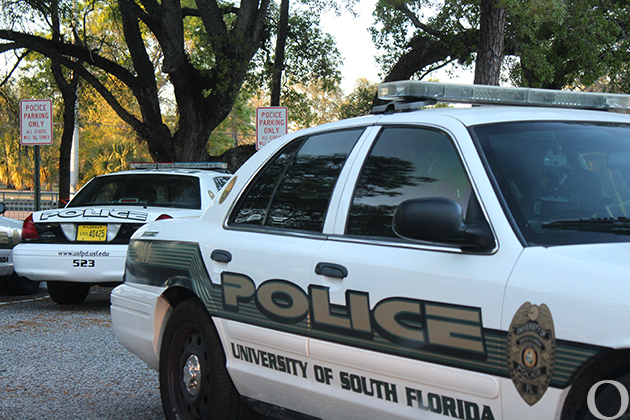
As of Sept. 23, there have been 27 school shootings on college campuses this year.
Photo courtesy of Aubrey Carr | The Crow’s Nest
By Dominic Feo
When University of South Florida freshman Nathan Billiot was leaving campus on Aug. 30, the last thing he expected was to see a fleet of cop cars speeding in the opposite direction. They were heading toward the campus library where an active shooter supposedly barricaded themself inside.
“I have a group chat with some friends, and everyone’s texting, ‘Do you guys know what’s going on? There’s cop cars everywhere,’” freshman Nathan Billiot said. “Then someone sent a picture of cop cars lined up around the library. That’s when we kind of knew something was up.”
When police arrived at the scene they searched for a shooter to no avail.
It was later revealed that there was never an active shooter on campus.
Online chatrooms and social media were how most students and their families learned that USF was the latest victim of a modern phenomenon called “swatting.”
Merriam-Webster describes swatting as making a false report of an ongoing serious crime in order to elicit a response from law enforcement.
The call on Aug. 30 elicited a response not only from the USF Police Department, but several other local units.
The Tampa Police Department, Hillsborough County Sheriff’s Office, Temple Terrace Police Department, and USFPD were deployed after TPD was immediately notified.
“USFPD officers responded to the library and arrived within two minutes of receiving the call,” said USFPD Chief Christopher Daniel via email. “Out of an abundance of caution the library was evacuated and thoroughly searched.”
Dozens of officers called in, and potentially hundreds of panicked calls between students, faculty and their families caused by just one ominous call from someone who may never be found.
“Technology has really made that type of deviance easy to do,” said Chair of the Department of Criminology George Burruss.
USF is one of nearly 50 U.S. colleges that have received a swatting call this academic year. The spike in hoax calls may be related to the increased frequency of real incidents in recent months.
A gunman opened fire at Florida State University on April 17, killing two and injuring six people. On August 27, a shooter attacked a Catholic school in Minneapolis, killing 2 students.
Threats to USF Tampa after real events are nothing new. An empty gun case with empty ammunition magazines were found at the USF Fine Arts Building on April 21. Four days later, an empty gun cartridge was found at the same building’s parking lot.
“I think an incident of any kind like that draws a lot of attention and creates copycats, just because they see what the effect is,” Burruss said. “It could be simple as someone watching social media, or the news. They see an effect and think, ‘I can do that too.’”
Burruss said he believes that the prestige of colleges and universities makes them common targets.
“[Colleges] are a prominent institution in the city, in whatever city you’re in,” he said. “If you do one incident, let’s say in the parking lot on one part of campus, it affects the entire campus.”
Hoax calls are treated with an abundance of caution due to the potential severity each threat holds. Even though USFPD said that the call they received showed “characteristics of swatting,” they evacuated the library and searched the surrounding area.
USFPD’s response was immediate, however, an alert was not issued by the school until an hour and a half later. USFPD’s reasoning was that issuing a notification straight away could “compromise efforts to respond to or otherwise mitigate the emergency.”
Billiot has mixed feelings about how USF handled the situation.
“It’s a little unsettling that there was nothing, but I understand at the same time because they don’t want to cause widespread panic,” Billiot said.
As modern technology continues to evolve, this problem has the potential to grow more common and widespread.
“People do it for really cheap, do it anonymously and without much concern about getting caught,” Burruss said. “This is one of those things in life we’re just going to have to live with.”