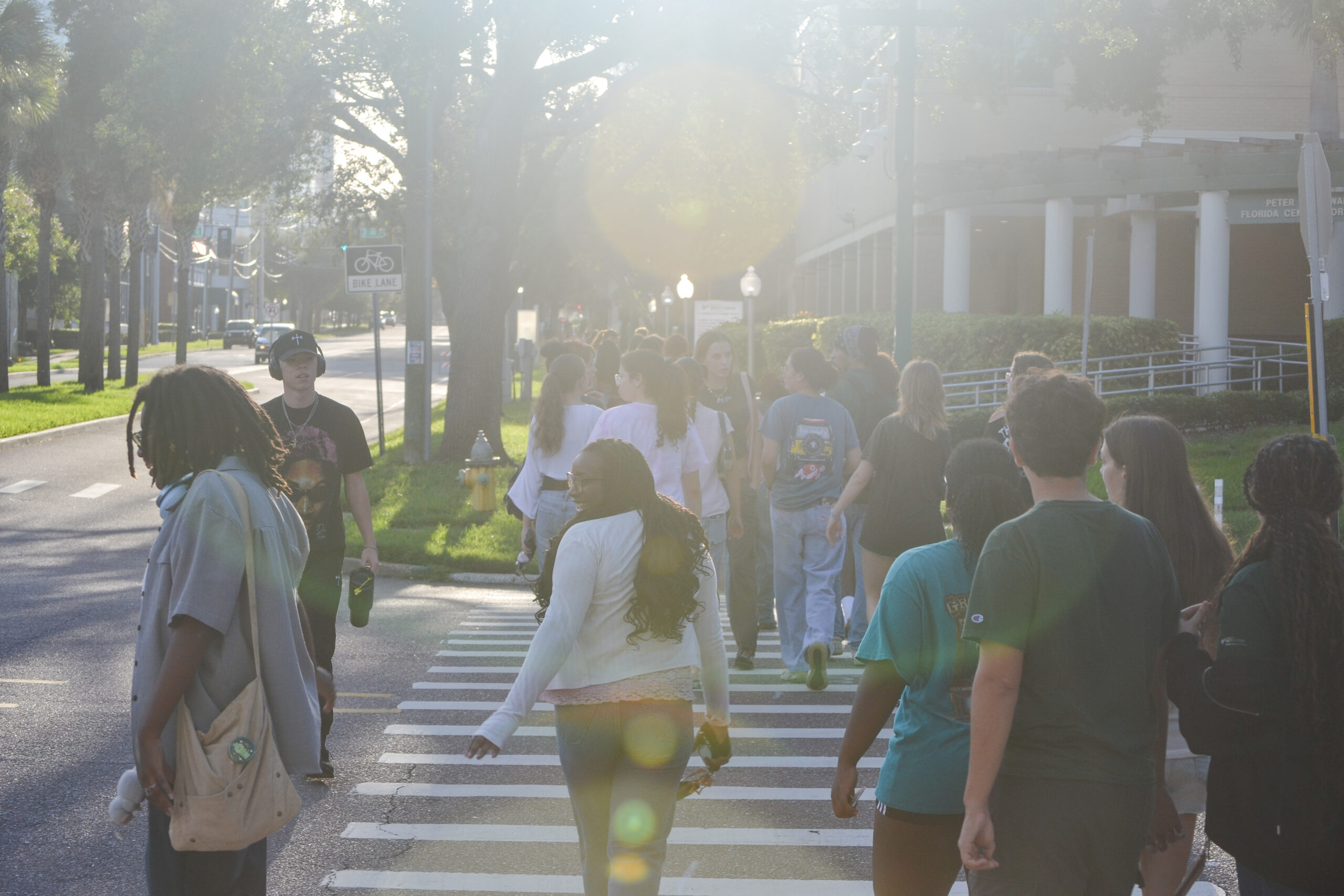
Photo by Makenna Wozniak | The Crow’s Nest
By Julia Birdsall
Nearly six years ago, the world changed in response to the COVID-19 pandemic.
People were absent from their jobs, their schools and their loved ones for months, or years in some cases.
While the worst of the threat is over and people are free to work, attend classes and see their loved ones as much as they would like, the impacts of the pandemic still linger — especially on college campuses where students were shaped by COVID-19 at various points in their academic careers.
Michael Schneider, a freshman digital communications and multimedia journalism major, was in 7th grade when COVID-19 moved in-person classes online.
He told The Crow’s Nest that he had the opportunity to go back to in-person learning for his eighth-grade year but chose not to.
“I had gotten so comfortable staying at home and doing my work and just going out in Zoom classes that I was kinda like a hermit at the time,” Schneider said.
Now, in college, he finds that online asynchronous classes are more “convenient” for him. He prefers them to in-person classes and especially to synchronous online courses, mostly because of his experience with Zoom classes during the COVID-19 lockdown.
“In our generation, I’d say if you asked them about how they thought about Zoom calls, people would probably say, ‘Oh yeah, I showed up, but I didn’t pay attention at all,’” he said.
Sophomore speech, language and hearing sciences major, Victorya Santos, was in eighth grade when the pandemic hit and said that she experienced a similar disconnect from learning during her months at home.
She told The Crow’s Nest that her school didn’t provide any education for the first few weeks of the lockdown, which may have contributed to a “phone addiction.”
Santos returned to school in fall 2020, but she stated that returning to in-person learning and starting high school was a shock.
“I definitely started to fail a little bit at the beginning of my freshman year because of the lack of study help,” Santos said. “I think COVID definitely — I wouldn’t say regressed me — but it just made me more lazy.”
While Santos’ education has not regressed on account of COVID-19 lockdowns, studies show that this is the case for a number of students.
The Harvard Graduate School of Education wrote that “The average U.S. public school student in grades 3-8 lost the equivalent of a half year of learning in math and a quarter of a year in reading.”
Victor Gallego, a senior biology major who was a junior in high school when the pandemic hit, said that the open-note quizzes and tests that his school offered to accommodate for online or hybrid learners in the months after the lockdown made testing too easy and had “slowly but surely lessened the use of critical thinking skills and true study skills.”
“I went from studying hard and organically doing my best, my junior year… My senior year I barely studied for any test or quiz that came, and putting off that hard work ended up setting a precedent that was not good,” he told The Crow’s Nest.
It isn’t just students noticing the pandemic’s impact on their academic abilities.
Julie Buckner Armstrong, an English professor who has been teaching at the University of South Florida for about 25 years, noticed a shift in her students’ capability to complete assignments in the years following the COVID-19 pandemic.
“In a literature class I used to [assign] way more than one novel—it might be a class where we read novels—and there might be a book a week,” they said. “There’s no way I would assign a book a week now because students either can’t or won’t read it. And that’s true of English majors.”
She also told The Crow’s Nest that, while they do not know whether or not the cause of this can directly be linked to the lockdown, Armstrong does believe that more time spent online “translates to shorter attention spans and less ability to concentrate deeply.”
This trend may align with students’ increasing habits of cognitive offloading in academic settings by using AI. Though the potential causes behind this phenomenon are still being studied, increased phone usage during the pandemic, as Santos experienced, may be one factor.
However, according to Armstrong, students have become “much more visually literate.”
An article published by The National Institute of Health (NIH) shows a link between social media usage and visual literacy skills.
Social media became one of the main ways for people, especially young people, to communicate with one another during the lockdown, which could explain why students became inclined to spend more time on their phones.
Schneider said that video games were his and many of his peers’ main form of connection with one another during the lockdown.
Now, he finds that communicating through online platforms is easier for him because he “got so used to it” during the pandemic.
While this form of communication was found to be positive and essential during the lockdown, excessive internet usage has been linked to mental health issues.
“More active and prolonged SM [social media] usage was associated with a negative impact on MH [mental health] of adolescents and students,” the NIH found.
This relates to another change that Armstrong witnessed in students: their proclivity to open up about mental health, which may be linked to the isolation that students experienced during the COVID-19 lockdown.
“Because there is a lot of social isolation and it does exacerbate things like anxiety and depression,” she said. “[Students] are much more likely to verbalize and advocate for themselves if they are getting treatment for those kinds of things.”
The heightened awareness of mental health issues was one positive impact of the COVID-19 pandemic. Another, Gallego observed, was that he and many others discovered the importance of maintaining friendships.
“The memories you make with people can help [form] a friendship. I think the absence of said memories [during COVID-19] helped contribute to the demise of some friendships,” Gallego told The Crow’s Nest.
Since returning to school and entering college, Gallego said that he always tries to make the most of his time with others.
“If there’s anything the COVID pandemic and that time period taught me,” Gallego said, “[It’s that] it’s important to treasure those who are close to you and also never be afraid to reach out to other people.”