
Photo by Makenna Wozniak | The Crow’s Nest
By Julia Birdsall
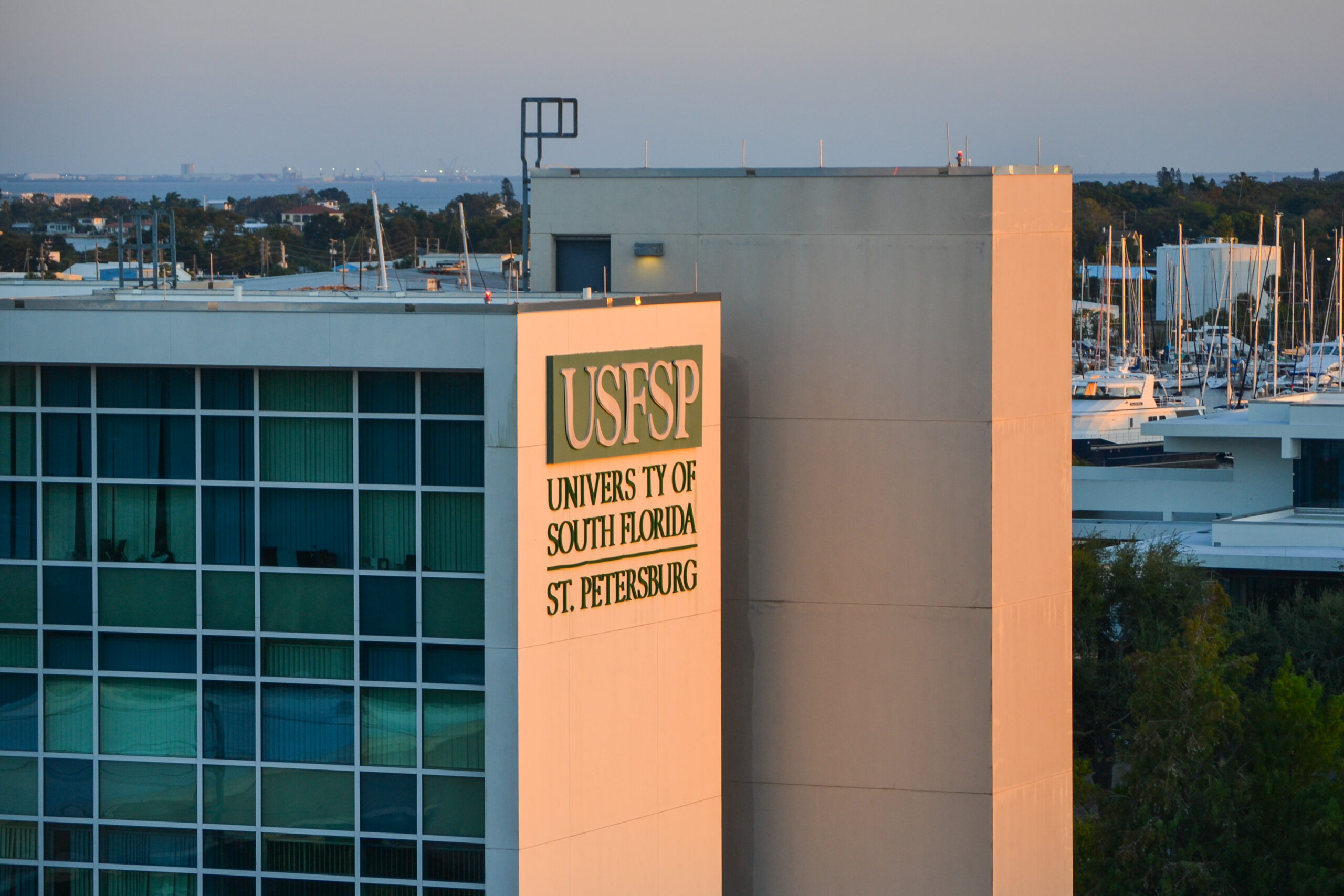
Donna Knudsen, the St. Petersburg campus assistant dean for graduate studies and former University of South Florida St. Petersburg graduate student, compared the St. Petersburg graduate student experience to the isolation experienced during the COVID-19 pandemic.
This is in comparison to the Tampa campus, which she said has “more graduate students living and working on campus.”
“You have much more of that engagement just strictly from the standpoint that it’s their residence as well,” Knudsen said. “So, everything is wrapped up within the [Tampa] campus. Whereas here [in St. Petersburg], it’s a commuter campus.”
USF St. Petersburg is known for its smaller class sizes. This is part of the reason that some undergraduate and graduate students choose to pursue a degree at the campus. However, graduate students say that life at the St. Petersburg campus is a negotiation between quality education and limited resources.
Liana Howe, a first-year graduate student in the Florida studies program whose main focus is history, told The Crow’s Nest that her program’s faculty inspired her to pursue it.
“They not only are so helpful as far as making sure I’m pursuing things that I’m interested in, but also mentoring me,” Howe said. “I feel like I’ve learned so much about academia and about what my future looks like through them.”
But she has had trouble connecting with other graduate students and believes that commuting to Tampa for future classes will allow her to form those connections.
The only drawback to commuting is the time it’ll take, which Howe is dreading.
“Something about grad school… it’s so busy,” she said. “It’s just the idea of losing that couple of hours of commute time is already stressful, let alone being able to afford the gas and everything is just a lot.”
Holly Shuff, a second-year graduate student in the Florida studies program with a concentration in environmental anthropology, commutes to the Tampa campus for a class and said she often misses the St. Petersburg campus environment.
“I’m getting a lot more out of that for myself and experience, work-wise, and more opportunities than I would have had anywhere else,” Shuff said.
Her class in Tampa does not utilize field trips like her St. Petersburg classes do, which is the biggest difference in her experiences at each campus.
“Those helped foster a sense of community with the other students in the program and professors, as well as to see real-world firsthand experiences of practical applications of our fields of study,” she told The Crow’s Nest.
However, she says that moving back home and away from the city St. Petersburg to reduce housing costs has had a negative impact on her academics.
“What does suck is because I do commute, I’m not on campus as frequently. It’s harder to get focused on your work and you’re not surrounded [by] that environment, versus when I’m here and around my peers it’s a lot more convenient and beneficial,” she said.
Most graduate students are commuters, but whether this is by choice or due to the limited number of designated space for graduate students in USF St. Petersburg’s residence halls is unknown.
This has forced many students to choose between living close to campus and paying the city’s rising prices for “really small places,” like Howe, or moving back home and committing to a long commute to the St. Petersburg campus, like Shuff.
Walker Adam Taylor, a second-year psychological sciences graduate student with a data analysis certificate, told The Crow’s Nest that living off campus in St. Petersburg becomes especially problematic during hurricane season.
His house was destroyed in Hurricane Milton. In the aftermath, he didn’t have the support he needed and had to search for an affordable place to stay on Facebook.
“I think that’s always going to be a struggle, honestly, and I think it’s just going to continue to get worse,” he said. “That’s just part of downtown [St. Petersburg] living.”
Despite this, he chooses to remain at St. Petersburg because he loves the location and the smaller campus.
“We’re such a small campus that if you do have questions, there’s not a line to wait,” he said.
Knudsen referred to the personalized education and close professor and student relationships as “the concierge approach.”
She said that a huge part of her job is helping to facilitate the relationships between students and faculty who can assist and mentor them.
“If you’re a graduate student in St. Petersburg, all of the professors in your program, in your major, know who you are and you know who they are,” she said. “They all, then, become advisors. And so, you really do get that concierge.”
She also facilitates peer relationships between graduate students through the recently implemented Relate-A-Bull program, which Knudsen helped create.
Through this program, graduate and doctoral students can volunteer to take training courses and become peer mentors.
So far, 120 students have been trained, Knudsen said, and they will be able to assist their peers by answering questions and giving pointers as someone who is or was in the same position.
“There’s that availability for the connectivity of like having and forming a relationship with a mentor, or your academic boss, or the students, or your peers around you,” Taylor said. “I think this campus kind of encapsulates that, because, again, it’s only 4,500 people.”