
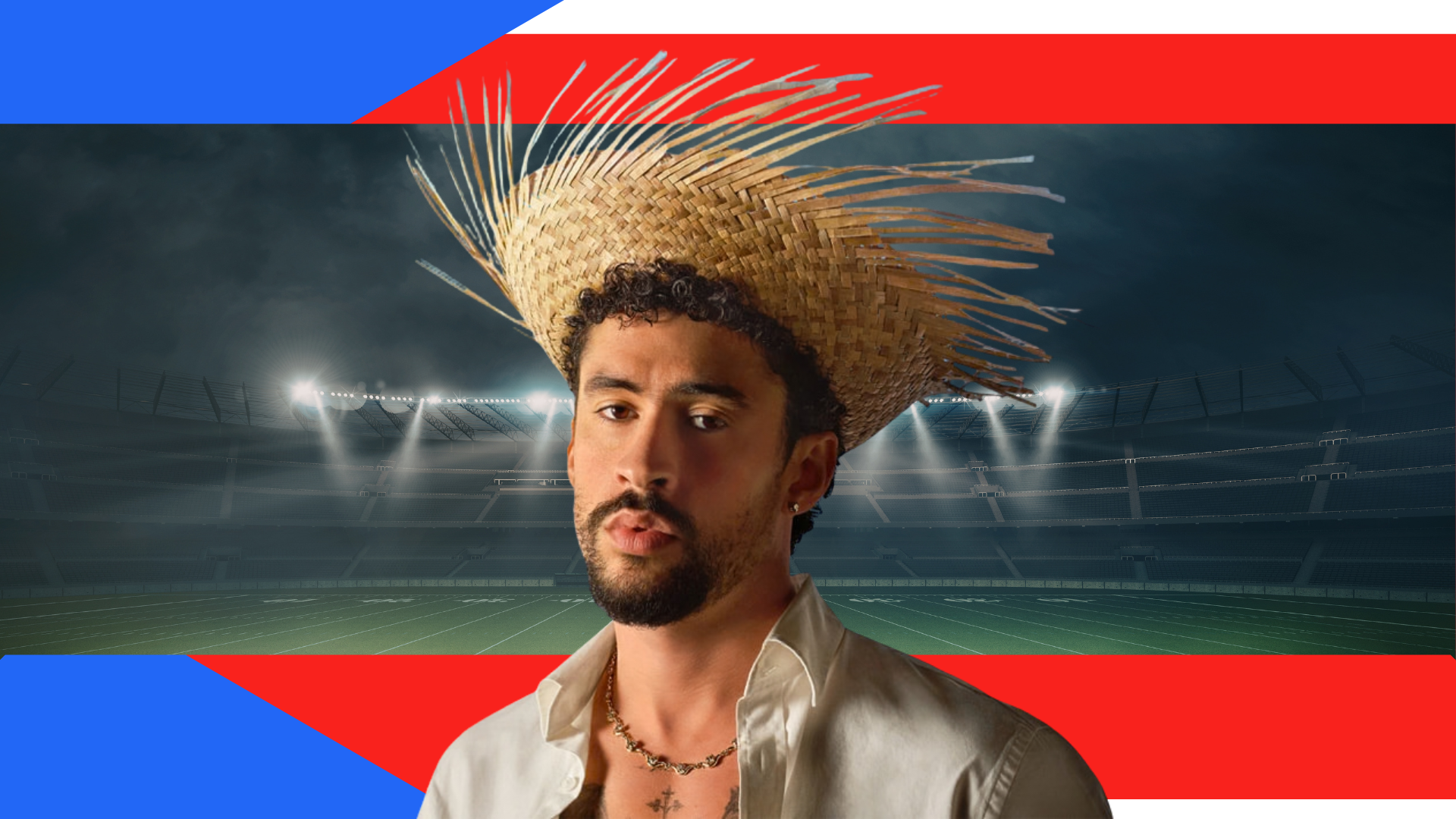
“I grew up mainly in Puerto Rico, so the Super Bowl wasn’t really talked about. Usually, it’s just the halftime show,” said junior psychology major, Andrea Mojica Gonzalez. “You sit down and watch the halftime show, and that’s it.”
By Secilia Ruiz
Hispanic and Latin American families across the world gathered around their televisions on Feb. 8 with flags around their shoulders and pride in their hearts.
Grammy-winning Puerto Rican artist Bad Bunny made history with his performance at the 60th NFL Super Bowl halftime show, which he performed almost entirely in Spanish.
Nerey Nunez, senior biology major and president of University of South Florida St. Petersburg’s Latin American Student Association (LASA), said the selection of Bad Bunny for the halftime show was important to them because they are Puerto Rican, so they grew up connecting to his music.
Junior environmental science major Adriana Santos echoed a similar sentiment.
“It doesn’t matter whether or not we like his music… he’s Puerto Rican, and it’s important to uplift Puerto Rican artists,” Santos said.
Many fans felt that the timing of Bad Bunny’s selection to perform was important, as he’s always been a strong activist for the struggles of all Latin American people.
“Bad Bunny has always been a person to speak out…He’s spoken out against the immigration policies. He’s spoken out against the president before,” said junior psychology major, Andrea Mojica Gonzalez. “So, for everything that’s happening right now with ICE, you just knew that he was gonna say something about it.”
When it was announced on Sept. 28 by the NFL and Apple Music that Bad Bunny would be performing at the Halftime show, there were a variety of strong reactions, including criticism.
Some stated Bad Bunny’s music is being primarily in Spanish, was not “American” enough.
However, junior English major Lauren Lee, pushed back on this notion.
“There’s not a singular language for the United States. It’s a mix of cultures, and that’s what America is about,” Lee said.
Puerto Rico has been a part of the United States since Dec. 10, 1898.
“It felt like it came from a place of ignorance, calling Bad Bunny ‘un-American,’ or ‘not American,’” Santos said. “Because Puerto Rico is an American colony. Whether I like it or not, it is a part of the United States, technically.”
Despite the controversy, Bad Bunny performed a love letter to Puerto Rican and Latin American culture.
“I didn’t grow up around a lot of Puerto Rican kids,” Santos said. “So being able to see Puerto Rico on national TV was so huge for me and so huge for my whole family that we didn’t really know how to react.”
Nunez pointed out the symbolism present throughout the performance.
“Not only was it fun and it celebrated Puerto Rican culture… it also drew attention to some of Puerto Rico’s social issues as well,” Nunez said. “Like when they performed ‘El Apagón’ on the light poles, that kind of [represented] how there’s frequent power outages in Puerto Rico because of mismanagement of their energy. So, it was very moving and very impactful.”
Students felt Bad Bunny emphasized the importance of unity in his performance.
“While it has caused division, I also think it has caused union where maybe [we], as a community, didn’t expect,” an anonymous member of USF St. Peterburg’s LASA told The Crow’s Nest.
“I’ve already seen Bad Bunny’s [Halftime] show bringing people together,” Nunez said. “Just on campus and people coming to… the Office of Multicultural Affairs, [which has a cardboard cutout of Bad Bunny displayed], and being like, ‘I love [your] Bad Bunny cut out. He did such a good job,’ and saying that they want to come to more LASA meetings.”
Lee’s desire is that this performance provides a sense of relief for Latin American people facing oppression right now and inspires lasting change in the way they are treated in the United States.
“I hope that [Latin American people] realize that there are people behind them supporting them…and that we will stand and we will fight for them,” Lee said. “I hope people realize that love is more powerful than hate.”


![“[The 9/11 Memorial Stair Climb is] really to show our support and help build community and camaraderie with the first responders that are putting on this event at the Rowdies Stadium and to showcase our office and give the student veterans here and miliary-connected students something positive to do that day and a feeling of belonging,” veteran and junior personal financial planning major Thomas Wells said. Courtesy: Tampa Bay Rowdies](https://crowsneststpete.com/wp-content/uploads/2026/09/Stair-Climb-1.jpg)