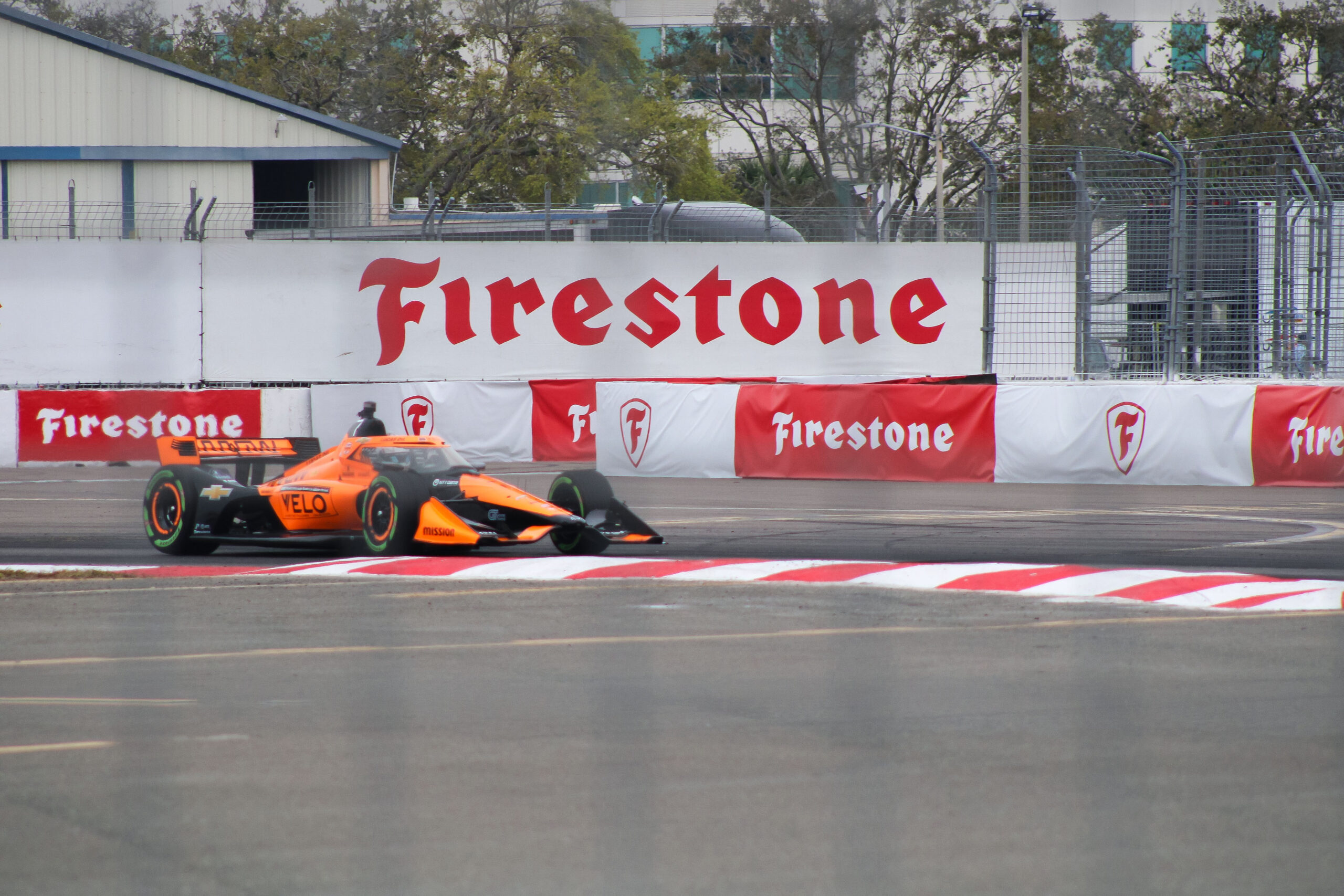
Racing on the St. Petersburg street circuit dates back to 1985. Today, it serves as the season opener for the NTT IndyCar season.
Photo by Irena Mesa
By Irena Mesa
With numerous series that all have their own rules and regulations, motorsports can be difficult to understand.
In anticipation of the Firestone Grand Prix of St. Petersburg beginning on Feb. 27, The Crow’s Nest has you covered on the essentials.
The St. Petersburg Grand Prix hosts five of those series: NTT IndyCar, IndyNXT, USF 2000, the Mazda MX-5 Cup and the NASCAR Craftsman Truck Series. This will be the first year that the NASCAR Craftsman Truck Series will be racing on the street circuit.
Nascar Craftsman Truck Series
The NASCAR Craftsman Truck series features stock trucks and it is the third tier of NASCAR’s three series. (The first is the Cup series — which is the NASCAR that one might think of — the O’Reilly Auto Parts series — their dedicated feeder — and trucks, which ranks just below the O’Reilly Auto Parts series.)
Alongside the drivers who will participate in the entire season, two drivers who are very familiar with the streets of St. Petersburg will be joining them.
The first is James Hinchcliffe, who raced in IndyCar from 2011 to 2021 and is currently on the IndyCar broadcast team. He won the race in 2013.
Dario Franchetti is the other addition, who has four IndyCar championship titles and won the Indy 500 three times, alongside a long racing career in numerous other series.
In 2011, Franchetti won the St. Petersburg Grand Prix.
IndyCar
Next on the list is IndyCar, which is the premier open-wheel racing series in North America.
While the IndyCars resemble those seen in Formula 1, they’re quite different.
Formula 1 gives racing teams a set of regulations and teams build their own cars based on them. IndyCar is what’s known as a spec series, meaning that the cars are the same aside from the engines.
IndyCar uses two engine types: Chevrolet and Honda. Each racing team selects its engine.
Despite having teams, it isn’t much of a team sport beyond teammates potentially sharing data and strategies to improve their lap times. Otherwise, the teams act primarily to support their drivers in the individual championship, which is won through scoring points with high finishes.
While those engine manufacturers didn’t change between the end of last season and now, there were plenty of driver changes — seven in total.
However, the most notable was a driver leaving a team.
Team Penske didn’t re-sign veteran Will Power and later selected David Malukas as the pilot of the number 12 car. Power is now racing for Andretti, taking over the number 26 from Colton Herta, who moved to Formula 1 as the test driver for Cadillac.
Another, Rinus Veekay, is moving from Dale Coyne Racing to Juncos Hollinger Racing.
Two other notable additions to the field are Mick Schumacher and Romain Grosjean, who both raced for Haas in Formula 1. Shumacher will be joining Rahal Letterman Racing, and Grosjean will drive for Dale Coyne.
The remaining additions are rookies who graduated from IndyNXT, the final step in the feeder series ladder before IndyCar.
Dennis Hauger won both the St. Petersburg Grand Prix and the IndyNXT championship last year, which earned him a spot with Dale Coyne Racing.
Caio Collet was on the podium in St. Petersburg last year and will be racing for AJ Foyt Racing in IndyCar.
USF2000
Two steps below IndyNXT is the USF 2000 Championship, which is not connected to the University of South Florida.
The driver who wins the series is awarded a scholarship to the next series, the USF Pro 2000.
Kyle Kirkwood and Christian Rasmussen are two current IndyCar drivers who won the USF 2000 Championship.
Mazda MX-5 Cup
Similar to the IndyCar series, the Mazda MX-5 Cup is another spec series with Mazda MX-5’s. They travel to races on the IndyCar and IMSA — an American endurance racing series — calendars.