Photo courtesy of USF St. Petersburg MPB
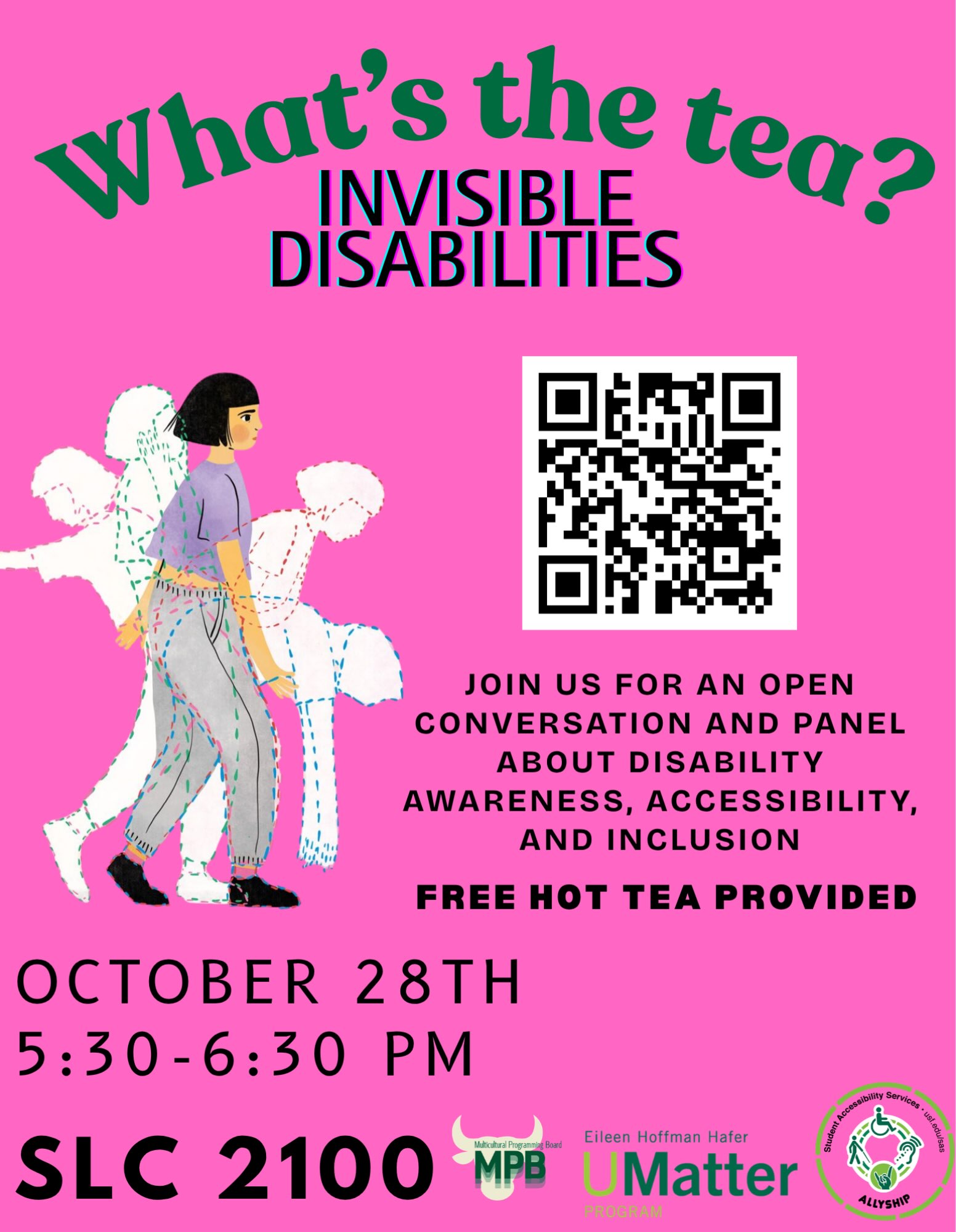
On Oct. 27, the University of South Florida St. Petersburg Multicultural Programming Board (MPB) hosted an event titled “What’s the Tea: Invisible Disabilities”. In partnership with the organization to speak at the event were USF St. Petersburg’s Student Accessibility Services (SAS) and UMatter program.
Invisible disabilities are disabilities that a person has that may not be visible on the outside. This can include attention deficit hyperactivity disorder (ADHD), arthritis, endometriosis, long covid, postural orthostatic tachycardia syndrome (POTS) and many other chronic illnesses and mental health conditions as stated by Hidden Disabilities Sunflower.
“It’s present, but it’s present in a way that is not apparent to the naked eye,” MPB Executive Director, Fabricio Lozada told The Crow’s Nest.
“If you see someone in a wheelchair you can infer that they have some sort of disability … but something like epilepsy, you can’t really tell from looking at a person. And it obviously impedes certain aspects of not only their student life but just life in general,” Lozada said.
MPB Coordinator of Programs, Alexis Slappey, inspired the organization to host the event. She pitched the idea to the board with a goal of educating students on invisible disabilities and ways that students who have them can find support on campus.
“… I think that some of the language that is used when it comes to these types of disabilities is ‘Well, you look fine … surely it doesn’t affect you as much.’ And it’s not like that at all … To simplify it to that, I think it’s really harmful for them,” Lozada said.
Someone who isn’t disabled may not naturally be having these conversations. In fact, they may even be the ones who perpetuate harmful rhetoric or discriminatory behavior towards those who do.
Lozada stressed that creating educational spaces where students have a chance to be curious and engage in dialogue amongst one another leads to more knowledge surrounding these disabilities and how students can be supported while navigating them in college.
“It’s a topic that’s very discreet,” he said. “Because I think that there’s a certain aspect of vulnerability that comes with talking about disabled individuals if you’re not disabled yourself.”
UMatter Program Advisor, Luke King, was the first to present at the event, highlighting the program’s mission to guide disabled students on campus through peer mentorship and support them as they navigate college.
“We’re really here to advocate for students with intellectual disabilities and help them feel a part of the community here,” King told The Crow’s Nest. “I have an intellectual disability, but I can communicate perfectly fine, I look like I don’t have one. But someone may not understand that… Perspective is the biggest barrier.”
Through the program, disabled students receive academic support that is tailored to their career goals, help with finding work, support with honing the ability to do tasks on their own and guidance in connecting with fellow students on campus.
“Coming into a college life experience like this, it can be a lot,” King said. “… It’s very exciting but very nerve-racking for a student with an intellectual disability, not knowing what it’s like to be away from home … We work on that as well as a team.”
SAS Associate Director, Allison Dinsmore, echoed a similar sentiment, stating that independently managing assignments, busy schedules, project deadlines and tests can take a toll on the wellbeing of students with invisible disabilities.
“College requires students to navigate many responsibilities at once, including coursework, exams, deadlines, attendance, group projects and independent time management,” Dinsmore told The Crow’s Nest. “…These demands may interact with challenges related to concentration, executive functioning, sensory processing, mental health, pain, stamina or other aspects of managing a chronic condition.”
As Dinsmore delivered her presentation, she emphasized that her department’s duty is to ensure that accommodations are given to students with disabilities, visible or not. They tackle the barriers that may stand in the way of disabled students being able to thrive in college.
Serving as one of these barriers is harmful language that dismisses the experiences of individuals with invisible disabilities. Dinsmore addressed this with a slide titled “Myths vs. Reality”. The slide displayed common phrases and false information that individuals with invisible disabilities may hear.
“Comments such as, ‘you don’t look disabled’ or assumptions that accommodations give someone an unfair advantage can unintentionally create barriers for people seeking support,” Dinsmore said. “The important thing to understand is that we cannot determine someone’s disability, its impact or their support needs simply by looking at them.”
Those with invisible disabilities have a harder time being believed in their struggles and them being taken seriously due to appearing “unaffected” on the outside. Dinsmore stressed that these individuals can experience a flare up of symptoms at any time, causing the days that they seem fine or experience immense pain or struggle to vary.
“College campuses bring together people with different experiences and levels of understanding about disability, so misconceptions can arise in any campus community. The opportunity is to address those misconceptions through education, communication, and collaboration,” she continued.
“… Remember that creating an accessible community is a shared responsibility. Small actions that demonstrate respect, flexibility, and consideration can help make educational environments more welcoming and accessible,” she said.
Lozada closed the event with a message to attendees, telling them that even after the event ends, they should continue the conversation surrounding supporting students with invisible disabilities on campus.
“Just wanting to learn and being willing to try to put yourself in other people’s shoes, trying to understand their perspective I think is really important,” Lozada told The Crow’s Nest.
“…That creates an environment where a student with an invisible disability doesn’t feel as isolated and they feel as though people understand what they are going through… It’s a matter of wanting to know, it’s a matter of trying to educate yourself … These are your friends, these are your peers, you want to look out for them,” he said.
Students can apply for academic accommodations, schedule accommodated exams and request accommodation letters by visiting the SAS website. To apply to the UMatter program, they can fill out the interest form on their website.