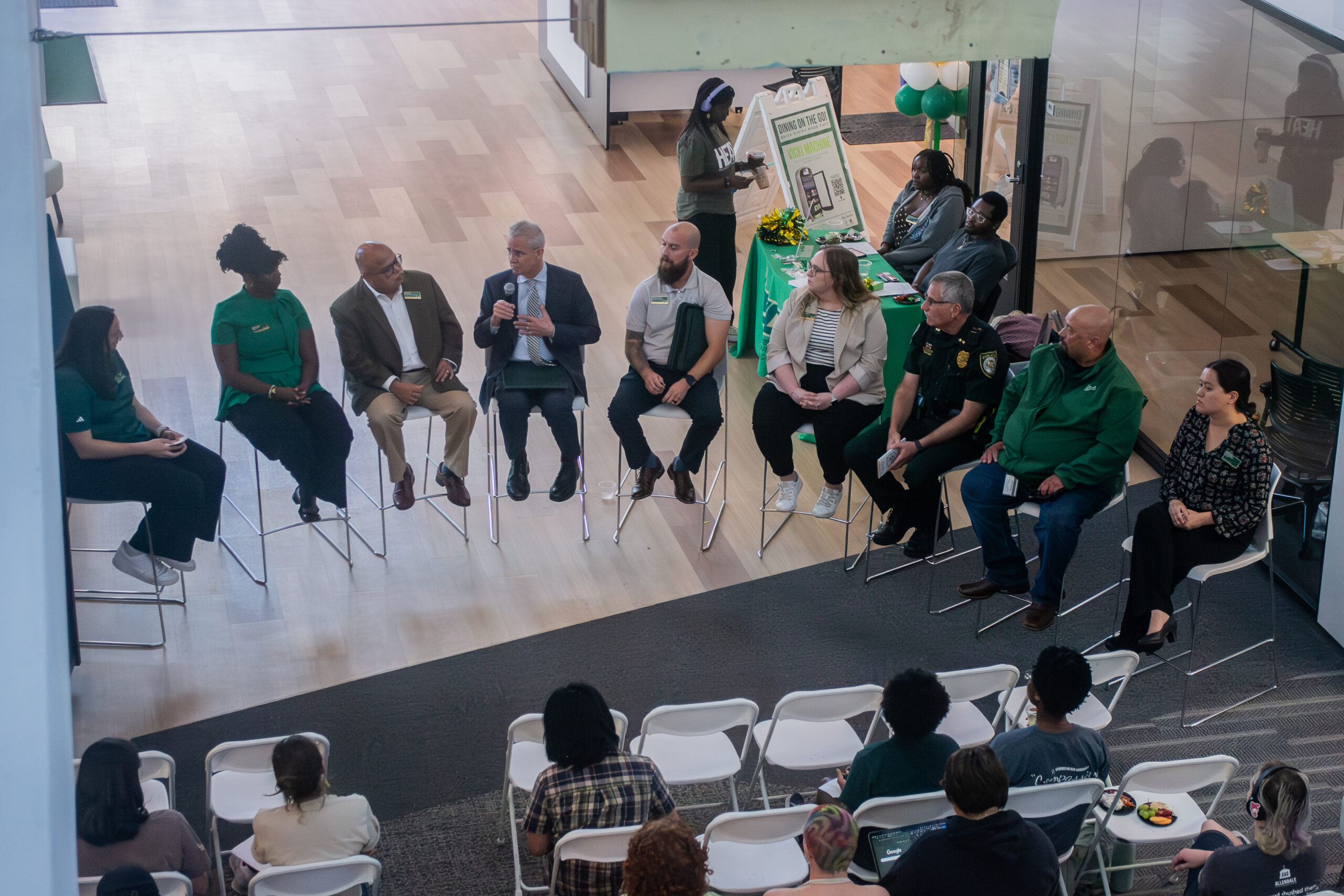
Students, government members and university faculty were asked questions on a myriad of topics, such as maintenance requests and the identity flags in the USC.
Photo by Makenna Wozniak | The Crow’s Nest
By Julia Ferrara & Alisha Durosier
University of South Florida St. Petersburg students and faculty from various departments met in the atrium of the Nelson Poynter Memorial on April 2 for the annual town hall — an opportunity for students to ask campus administrators questions and voice their concerns.
Hosted by the USF St. Petersburg student government, students addressed their questions to a panel of campus faculty and student employees.
The panel consisted of Interim Regional Chancellor Thomas Smith, campus Governor Elise Prophete, Lieutenant Governor Victoria Drews, Assistant Director of Housing Stephen Harris, Assistant Director of Residential Education Amy Pounders, Regional Chief of Police David Hendry, Facilities Director of Operations, Parking and Transportation Director Scott Fox, USF Dining’s Marketing Coordinator Rachel France and USF Culinary Director Antonio Garcia.
The event touched on a number of topics, from housing cost to censorship. Here is what you need to know.
Campus Diversity
Much of the concerns brought forward by students referenced diversity and representation on campus.
Diversity in higher education has been a point of contention for Florida universities since 2023, when Gov. Ron DeSantis signed SB 266.
Tensions spiked for USF St. Petersburg students a year later, when the identity and multicultural flags once adorning the ceiling of the campus university student center were taken down after a visitor complaint.
Interim Chancellor Thomas Smith and Dean of Students Jacob Diaz took the lead in responding to questions regarding representation.
Smith took a more academic approach with his response, noting the importance of intellectual diversity within the classroom.
Alternatively, Diaz touched on diversity from a more political standpoint.
“I think we live in times right now where there still exists this hierarchy of human value. And I think for me, what keeps us awake at night here is this idea that we still have a lot of work left to do about addressing that gap. And I think that systemic oppression, systemic racism, gender, class, it still impacts the environment. And so, I think for me, it is about having a discussion about ideas, about who’s represented, who isn’t…” he said.
Students agreed with this sentiment but also emphasized wanting something tangible.
“I do agree that the multicultural organizations provide a beautiful community for our diverse population. But as a Latin American student, I don’t feel like that’s enough representation for me on this campus,” environmental science and policy junior Emilia Wrucke said. “I would like to see some change in that.”
However, Smith and Diaz said that multicultural flags and other non-USF signage cannot be permanently displayed on campus and without approval or purpose in compliance with USF policy.
“So, any non-USF flags, one must be run through our process for consideration, but the other is it can’t be permanent. So, if we’re having an event, like Thomas just mentioned, we can certainly have flags that reflect the purpose and spirit of that event. They can’t be permanent. And that’s what we’re following right now,” Diaz said.
The panel didn’t clarify the exact policy they were referencing; however, they may be referring to USF’s Activities, Signage, and Use of Public Space-Policy 6-028
Another student brought up a concern regarding the integrity of multicultural student organizations.
“Something… I think a lot of us have been concerned about, is the integrity of multicultural orgs on campus. There have been a lot of changes to how we operate recently,” English senior Julia Birdsall and secretary of PRIDE Alliance said. “The words that we use in our marketing, the way that our windows in the OMA (Office of Multicultural Affairs) office have been fogged over, the way that we can use that space.”
Diaz led his response, saying that the windows of the OMA office were fogged over at the request of students.
According to Birdsall, students requested curtains to open and close at will.
Diaz also said that faculty have had to adjust to the restrictions enforced by SB 266
“I think we’re trying to operate within the context of restrictions imposed that all public institutions are wrestling with,” he said.
Both Smith and Diaz referenced a list of words that multicultural organizations on campus were reportedly told not to use in their marketing last year.
The list originated from a report by the Committee of Science and Transportation led by Sen. Ted Cruz conducted into the National Science Foundation (NSF). The report looked into NSF-funded research proposals and the common keywords deemed “woke.”
This list included words like marginalized, women, LGBTQ+, ethnicity and more.
“… That certainly had an effect — no question about it — on federal research. But that should not filter down at all to student organizations,” Smith said.
According to Birdsall, the list was “explicitly enforced” onto multicultural organizations last year, though organizations are no longer required to adhere to the list.
“Our main concern is just ensuring that students feel safe and protected on campus,” Birdsall said. “Because while a lot of these things you say were put in place to help us and protect us and uplift us, it feels like we’re being pushed out.”
Dining
Students posed several questions pertaining to dining, such as extending the dining hall’s hours, fixing the menu signs to accurately display what’s being served and providing services for those with food sensitivities.
Garcia, the campus culinary director, said that extended dining hall hours would depend on how many students would actually be coming in during the extended time period.
As for the menu displays, Garcia said that when there’s an influx of students and a popular dish goes quickly, it can take time to change the menu, so it may not accurately depict what’s being served.
“We try and replace it as soon as we can and are working diligently every day to make sure we have enough food to accommodate everyone here and try to please everyone with dietary restrictions,” Garcia said.
He added that for those with allergies, it’s best to eat at the allergen station, which is the safest of them, or to talk to the chef. Garcia also shared that students can always reach out to the dietician on staff with concerns.
Facilities & Housing Costs
Harris, the assistant director of housing, responded to inquiries about campus changes, saying that issues were addressed based on level of importance.
He shared that his department, along with facilities, has plans to upgrade the courtyard in the back of RHO, as well as more internal upgrades. No set date was given for these changes, but Harris shared that they plan to start in the summer.
The facilities director of operations answered questions about maintenance requests saying that they depend on urgency.
Emergencies are usually resolved with the first hour.
During the weekend or after hours, housing has an on-call service that takes about an hour to address the situation or circumstance. Standard work orders can take between 15 and 30 days to resolve.
Students also brought up the issue of increasing housing costs. One student even shared that they can no longer live on campus because of the price tag attached.
Harris responded to this concern by saying that these increases are not decided by him or his team.
“We would never change rates it if was up to us, but as everyone understands, there’s inflation, costs of living change, costs of utilities change,” Harris said. “So, for us, we’re looking at those incremental increases to ensure that we can not only support you but support the infrastructure of the buildings and the campus.”
He added that these changes are rolled out slowly, over the course of several years, as to lessen the severity of the impact as much as possible.
Inter-campus transportation
Inter-campus transportation has been a consistent request for St. Petersburg students for many years. Students who want to take classes on different campuses but may not have access to reliable transportation hope that it could be something the university could provide.
Drews, the campus Lieutenant Governor, responded to inquiries about the issue by sharing that student government has sent out surveys over the past several years to gauge the need for inter-campus transportation, but they found the cost didn’t outweigh the demand.
“We found that for the long-term implementation of buses from campus to campus compared to the utilization day-to-day that students would actually say they want or need that transportation is too low,” Drews said.
They added that while this is true, they have seen progress in getting students to big events in Tampa by bus, such as the homecoming game. Drews also mentioned that the cost of inter-campus transportation would come out of students’ pockets through tuition and fees.
Accessibility
One student voiced a concern about accessibility on campus.
“But I do have to say on a systematic level, an institutional level, the way that USF has failed to acknowledge and also to address inaccessibility here is really disheartening as a student,” Marketing senior Tyvell Dorvil said.
Dorvil uses a wheelchair and has experienced challenges since he transferred here in 2024.
He notes that of USF St. Petersburg’s three residence halls Pelican Apartments is the only residential building with first-floor housing, and that he constantly raises concerns about appliances being too high or washing and drying machines being too close together, which have not been met.
“So, I’m not even coming to you as a student, but I’m also coming to you as a future [alumnus] and as a human being to see how these things are going to be addressed,” Dorvil said.
In response, Harris stated that the university has been working with its laundry contractor to address Dorvil’s concerns.
“But that’s why the dialogue that you opened is so important, right? This is a building that’s been open since 2006, and you’re the first individual that has said, hey, I would like to see this look different,” Harris said.
287g update
USF officially announced its intention to sign the 287(g) agreement with U.S. Immigration and Customs Enforcement last year. The partnership delegates tasks typically reserved for ICE to local law enforcement.
In response to a student’s question regarding the agreement, Hendry said UPD has not intention of carrying out immigration enforcement duties.
“So, in terms of student safety, we’ve had no compromise with student safety as a result of that, for the mere fact that there has been no action on that topic,” Hendry said.
What students thought
Ellie Durant, a first-year sustainability studies and political science double major, said that she attended the event out of concerns about the censorship in courses and the diversity representation on campus.
“I asked the panel about political science professors feeling the weight of their words being restricted beyond the normal in fear of what, I assume, is backlash from possibly the administration and at worst, our current government, and sociology classes disappearing,” Durant said.
Smith said he found the idea of professors “picking and choosing” their words in the classroom troubling.
“I don’t know about courses not being offered in the past. There could be a number of reasons for that, Smith said. “I haven’t been in the classroom in more than three years. But I do think that politics, in any class, you never want to get into this situation of trying to figure out what does the professor want, or what does the professor think. That’s the least important thing happening in the classroom.
She thought that the panel’s responses were a little surprising, but also exactly what she was expecting to hear.
“With questions surrounding that flags they always kind of dance around it or fell back on how they are “against policy”, although my peers and I feel that the specific policy they’re referring to is a bit of a gray area,” Durant said.
Durant also said she went to be an advocate for those who couldn’t or didn’t go to the event. Other issues she wished were covered more thoroughly were in regard to dining as someone with severe food allergies.
“The menu being wrong is not only a hazard for me, but also for other people with more uncommon allergies,” Durant said.
Victoria Phan, a fourth-year biological health sciences major, said she attended the town hall to see how the faculty and staff would address concerns and questions from students.
“Since it’s my last year on campus, I’ve some to learn that actively participating in community engagement activities such as this one allows there to be open discourse on how to problem solve current issues,” Phan said. “Or at least make it aware to high professionals in our university that these issues exist.”
Phan continued by saying that the topics that resonated with her included the ones surrounding diversity and expression on campus.
She believes that the professional staff are here to serve the students, whether it be with academics, well-being, or safety.
“Having this time and space to hold them accountable for their actions, or in this sense, the lack thereof, hones in on how students’ voices matter,” Phan said.
She added that the panel’s responses reframed the questions asked rather than directly answering them.
“This protects them from being pinned down to that binary ‘yes/no’ answer,” Phan said. “They also did their best to de-escalate the issue by using examples to clarify but also redirect the students’ attention away from the issue.”
Other issues Phan wished were discussed during the event include the expansion of certain majors that host classes primarily on the Tampa campus, as well as recycling, especially within the residence halls.