Photo courtesy of Kayla James
By Laura Troyer
When the Twin Towers fell and the Pentagon burned on Sept. 11, 2001, most of today’s college students were not born yet. For them, the events of 9/11 only exist in classrooms, online spaces and memorials.
University of South Florida students recall learning about the historical event through short videos and surface-level lessons on the anniversary.
While many Americans recall a time of tragic loss, fear, unity and chaos, students today can only muster fragmented pieces of history, emotional detachment and an objective awareness of the prejudice and division that followed.
Kayla James, a junior studying pre-law, remembers the annual observances lacking depth.
“We only really watched YouTube videos and didn’t really have any discussions,” she said.
James’ experience reflects the broader consensus from students that classroom lessons rarely captured the weight of the attacks.
Sofiya Rizzo, a junior studying digital communication and multimedia journalism, sees her experience differently.
“Some teachers would tear up in class,” Rizzo said. “But, at such a young age, we couldn’t grasp the importance or severity of what happened that day.”
Moments like these stuck with Rizzo, but without context, they often left more questions than answers, she explained.
Some Generation Z students describe their understanding of the event with empathy, while others admit to feeling emotionally detached.
Miguel Rios, a senior majoring in digital communications and multimedia journalism, draws a line between empathy and experience.
“I feel like I can’t resonate on the same level as people who either lived through it, or who had family members who experienced it,” Rios said. “But I understand how terrible the event was.”
Aspen Burke, a junior majoring in business management at USF, admits her disconnect.
“It was before my time, and it’s kind of hard to fathom an event like that,” she said.
Students agree that Gen Z processes tragedy differently than previous generations and Rios thinks part of it is a result of social media.
“People talking about 9/11 online make jokes and memes about it, and I feel like that sort of banter reduces the impact of the event,” he said.
On the other hand, Rizzo sees satire as a form of coping, though not without consequences.
“We’re apprehensive when it comes to comedic takes on tragedy because it’s a form of coping,” she said. “I know we’re not super aware of 9/11, but events we have lived through have also had comedy attached to them. I think social media has a lot to do with that.”
For James, the weight of the event overrides any acceptance of humor.
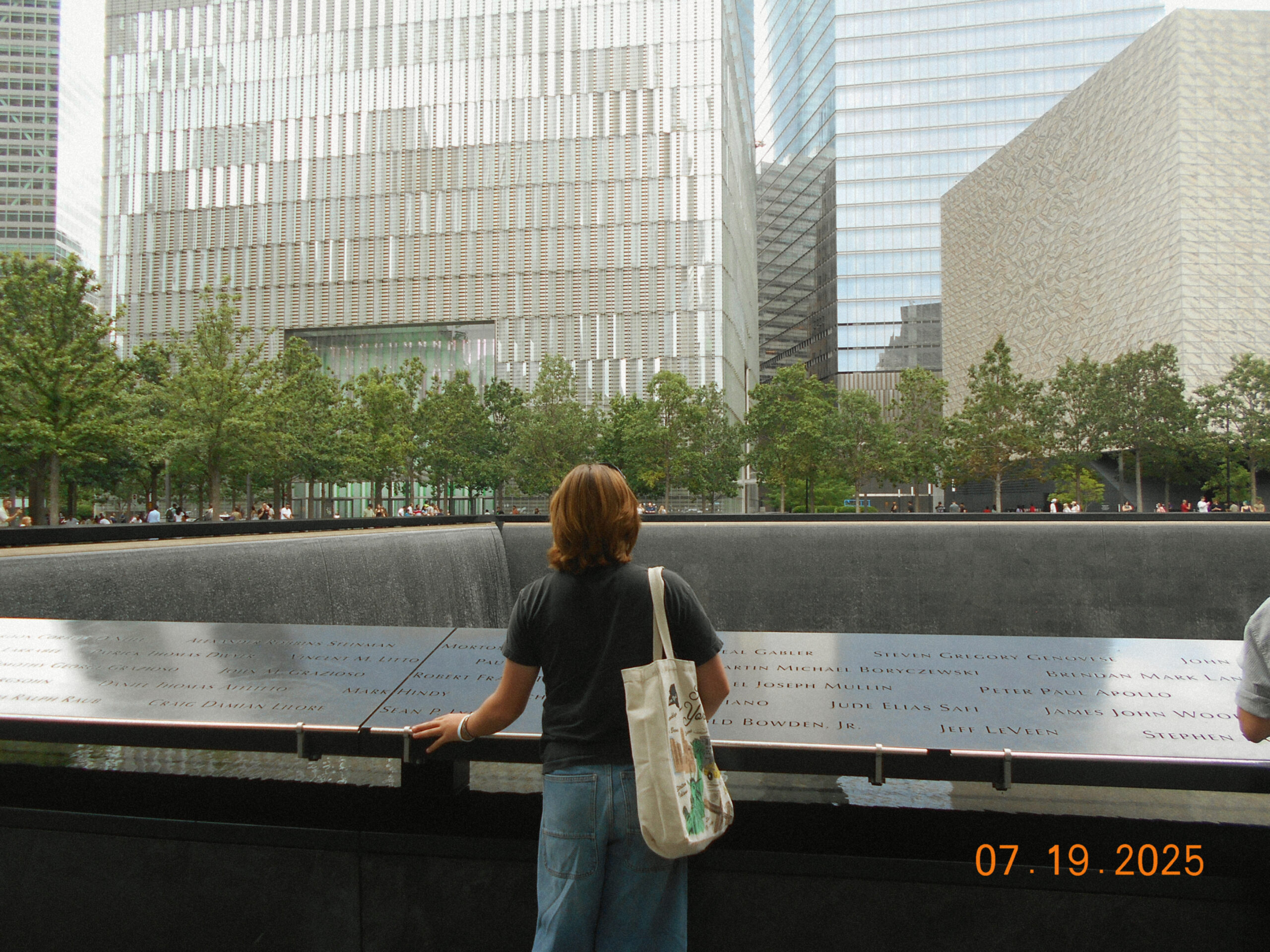
“I don’t believe there should be a comedic take on it, period,” she said. “After going to the memorial, I definitely recognize the emotion – it’s very somber in New York on that day.”
Arturo Jimenez-Bacardi, a professor of international affairs, international law and American foreign policy at USF St. Petersburg, thinks it may help Gen Z in the long run, making them more objective and less driven by fear when confronted with international conflict.
“I think a lot of people were consumed with a fear that another 9/11 would happen,” he said. “I think revenge and fear will allow individuals to rationalize doing a lot of counterproductive and immoral things.”
Jimenez-Bacardi added that younger generations may be better equipped to look at the event and instead focus on learning from its consequences.
Students also reflected on 9/11’s global impact and its connection to racism. Many agree the emotional connection to the tragedy contributed to older Americans adopting prejudices against Muslims, Arabs and others who appeared different from the stereotypical American.
Rizzo pointed to those lasting impacts – a perspective that connects experience with broader national consequences.
“I think there’s a lot of racism and xenophobia surrounding the topic of 9/11,” she said. “It changed how we do security in the airports – then, of course, came the random pat-downs you see with people with similar names.”
In the United States, hate crimes targeting Muslims were still about five times more common in 2016 than they were before 9/11, according to Goleen Samari, a public health researcher at the University of Southern California.
Jimenez-Bacardi recalled the rise of Islamophobia post-9/11 and attributed Americans’ prejudices to the choices leaders made in the years that followed.
“With the FBI spying on Muslim communities and all of the warrantless surveillance, there was quite a bit of Islamophobia after,” he said. “But it hasn’t necessarily gone away, a lot of people in the U.S., they still associate Islam or the Middle East with 9/11.”
Jimenez-Bacardi highlights the need for critical thinking and advises students to use education as a tool for both remembrance and resilience.
“It takes a lot of work, but building intellectual self-defense is a necessary condition in order to be able to question properly and push back, if need be,” he said.
Rios urged his peers to see remembrance as a path to unity, suggesting that commemoration is not only about the past, but also the future.
“I feel like talking and learning more about 9/11 and being open to sharing that can make a difference in people’s understanding of the event,” Rios said. “It can help others understand why peace and unity are so important to our society.”