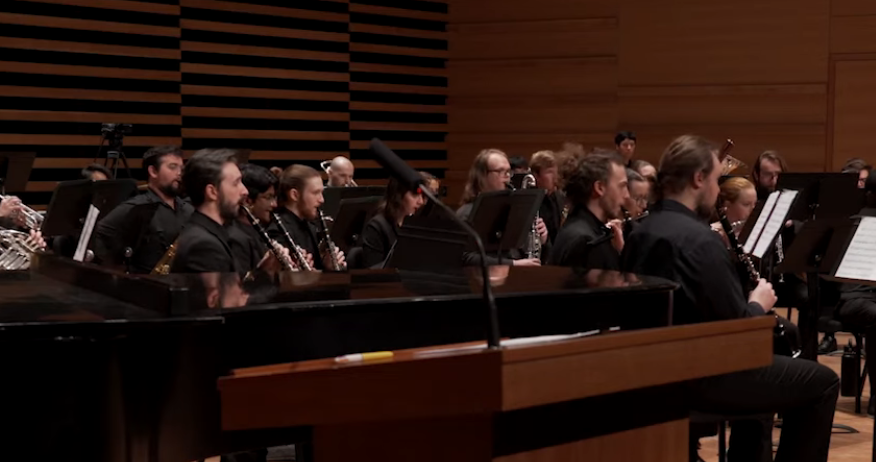
The University of South Florida’s Symphonic Band and Wind Ensemble performing a composition by CRESCENDO.
Photo Courtesy of USF Newsroom
By Jasmin Parrado
In a dimly lit venue, the University of South Florida’s Symphonic Band and Wind Ensemble welcomed its audience with a unique composition.
It drew out random notes through an array of instruments, the clang of triangles and the roar of trumpets conversing in the backdrop before pausing, playing and pausing again.
At some intervals, a strong, fluid melody resounded. At others, an awkward dissonance. Choppy, spontaneous and disjointed.
This was the voice of data singing.
Translated to notes on paper, every part of the ensemble’s two-part composition called “Sanctuary” and “Cardinal Flow” is a piece of quantitative information from USF anthropology professor Heather O’Leary’s research on environmental issues.
O’Leary’s project, called Communicating Research Expansively through Sonification and Community-Engaged Neuroaesthetic Data-literacy Opportunities (CRESCENDO), has given researchers a glimpse into how science data communications can manifest in other ways – and how they can truly stick with audiences.
“It’s not music that you’re going to want to listen to on your way home after a tough day,” said Matthew McCutchen, director of bands at USF. “There’s no melody. It doesn’t work like that. Data is messy; so, the music is messy. And while I wouldn’t call it beautiful, I would certainly call it poignant.”
The project is O’Leary’s brainchild. It was born in 2021, when she found herself witnessing troubling trends from government database research, such as devastating economic and social impacts from red tide and stony coral tissue loss.
At the same time, USF’s School of Music reopened its doors to the public for ensemble performances, which O’Leary and her then three-year-old daughter attended on a regular basis.
Getting to observe how deeply her daughter engaged with the music gave O’Leary an idea, she said.
“She doesn’t know how to play a musical instrument, and she doesn’t know how to read music,” O’Leary said. “But she was able to access the emotional and cultural messages of the past, just by listening to music. And I thought, ‘Gosh, I wish people could be that literate with the type of data I work with.’”
As a self-proclaimed “water anthropologist,” O’Leary was set on making that wish come true. For her, there had to be some universal way to bring her data into the creative spotlight.
So, O’Leary contacted McCutchen – whom she met at one of his concerts – with one question: Could the data from her research on environmental issues be made into music?
“I said, ‘Well, I have no idea, but we’ve got a composition, studio and teachers and students –let’s get them involved too,’” McCutchen said.
O’Leary and McCutchen assembled 17 faculty members and nine student contributors of various disciplines. From experts in communications and hospitality management to scholars in biological oceanography and music, the team was a rare pool of different people with the same goal.
Of course, that fact alone came with its own challenges, McCutchen recalled. Aside from 26 people interpreting data differently, members from the School of Music had to bring O’Leary’s unmusical findings into an abstract world.
That, however, was the most important part of the mission for O’Leary. Regardless of how successful the effort would be, what mattered to her was taking that first step toward a new, universal kind of science communication, she explained.
“You can’t lose that ability to communicate across boundaries with other people,” O’Leary said. “Otherwise, the important, brilliant messages that you are going to find are just going to be lost to the world, because they’re not going to make it outside of your bubble.”
The team was determined to find a solution. Music students gathered to discuss and develop how they’d translate the data.
At the core of it all was one rule: The data had to be translated exactly as it was.
That meant contributors couldn’t make their own somber or happy melodies. They had to take data trends, however unpredictable and dissonant, and produce a parallel auditory representation in a process called sonification.
That process was the ultimate blueprint. But a human touch was still key to transforming the piece, which “was more like noise than music,” into a digestible and entertaining experience. McCutchen explained.
Huron Falkenburg, a junior in music education at USF, was one of those contributors. He remembers how unique the challenge was, especially for music majors.
“It’s atypical of the composing world to see a group of composers that large working together,” Falkenburg said. “While there was no friction in the group whatsoever, it was still a challenge trying to navigate just through the purposes of figuring out what we all wanted as a collective.”
What the project did allow contributors to do was produce sounds often intrinsically related to environments and concepts in society, Falkenburg explained.
The team tied in those details where it counted, weaving a layer of symbolism into CRESCENDO’s musical communication.
For instance, during the beginning of its contemporary ensemble piece, percussive instruments like mallets and marimbas emulated sounds associated with coral reefs, to bring the topic of coral bleaching to life.
Additionally, the team experimented with different genres, integrating jazz into its piece about a threatened oyster population along Florida’s coasts.
But O’Leary didn’t want the project to just jazz up the hard science. She wanted to make music on her data, capturing how those problems impacted the economy and how social media behaved in response to that science.
Presenting all the data on how society perceives an issue and suffers from it is vital to bringing people closer to the issue, O’Leary explained. Per the United Nations’ Sustainable Development Goals, a triple bottom line of factors is necessary to make a development project or campaign sustainable: people, planet and prosperity.
“So, if we’re only looking at the environment, or we’re only looking at the economy, or we’re only looking at what people say they need or want and how they’re acting, we don’t have all the pieces of the puzzle,” O’Leary said.
CRESCENDO’s pieces represent sociological, scientific and economic data. Just as the numbers on “panicky tweets” and financial drawdowns vary, so does the music, O’Leary explained. No piece tells the same story of the ocean’s plight.
For O’Leary, the project is evidence of a greater human potential – one that the team proved exists.
“I encourage all students to make sure that they’re still having these big conversations,” O’Leary said. “Not just with friends about what’s fun to do right now, but also, ‘Hey, how can your secret academic superpowers that you’re learning complement mine, so that we can make the difference that we want to see in this world?’”