Additional staff concerns included issues such as broken elevators, AI in the classroom and student resources on campus — like the therapy dog program and mental health services.
Photo by Makenna Wozniak | The Crow’s Nest
By Julia Birdsall
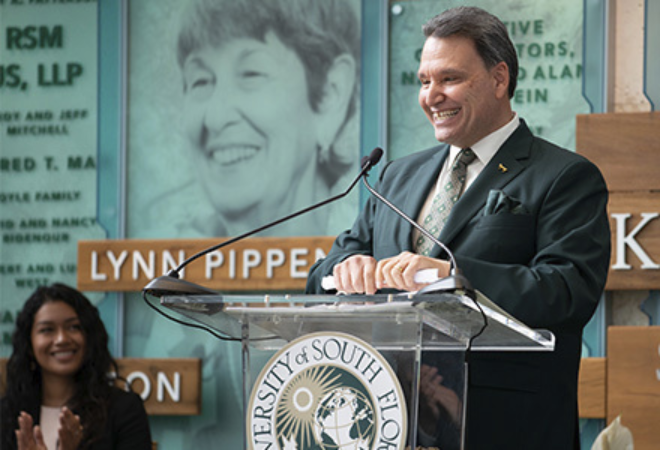
On April 7, the University of South Florida St. Petersburg’s staff and faculty gathered in the USC Ballrooms to listen as Moez Limayem addressed their concerns in his first St. Petersburg campus town hall as the university’s president.
“[St. Petersburg is] not only the most beautiful campus, but this is where magic happens,” Limayem said in his opening speech. “This is where amazing things are happening and hopefully with all of you, we’ll make them even better.”
To continue his speech, Limayem addressed some prevailing issues that USF St. Petersburg faces, such as HR, technology implementation and the university culture which, according to the president, “like many other institutions in Florida and every other part of the country, received a hit.”
“My goal is to do everything we can to fix these foundational issues as soon as possible,” he said. “We’ll share with you what we are doing to assess where we are, where [the gaps are], and what we’re going to do about that.”
Much like the SG town hall hosted on April 2, Limayem responded to a series of pre-submitted questions, as well as those submitted throughout the event.
Salaries & technology concerns
One of the main concerns that employees had was the status of their salaries in comparison to the rising cost of living in the Tampa Bay area, as well as how their pay compared to that of other Association of American Universities (AAUs).
Limayem — who boasted implementing the first salary raise that USF had seen in two years in his opening speech — said that while salary increases were a top priority, they will be difficult and take time to achieve.
“We will develop a plan hopefully to start with our blind spots and then slowly but very surely take care of everyone,” he assured the room.
Employees were also concerned about departmental inconsistencies in hybrid work, as there are allegedly some departments that enforce in-person work more than others.
“My belief is USF is not an online university,” Limayem said. “Our students need us. Even if we’re not working directly with the students, our colleague needs us, our culture needs us…and what we will do is review our policy on hybrid and remote work. We will tighten it up, so it is much… clearer and also applied in a very consistent, fair and equitable way.”
Further issues with technology have arisen through Oracle HR. Though moderator Adam Freeman and Limayem were not explicitly clear on which issues employees were most concerned about, both commented on how frequently these concerns were brought to them.
“Mistakes did happen. The most important thing is that we understand them so that we do not repeat the same mistakes,” Limayem said. “We will fix it. We will share [a plan with you] very soon.”
Culture erosion
Some employees raised concerns about the “erosion” of St. Petersburg campus culture due to statewide policies and consolidation of the three USF campuses.
Limayem said that he and his team have been sending out and will continue to send out surveys about employee satisfaction with different aspects of campus environment.
He urged all employees to take these surveys seriously and give detailed complaints as well as solution proposals.
“Consolidation was made with the intent to make us stronger, to make USF, one USF — much stronger than Tampa alone, St. Pete alone and Sarasota alone,” he said. “That’s what we will assess, see what worked, what didn’t work and make necessary adjustments.”
A&S fees
Employees also considered student needs in their questions, and many asked about the university’s plans for handling A&S funds in the coming years because, as Freeman said, “those fees remain flat, but the costs continue to go up.”
Limayem touted USF for having “the least expensive tuition in the country.”
While USF can boast having a lower tuition than the average public university, its tuition is much higher than that of Florida State College at Jacksonville and several other universities.
Limayem also stated that USF’s tuition, and he included fees in this assessment, is “less expensive than it was 14 years ago” after accounting for inflation and cost of living.
However, the university increased its tuition for non-Florida residents by 10% in fall 2025.
In response to this question, Limayem said that the university would need to become more strategic and efficient in their expenditures.
“We’ll be looking very carefully [at] how we can be more effective, more efficient about the use of these fees,” he said. “Unfortunately, increasing them is probably in the near future.”
Graduate program enrollment
With 40 of USF’s graduate programs ranked among the United States’ best, Limayem was asked about what he intends to do to increase graduate student enrollment.
Limayem stated that, while he is happy with the graduate programs’ current ranking, he wants to see more of them reaching the top 20.
“It is true that like many other universities, graduate enrollment took a major hit,” he acknowledged. “Because of the geopolitics and the number of international students is in decline.”
To increase enrollment, he believes that the university must create a plan to recruit certain programs in different parts of the world.
However, an attendee raised her hand and interrupted him.
“A lot of us were not part of a graduate program before consolidation. Now we have that opportunity…except that there is no funding for us to have graduate students on our campus,” she said. “We’re competing with people who are experienced in that negotiation with each other in each department and we lose out every time.”
Another problem that she cited was the amount of time that St. Petersburg professors have to spend teaching graduate classes in Tampa.
“We’re driving more than we’re teaching,” she said. “And I can tell you that we get asked to be advisers all the time, but logistically and financially it is not working out well.”
Limayem acknowledged that more research needs to be done into the “unintended consequences of consolidation.”
He urged staff and faculty to help him in this regard by contacting him about the problems but only if they also proposed solutions.
“There is no one…who understands the challenge for St. Pete — the [challenges] for certain programs — [better] than you. I don’t know what I don’t know,” he said. “It is easy to point to problems and challenges, but please help me with solutions.”