
Photo by Matthew McGovern | The Crow’s Nest
By Jasmin Parrado and Alisha Durosier
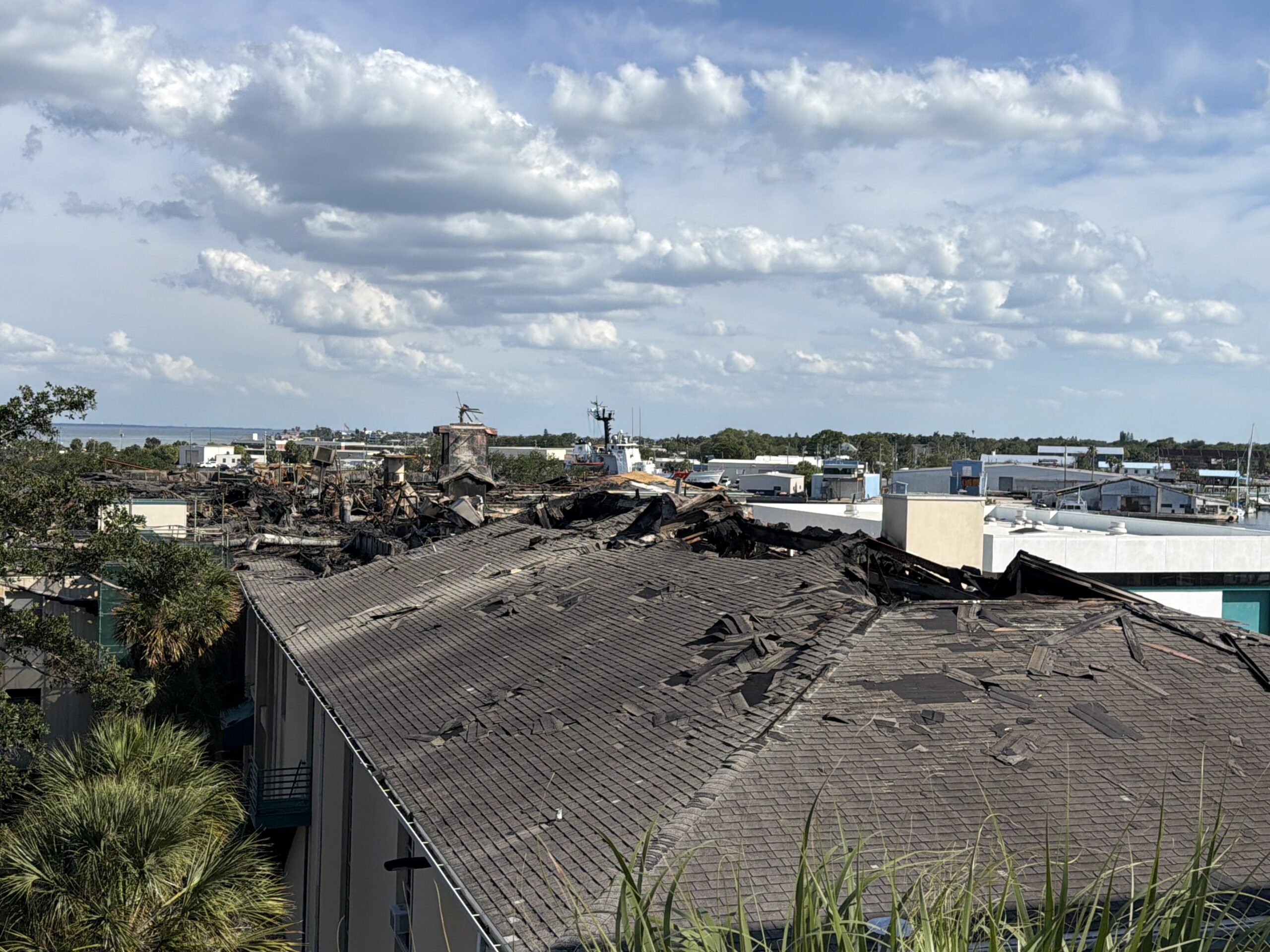
The University of South Florida St. Petersburg campus’s Marine Science Laboratory (MSL) is “likely a total loss,” officials say, after a fire erupted on May 2, at approximately 5 p.m.
Emergency personnel confirmed that no one was in the building at the time and there were no reported injuries.
St. Petersburg Fire District Chief Michael Lewis told reporters on Saturday night that the fire destroyed the building’s entire roof and that the next steps include hazmat teams assessing the area to ensure there are no additional hazards.
Authorities are still investigating the cause of the fire, but an afternoon thunderstorm prompted lightning in the area around the time it started. The university awaits an official determination from the State Fire Marshal, which has taken over the investigation.
USF President Moez Limayem said in a university-wide email on May 3 that the university is still assessing the damage and recovery teams are working to “prioritize key research material and equipment for salvage assessment…”
The massive fire produced massive plumes of smoke that could be spotted miles away. The blaze also prompted a two-alarm response, with over 60 units and 200 firefighters across the Tampa Bay area dispatched to the scene.
Along with Limayem, St. Petersburg Mayor Ken Welch, former Florida Gov. Charlie Crist and Florida Senator Rick Scott took to the internet to express their sympathies and commend the Tampa Bay emergency personnel who responded to the scene.
“I’ve spoken to USF President Moez Limayem and USFSP Regional Chancellor Thomas Smith. The City of St. Petersburg stands with our USF family,” Welch wrote on X on May 3. “We will work with our community to rebuild better than before.”
This is a devastating loss for USF St. Petersburg, as the MSL is one of the oldest buildings on campus, spanning more than 80 years.
In the 1940s, the building served primarily as a training station and dormitory for the U.S. Marine Merchants as World War II ensued. About two decades later, the installation of new laboratories at the MSL kick-started research efforts for various disciplines, turning it from a maritime resource to a core facility on campus.
Joan “Sudsy” Tschiderer, founder of The Crow’s Nest, said it was “soul-crushing and devastating” to see the marine science community’s hard work potentially ruined, though she’s relieved no one was injured.
“It’s certainly encouraging that the president of the university is standing behind resurrecting everything that was there before and making it even better, but Mother Nature will do what Mother Nature wants to do,” Tschiderer told The Crow’s Nest.
Tschiderer attended USF St. Petersburg in 1969, and she helped form the campus’s student government, established its student publication and led campus recreation for decades after.
The MSL building was where Tschiderer first attended classes. But with an auditorium, art lab, bookstore and a “rickety old” freight elevator, it was much more than that, she recalled.
“It was homely, but it was our home,” Tschiderer said. “Our library was in there — a small library — and of course, Eckerd College had been here before us for a couple of years. So, I have a tremendous amount of memories connected to the building.”
Discourse around the MSL building’s repairs came into question in 2022 when Gov. Ron DeSantis vetoed a $75 million funding proposal for the Environmental and Oceanographic Sciences (EOS) research and testing facility. A year later, he accepted funding for less than half the amount.
In addition to the facility’s construction, parts of the MSL would be repurposed, though a larger funding outlook for its overall maintenance was deferred to make way for the new building, according to The St. Pete Catalyst.
Tschiderer has remained in the city ever since her first semester at USF St. Petersburg. Though a substantial amount of time has passed, she believes age was trivial in the discourse around the MSL’s structural integrity.
“I shouldn’t say it doesn’t make me laugh, but I chuckle a little when people say, ‘Oh, it’s an old building,’” Tschiderer told The Crow’s Nest. “Well, it’s 86 years old. Look around the world; there are buildings that are hundreds of years old and still standing and functional.”
Tschiderer said she remembered seeing emblems of the building’s initial status as a “civil defense shelter,” and the MSL’s concrete walls and versatility as a bomb shelter during World War II spoke to its strength.
Since the growth of its high-tech inventory and space, the MSL has been touted as a state and local hub for marine science and oceanographic studies, with lifetimes worth of research, including time-dependent and global samples that are largely irreproducible.
Tschiderer is saddened on behalf of the marine science community, which she saw thrive over the years and the loss of essential research it cultivated.
“I know so many people who work and study and just socialize and engage with each other on so many levels,” Tschiderer said. “It was a very powerful arrow in my heart that many of them will be suffering.”
Tschiderer said she hopes to see Limayem build “bigger and better” to honor the ongoing efforts of researchers, whose studies ranged from harmful algae blooms to red tide and the impact of waves on navigation.
“We’re all over the place in marine science,” Tschiderer said. “I salute my colleagues, and I am in utter admiration of all that they do and I know that they are very strong and resilient scholars. And while this is a major setback, it’s not an insurmountable setback — they will find a way to move forward.”